












Story Highlight
– Multiple food recalls for safety due to contamination risks.
– Aldi recalled Mozzarella Sticks for undeclared egg allergen.
– Disaronno recalled for potential glass contamination in bottles.
– Tesco and B&M recalled crisps for undeclared allergenic ingredients.
– Iceland recalled Vegetable Lasagne for possible plastic pieces.
Full Story
A range of food products has recently been recalled across the UK due to various safety concerns, including the risk of contamination from foreign objects such as glass or plastic, and instances of incorrect use-by dates. These recalls affect items that are widely available in supermarkets and are part of a growing trend where retailers are taking precautionary measures to ensure consumer safety.
In particular, the Food Standards Agency (FSA) has alerted consumers to the potential health risks associated with these products, advising anyone who has purchased them to heed official guidance concerning their disposal or return.
**Aldi Recall: Allergy Risk from Popular Product**
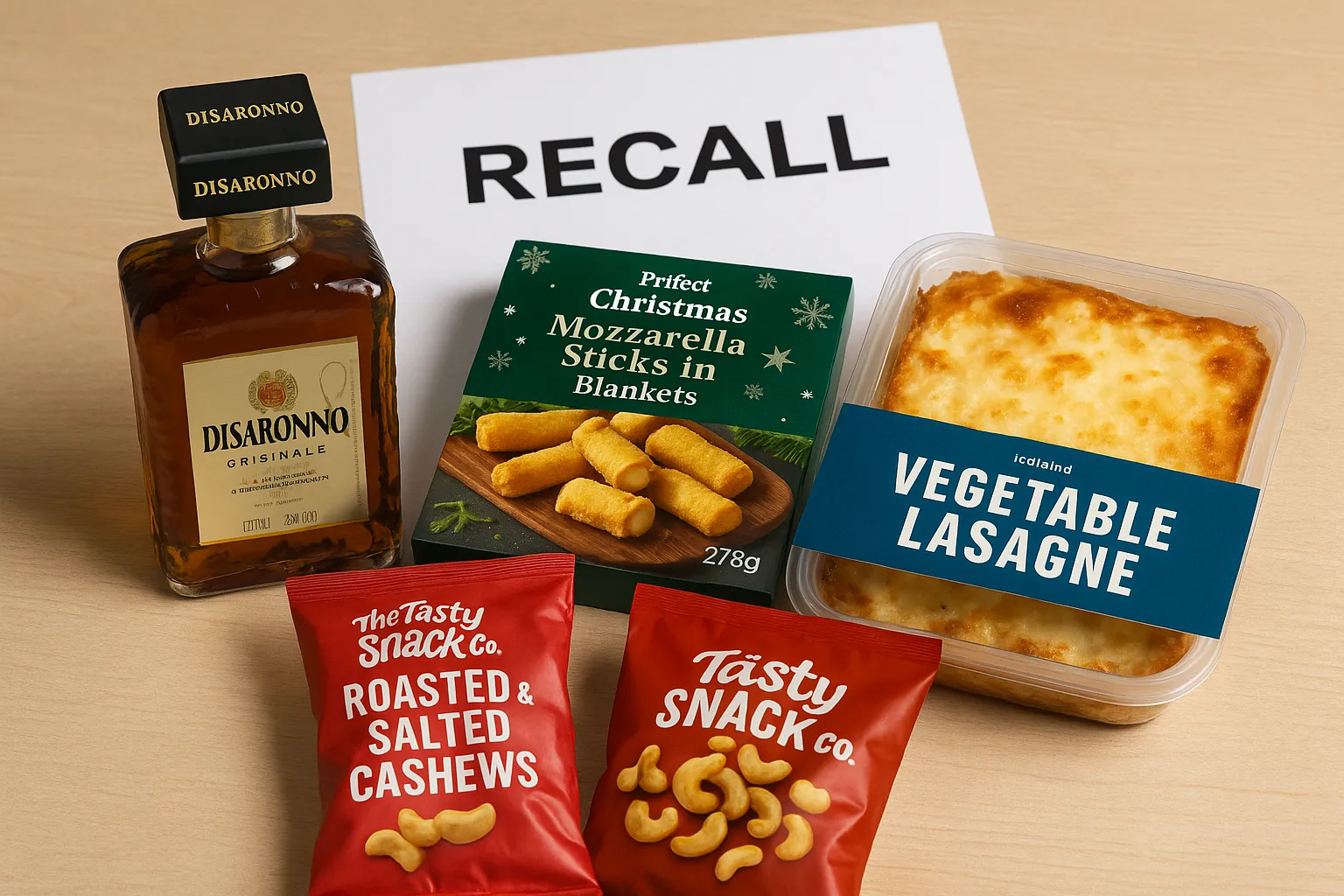
Supermarket chain Aldi has issued a recall for one of its festive food items, specifically the Perfect Christmas Mozzarella Sticks in Blankets. This action has been prompted by an allergy risk linked to undeclared egg content in the product, which was not mentioned on the packaging. As this could pose a danger to individuals who are allergic to or intolerant of eggs, Aldi is urging anyone who has purchased this item to return it to their nearest store for a full refund.
The affected product information is as follows:
– Weight: 278g
– Barcode: 4069365328743
– Use By Date: 15th December 2025
Aldi has communicated, “As a precautionary measure, our supplier is recalling Perfect Christmas Mozzarella Sticks in Blankets because the product is labelled incorrectly and contains an undeclared allergen (egg). Customers are asked to return this product to their nearest store, where a full refund will be given. We apologise that this product did not meet our normal high standards and thank you for your co-operation.”
The FSA reiterates this warning, stating, “If you have bought the above product and have an allergy or intolerance to egg, do not eat it.”
**Disaronno Recall: Glass Contamination Risk**
Another product facing recall is Disaronno Originale, the well-known almond liqueur produced by Illva Saronno S.p.A. Eager customers may be at risk, as some 700ml bottles might contain fragments of glass, rendering them unsafe for consumption. The affected batch codes include 25374, 25375, 25381, 25382, 25435, 25442, and 25444.
An FSA representative stated, “Illva Saronno S.p.A is recalling the above product. Point of sale notices will be displayed in all retail stores that are selling these products. If you have bought the above product, do not consume it. Instead, return it to the store from where it was bought for a refund or replacement.”
The reason for the recall has been attributed to an anomaly on the bottling line, resulting in the potential presence of glass. This announcement has raised concerns among consumers who look to enjoy the festive season without health hazards.
**Tesco and B&M Recall: Allergens in Crisps**
In another call for caution, Tesco and B&M have recalled certain packets of Calbee crisps due to unreported allergens that may provoke severe allergic reactions. The specific products are the Calbee Hot & Spicy Chips, which contain undeclared mustard, and Calbee Pizza Chips, with undeclared celery.
The supermarkets notified customers via urgent recall notices, encouraging those who bought these crisps to refrain from consuming them and return the products to stores for refunds. The crisps in question come in several sizes, with the affected best before dates extending to June 2026 and April 2026 for the respective products.
A spokesperson from the FSA expressed the seriousness of the situation, noting, “Calbee Group UK Ltd is recalling Calbee Hot & Spicy Chips because they contain mustard and Calbee Pizza Chips because they contain celery which are not mentioned on the label. This means the products are a possible health risk for anyone with an allergy to mustard or celery.”
**Asda Recall: Incorrect Use-by Dates**
Asda has also joined the list of retailers recalling products, specifically the Asda 10 Mini Duck Spring Rolls with Hoisin Dip. These spring rolls have been flagged due to an incorrect use-by date printed on the packaging. Consumers may find a use-by date of December 29, while the actual date should be November 29, thus marking them as unsafe for consumption beyond that point.
A representative from the FSA advised, “If you have bought the above product do not consume it. Instead, please return it to your nearest store for a full refund. You do not need your receipt.”
**Poundland and Lidl: Glass Hazards in Cashews**
Both Poundland and Lidl have issued notices regarding their respective cashew products, which may be contaminated with glass. Poundland is recalling The Tasty Snack Co. Roasted and Salted Cashews, while Lidl has identified a similar risk with their Simply Roasted and Salted Cashews.
Customers are requested to return these products for a full refund without needing proof of purchase. In both instances, the retailers emphasised the importance of consumer safety and the steps being taken to remedy the situation.
**M&S and Iceland Recalls: Allergic Reactions and Plastic Risks**
Marks & Spencer is also recalling its Milk Chocolate Honeycomb due to potential undisclosed peanut contents, posing a significant risk for individuals with peanut allergies. The product’s lot number is 5242 with a best-before date of May 12, 2026.
Simultaneously, Iceland has flagged its Vegetable Lasagne for possible plastic contamination, urging customers not to consume products with best before dates from July 23, 2026, or July 30, 2026. The grocery retailer has issued guidance indicating that consumers should return these items for a full refund.
**Understanding Product Recalls**
Product recalls serve as a crucial safety mechanism in the food industry. When a significant issue arises with a product, it’s either withdrawn from shelves or a recall is issued for customer returns. The FSA diligently communicates these problems through Product Withdrawal and Recall Information Notices, aiming to protect consumer health and well-being.
As recalls increase and affect a broader range of products, consumers are encouraged to remain vigilant and informed, ensuring they follow the guidance provided by manufacturers and retailers.
Our Thoughts
Several safety failures are evident in the article regarding food recalls due to contamination or mislabeling, which violate UK health and safety regulations, particularly under the Food Safety Act 1990 and the Food Labelling Regulations 1996.
1. **Proper Labeling and Allergen Management**: The recalls due to undeclared allergens (e.g., egg in Aldi’s product, mustard, and celery in Calbee crisps) indicate a failure in compliance with food labelling regulations. Implementing stringent checks during production and packing could ensure accurate allergen disclosure to protect consumers with allergies.
2. **Quality Control in Production**: Reports of glass contamination (e.g., in Disaronno and Lidl cashews) highlight inadequate quality control measures. Enhanced monitoring of production lines and immediate correction of anomalies would reduce the likelihood of foreign contaminants entering food products.
3. **Use-by Date Verification**: The incorrect use-by date on Asda’s spring rolls exemplifies lapses in date verification processes. Establishing robust systems for date checking prior to product release can prevent the distribution of potentially unsafe products.
**Key Lessons**: Regular audits of compliance with food safety regulations, better training for staff on labelling and allergen management, and rigorous quality control protocols can significantly mitigate risks associated with similar incidents in the future.