















Workplace Transport Safety: Forklifts, Pedestrians & Traffic Management
Last updated: 7 September 2026
Author: Jade Anderson, Senior Reporter, UK-Safety.News
Reading time: about 13 minutes
What this guide covers
- Why workplace transport matters
- The law: which regulations apply
- Safe site, safe vehicle, safe driver
- Safe site: layout and segregation
- Reversing, speed, visibility and lighting
- Loading and unloading
- Safe vehicle: inspection and thorough examination
- Safe driver: lift truck operator training
- A traffic management plan in six steps
- Yard audit checklist
- Case study: a reversing forklift on the quayside
- Common mistakes
- Special cases
- Frequently asked questions
- Further resources
Why workplace transport matters
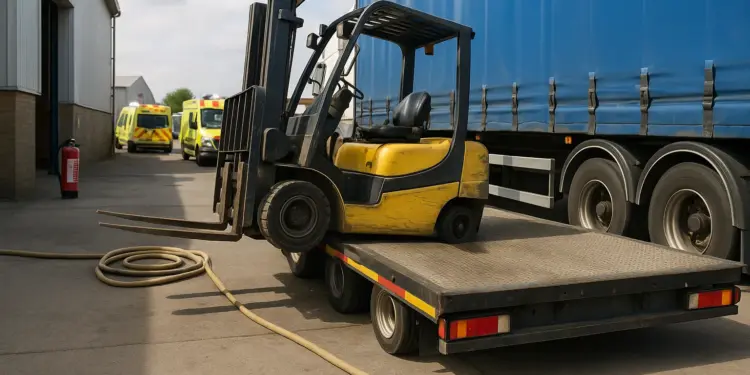
Vehicles moving around a workplace are one of the most consistent killers in British industry. In 2025/26, HSE recorded 126 workers killed in work related accidents in Great Britain, and being struck by a moving vehicle accounted for 24 of those deaths, the second most common cause after falls from height. HSE also estimates there are over 5,000 workplace transport incidents each year, with lift trucks involved in about a quarter of them.
The pattern is remarkably stable: a pedestrian in an area where vehicles work, a driver reversing without seeing behind, a visiting driver who does not know the site rules. None of these involve exotic hazards, which is why HSE inspectors so often describe these deaths as “entirely preventable”. The controls are well understood and cheap compared with one serious injury. This guide sets out the law, HSE’s framework, and how to turn both into a traffic management plan for your yard, warehouse, depot or site.
The law: which regulations apply
There is no single workplace transport regulation. Six pieces of legislation overlap, and an inspector will charge under whichever fits the failure most closely.
| Legislation | What it requires for workplace transport | Who holds the duty |
|---|---|---|
| Health and Safety at Work etc. Act 1974 | Section 2: protect employees so far as is reasonably practicable. Section 3: the same for others affected, including visiting drivers and the public. | Employers and the self employed |
| Management of Health and Safety at Work Regulations 1999 | Regulation 3: a suitable and sufficient risk assessment of vehicle movements, with proportionate precautions and a safe system of work. | Employers and the self employed |
| Workplace (Health, Safety and Welfare) Regulations 1992 | Regulation 17: every workplace must be organised so that pedestrians and vehicles can circulate in a safe manner, with suitable and sufficient traffic routes, separation where necessary and signs where needed. Regulation 8 covers lighting, regulation 12 surfaces. | Employers and anyone in control of a workplace |
| Provision and Use of Work Equipment Regulations 1998 (PUWER) | Vehicles must be suitable, properly maintained and inspected at suitable intervals. Regulation 9 requires adequate training for users, and specifically for operators of rider operated lift trucks. | Employers and anyone with control of the equipment |
| Lifting Operations and Lifting Equipment Regulations 1998 (LOLER) | A lift truck is lifting equipment. Lifting operations must be planned, supervised and carried out safely. Regulation 9 requires thorough examination at least every 12 months (6 months where the truck lifts people) unless a written examination scheme applies. | Employers and the self employed who use or control lifting equipment |
| Health and Safety (Safety Signs and Signals) Regulations 1996 | Where risk cannot be avoided by other means, provide and maintain signs, and use the standard hand signals for signallers. | Employers |
Note that the regulation 17 duty covers everyone who circulates in the workplace, including a delivery driver who visits once, and that PUWER and LOLER both bite on hired trucks and contractors’ vehicles. Injuries from vehicle strikes are usually reportable: see our guide to reporting safety incidents for what must go to HSE under RIDDOR.
Safe site, safe vehicle, safe driver
HSE’s guidance HSG136, A guide to workplace transport safety (third edition, 2014), organises everything around three questions. Is the site safe? Is the vehicle safe? Is the driver safe?
- Safe site: layout, segregation, one way systems, crossing points, speed limits, signs, lighting, surfaces, loading areas and parking.
- Safe vehicle: the right vehicle for the job, maintained, with mirrors, lights, reversing aids, seat belts and rollover protection, and thoroughly examined where LOLER applies.
- Safe driver: selected, trained, authorised in writing, supervised and reassessed, whether employee, agency worker or visitor.
The order matters. Site design removes the hazard, vehicle equipment reduces it, and driver behaviour is the last line.

Safe site: layout and segregation
Separate people from vehicles
Ask first whether pedestrians need to be in a vehicle area at all. For those who do, provide separate routes where possible and, where space must be shared, separate by distance, barriers or kerbs.
- Physical barriers, not paint, wherever pedestrians and vehicles share an area for long periods. Painted walkways are crossed within a week.
- Pedestrian doors beside vehicle doors, with vision panels, so nobody steps out of a building into a traffic route.
- Signed crossing points with good sightlines and barriers that make pedestrians turn and look. Vehicles give way.
- Visitor parking away from the operational yard, with a marked walking route to reception.
Design the routes
Provide a one way system if you can. Make routes wide enough for the largest vehicle plus its load. Avoid sharp bends, gradients and blind corners; where they cannot be removed, fit mirrors and cut speed. Keep surfaces firm, even and drained. Use Highway Code style signs so visiting drivers recognise them, and keep them few enough to be read: a yard with forty signs has no signs.
Reversing, speed, visibility and lighting
Reversing
HSE states that nearly a quarter of all deaths involving workplace transport occur during reversing. Its hierarchy is simple: remove the need to reverse with one way systems and drive through loading positions; where reversing cannot be avoided, confine it to marked reversing areas that pedestrians are excluded from; and only then rely on aids and people.
- Clean, correctly adjusted mirrors, plus cameras or refractive lenses where the vehicle has blind spots.
- Audible reversing alarms loud enough for the environment, and sensors that warn or stop the vehicle.
- Wheel stops, buffers and floor lines at loading positions so nobody stands behind the vehicle to guide it.
- A trained signaller only where risk assessment shows the site cannot be improved further. Signallers use the standard signals, wear high visibility clothing, stand where the driver can see them and stop the vehicle if they lose sight of the driver.
Speed
Set limits that fit the route and the vehicle, often 5 mph in shared yards and walking pace inside buildings. Enforce them with layout (chicanes, narrowing, humps suited to the vehicles) and with telematics or speed limiters, not with posters.
Visibility and lighting
Provide high visibility clothing for everyone who enters vehicle areas, visitors included. Regulation 8 of the Workplace Regulations requires suitable and sufficient lighting; check yards, bays and junctions at night and in winter, and store nothing that blocks a sightline.
Loading and unloading
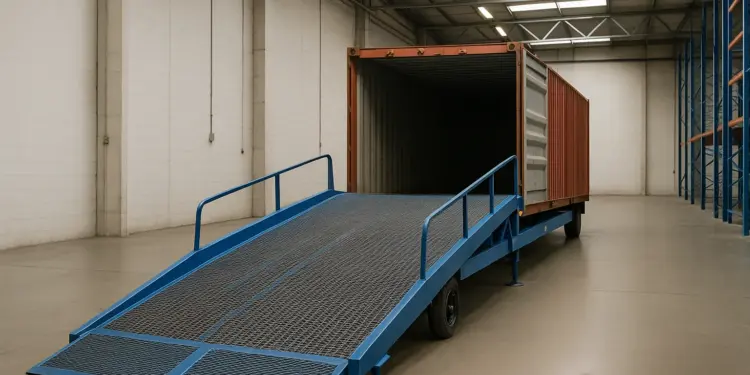
Loading bays concentrate every hazard in one place: reversing lorries, lift trucks, pedestrians handling straps and curtains, and drivers who do not work for you. Plan each delivery type, not just the yard.
- Drive away prevention. Key control, traffic lights or vehicle restraints so a trailer cannot pull off the dock while a lift truck is inside it.
- A safe place for the driver. A marked, protected waiting area with a view of the vehicle.
- Sequence the work. Curtains open and straps off before the lift truck approaches, or the truck waits at a marked point until the pedestrian signals clear. Never both at once.
- Access to vehicle beds. Steps, gantries or fall protection. See our guide to working at height.
- Tail lifts and dock levellers are lifting equipment under LOLER and need thorough examination too.
Safe vehicle: inspection and thorough examination
Choosing the vehicle
PUWER requires equipment suitable for the task and the environment: a warehouse counterbalance truck is not suitable for a rutted yard, and a diesel truck is not suitable for an enclosed store. Specify seat belts, rollover protection, mirrors, lights and reversing aids at purchase or hire.
Daily pre use checks
Every driver checks the vehicle before first use each shift and records the result: tyres, forks and mast, chains and hydraulics, brakes, steering, lights, horn, reversing alarm, mirrors, seat belt, leaks and the overhead guard. A defect that affects safety takes the truck out of service until fixed.
Maintenance and thorough examination
Maintain to the manufacturer’s schedule, with particular attention to brakes, steering, tyres, lights and mirrors. Separately, LOLER regulation 9 requires a thorough examination by a competent person, normally an independent engineer, at least every 12 months for a lift truck, or every 6 months if it is used to lift people, and after any exceptional circumstance such as a collision or overturn. Keep the reports and act on the defects.
| Check | How often | By whom | Record |
|---|---|---|---|
| Pre use check | Start of every shift | The operator | Checklist kept for the truck |
| Planned maintenance | Manufacturer’s interval or hours run | Trained technician | Service record |
| LOLER thorough examination | At least every 12 months (6 months if lifting people), or per a written scheme | Competent person, independent of the operation | Report of thorough examination |
| Attachments and lifting accessories | At least every 6 months | Competent person | Report of thorough examination |
Safe driver: lift truck operator training
The Approved Code of Practice L117, Rider-operated lift trucks: Operator training and safe use (third edition, 2013), sets out what HSE expects. There is no “forklift licence” in law; there is trained, tested, authorised competence, and the employer has to prove it.
Three stages of training
- Basic training, off the job: the skills and knowledge needed to operate the type of truck safely and efficiently.
- Specific job training, also off the job: the operating principles and controls of the actual truck, its attachments, the loads and the site’s rules.
- Familiarisation training, on the job under close supervision: applying those skills under normal working conditions.
A training provider’s certificate covers stage one and sometimes stage two. It never covers stage three, so an experienced operator joining from another employer still needs site familiarisation before working alone.
Authorisation, age and fitness
Give operators written authorisation naming the trucks they may use and any limits. L117 states operators must be over the minimum school leaving age (16), except in ports, where they must be at least 18, and should be free from physical or psychological conditions that would make them a danger.
Refresher training and supervision
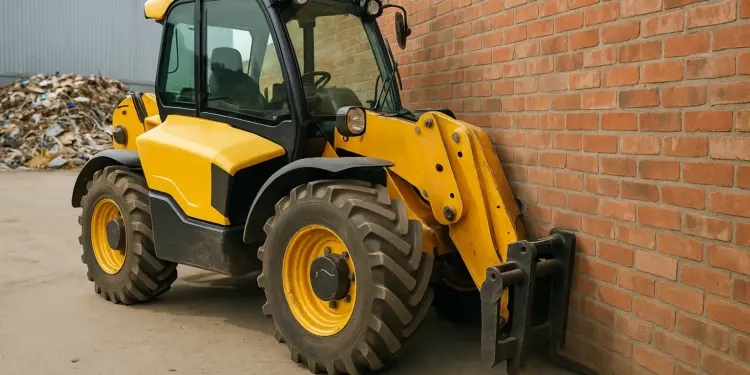
L117 sets no fixed refresher period but says employers may decide that automatic refresher training or a retest after a set period, for example 3 to 5 years, is the best approach. Refresh sooner after an incident, a long break, a change of truck or task, or where supervision spots poor practice. Supervisors must act when they see seat belts unused, loads carried high, speeding or pedestrians in the aisle. The same principles apply to shunters, telehandler operators and visiting HGV drivers, who need a short written induction at the gate.
A traffic management plan in six steps
The plan ties the three safe elements together. It need not be long, but it must be specific to the site and known by the people in it.
- Map the movements. Draw the site and mark every vehicle type, its route, where it stops, where it reverses and where pedestrians go. Include contractors, deliveries and staff cars.
- Find the conflicts. Every point where pedestrian and vehicle routes meet or share space is a hazard. Rank them by frequency and severity.
- Design out what you can. Reroute pedestrians, fit barriers, introduce one way flow, move the smoking shelter, relocate the parking. Most of the benefit comes from this step.
- Control what remains. Speed limits, crossing points, reversing areas, signaller procedures, loading bay rules, high visibility clothing and lighting.
- Write it down and brief it. A one page site plan, a driver rules sheet, a visitor induction card, a pre use check form and an authorisation register, all fed into induction and toolbox talks.
- Check it works. Audit against a checklist, record near misses, and review after any incident, any site change and at least annually.
Editable versions of these documents are on our Useful Documents page.
Yard audit checklist
This table follows the structure of HSE’s own workplace transport inspection checklist. Walk the site with it and give every “no” an owner and a date.
| Area | Question | Yes / No | Action and owner |
|---|---|---|---|
| Site layout | Are pedestrians separated from vehicles by distance or physical barriers on the main routes? | ||
| Is there a one way system, or has reversing been reduced as far as practicable? | |||
| Are crossing points marked, signed and placed where sightlines are good? | |||
| Signs, speed and light | Are speed limits set, signed and enforced by layout or telematics? | ||
| Is lighting adequate at all operating times, especially at junctions, bays and crossings? | |||
| Vehicle movements | Are reversing areas marked, and non essential people excluded from them? | ||
| Where a signaller is used, are they trained, visible and using standard signals? | |||
| Loading and unloading | Is there a safe place for visiting drivers with a view of their vehicle? | ||
| Are drive away and trailer creep prevented at docks, and is there safe access to vehicle beds? | |||
| Vehicles | Are pre use checks done each shift and defects acted on? | ||
| Are maintenance records and LOLER reports current for every truck, including hired ones? | |||
| Drivers | Is there a register of authorised operators with training dates and truck types? | ||
| Are visiting drivers inducted on arrival, and do supervisors challenge unsafe driving? |
Case study: a reversing forklift on the quayside
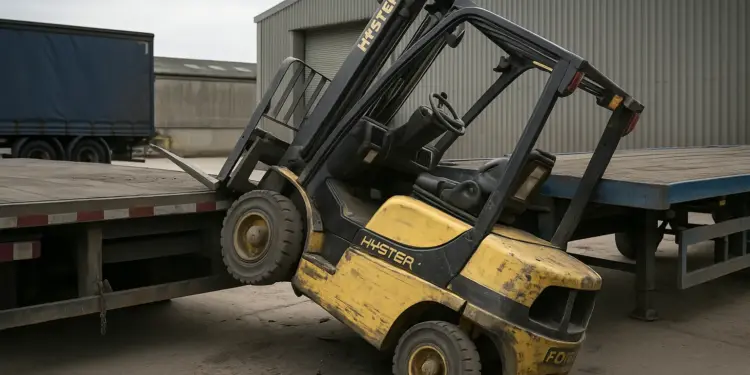
On 26 September 2024 a 43 year old yard operative at Palmerston Quay, Aberdeen Harbour, was unclipping the curtain side of a trailer when a reversing forklift struck him. The rear nearside wheel caught his right leg and pulled him to the ground. He suffered multiple fractures to his foot and lower leg and a degloving injury, needed two operations and skin grafts, and had not returned to work by the time of the hearing.
HSE found that the employer, Streamline Shipping Agencies Limited, had failed to ensure adequate separation between pedestrians and vehicles. A traffic management plan existed, but it did not contain enough detail to manage loading and unloading operations happening at the same time in the same space.
At Aberdeen Sheriff Court on 22 May 2026 the company pleaded guilty to breaching regulation 17(1) of the Workplace (Health, Safety and Welfare) Regulations 1992 and was fined £146,700 with an £11,000 victim surcharge. The HSE inspector called it “a serious and wholly avoidable incident”.
What to take from it. A plan on paper is not a control. The failure was sequencing: a pedestrian task and a vehicle task ran in parallel in the same footprint. The fix costs almost nothing: a marked stand off point for the truck, a clear signal from the operative when the trailer is ready, and supervision that enforces the order of work.
The pattern repeats. In June 2026 a Wolverhampton civil engineering company was fined £125,000 with £150,000 costs after a reversing flatbed truck left an employee with life changing head injuries; HSE found no demarcated pedestrian routes and no safeguards against reversing. More examples appear in our round up of workplace safety failures.
Common mistakes
- Relying on paint. Where pedestrians and lift trucks share space for hours, use barriers.
- Treating the certificate as the training. Basic training alone does not meet L117; an inspector will ask for all three stages.
- Forgetting visitors. Delivery drivers need an induction, a safe place to wait and someone responsible for them.
- Confusing maintenance with thorough examination. An annual service does not satisfy LOLER, and a LOLER report is not a service.
- Trucks running with known defects. A defect book full of unactioned entries turns every later incident into a management failure.
- Ignoring near misses. Every clipped racking leg and every pedestrian who had to jump back is a warning.
Special cases
Agency and hired in operators
The host employer is responsible for specific job and familiarisation training, written authorisation and supervision. Check the agency’s evidence of basic training before the operator drives.
Shared premises
On multi occupancy sites, the person in control of the premises holds the regulation 17 duty for common areas. Agree in writing who manages the yard.
Agriculture and construction
These sectors carry the highest share of vehicle deaths. Telehandlers, tractors, dumpers and quad bikes each have specific HSE guidance, and construction adds CDM 2015 duties on the principal contractor to organise site traffic.
Frequently asked questions
Do forklift operators need a licence?
No. There is no statutory licence. PUWER regulation 9 and the L117 ACOP require adequate training in three stages (basic, specific job and familiarisation), followed by written authorisation from the employer. A training certificate is evidence of the basic stage only.
How often must a forklift have a LOLER thorough examination?
At least every 12 months, or every 6 months if it is used to lift people, unless a competent person has drawn up a written examination scheme. An examination is also required after any incident that could affect the truck’s safety.
How often should operators have refresher training?
L117 does not fix a period but suggests automatic refresher training or a retest after a set interval, for example 3 to 5 years. Provide it sooner after an incident, a long break, a change of truck or task, or where supervision shows poor practice.
Do we need a banksman for every reversing lorry?
No, and HSE prefers that you do not. A signaller is the last resort after layout, one way systems, reversing areas, mirrors, cameras and alarms. If a risk assessment shows one is still needed, the person must be trained, visible, using the standard signals and able to stop the vehicle.
Is a painted walkway enough to separate pedestrians and vehicles?
Paint may be adequate in a low traffic area with good sightlines. Where lift trucks work alongside people for long periods, regulation 17 asks for sufficient separation, and physical barriers are what an inspector will expect to see.
A delivery driver was hurt in our yard. Who reports it?
The driver’s own employer reports an injury to their employee under RIDDOR, but you must record and investigate it, and if the driver is self employed you report it as the person in control of the premises. See Understanding RIDDOR.
Can a 17 year old drive a forklift?
L117 says operators must be over the minimum school leaving age (16), except in ports where the minimum is 18. A young operator still needs all three stages of training, written authorisation and closer supervision.
Further resources
- HSE: Introduction to workplace transport safety
- HSE: Workplace transport and the law
- HSE: Reversing
- HSE: Workplace transport inspection checklist
- HSE: HSG136 A guide to workplace transport safety
- HSE: L117 Rider-operated lift trucks: Operator training and safe use
- HSE: Work-related fatal injuries in Great Britain
- UK-Safety.News: Reporting safety incidents
- UK-Safety.News: Working at height
- UK-Safety.News: Managing contractors under CDM 2015
This guide is general information for Great Britain and is not legal advice. Check the current HSE guidance before acting on a specific case.
About the author: Jade Anderson specialises in turning regulations into practical steps for supervisors and safety leads.