














Story Highlight
– UK farmers raise concerns over imported eggs from Ukraine.
– Recent shipment failed to meet UK food safety standards.
– Lower-welfare imports undermine British farming efforts.
– Industry calls for fair trade and high welfare standards.
– Retailers criticized for driving imbalance in egg market.
Full Story
Concerns have emerged from representatives of the UK egg industry and farmers regarding the impact of lower food safety standards and imports on domestic producers. This follows the discovery of a recent egg shipment from Ukraine that failed to meet the established UK standards.
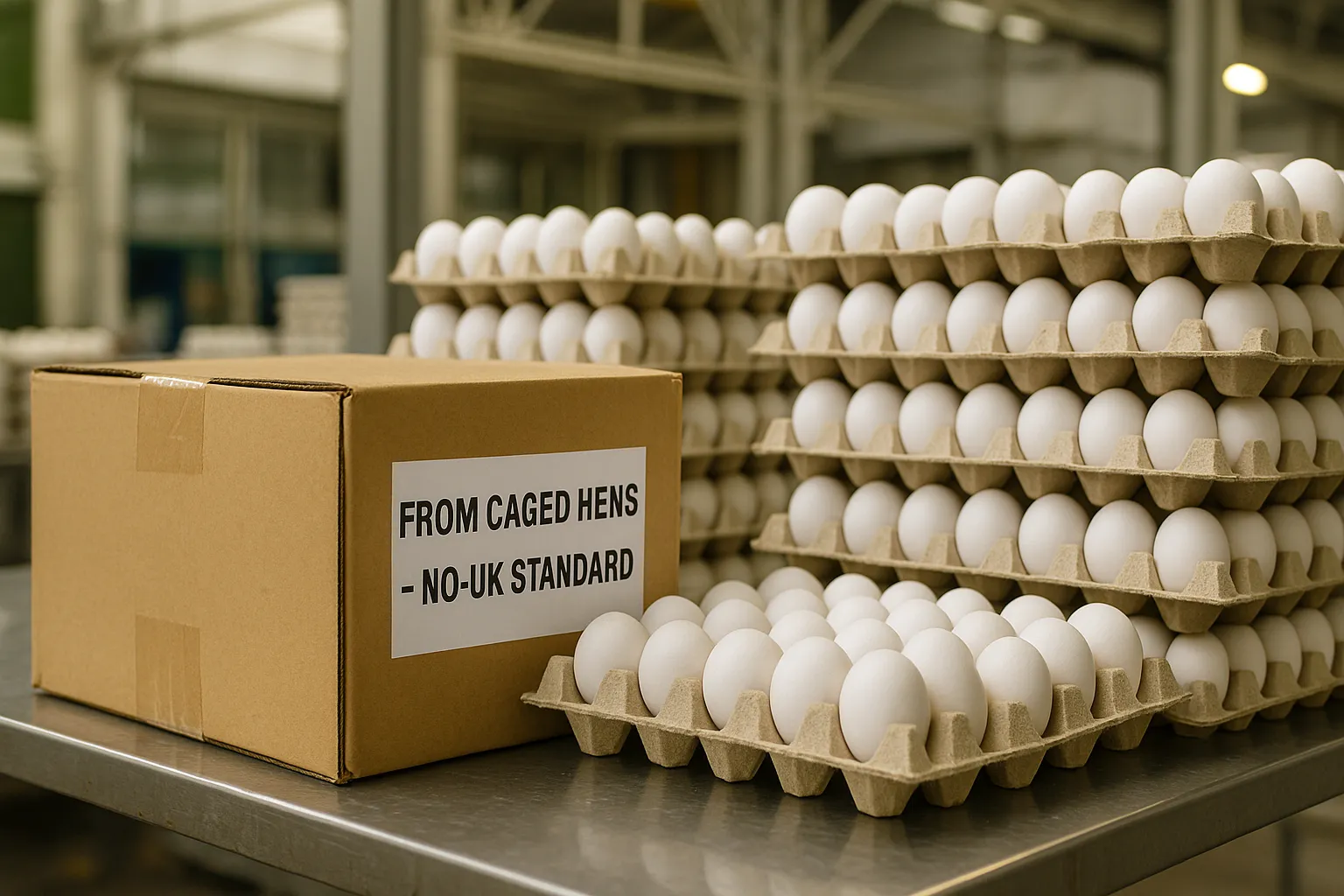
The issue was highlighted by Gary Ford, who heads the strategy at the British Free Range Egg Producers Association, during an inspection at Smithfield Market on 22 December. The shipment bore the label “From caged hens – No-UK standard,” raising alarms among industry stakeholders.
Data from the Animal and Plant Health Agency indicates that in the first half of this year, the UK imported a total of 8 million kilograms of eggs from Ukraine, alongside 7 million kilograms from Poland and 5 million kilograms from Spain. This influx of imported eggs has prompted fears among UK farmers about the sustainability of their practices.
Ford expressed his apprehensions: “The industry remains deeply concerned about future Ukrainian imports and the implications of any renewed trade agreement. Fair trade must be the foundation of policy, ensuring UK animal welfare standards are upheld and that production methods banned here, such as battery cages, are not indirectly reintroduced through imports.”
The timing of these concerns is particularly noteworthy, as imports were noted on the same day the UK government released its Animal Welfare Strategy, which aims to phase out enriched colony systems within the country.
Victoria Shervington-Jones, a free-range egg producer from South Wales, voiced her deep concerns regarding the safety of the imported eggs. “We work so hard to make sure our eggs are safe and are audited to an inch of our lives and follow the Lion code and RSPCA Assured standards. Why import when we have no idea what is being sent over?” she questioned.
Nick Allen, chief executive of the British Egg Industry Council, underscored the rigorous standards under which British Lion eggs are produced, citing an extensive system of over 700 auditable criteria and a strong Salmonella control programme. In contrast, he noted that the Ukrainian sector has not yet reached equivalent levels of food safety, assurance, or enforcement.
Allen asserted, “If the UK government is serious about championing high standards, supporting British farming, and protecting public health, then imports produced to lower requirements must not be allowed to enter our market.”
Recent cases involving Salmonella and antibiotic residues in Ukrainian eggs further highlight the potential dangers of allowing imports produced under less stringent guidelines. Allen emphasised, “Bringing in eggs that fall short of the standards required here in the UK undermines the hard work and investment of our British farmers and exposes consumers to unnecessary food-safety concerns.”
Shervington-Jones also pointed out the issue regarding consumer choice: although imported eggs may be identifiable on supermarket shelves, this distinction is lost when eggs are incorporated as ingredients in various products such as cakes and quiches.
John Seed, a farmer from Woodend Farm in the Scottish Borders, echoed these sentiments, highlighting a disconnect between food and agricultural policies in Scotland. Seed, who oversees a free-range laying flock of 32,000 birds, noted that the Good Food Nation Plan exists alongside fragmented rural initiatives, leading to inconsistencies.
He remarked, “UK farming families are heavily regulated, facing costly and near-impossible standards, while consumers are encouraged to buy products produced elsewhere under lower standards.” Seed attributed much of the imbalance to retailers, arguing that the government must take action to create a fairer market. “If this continues, we risk offshoring production and shutting down UK farming,” he warned.
The issues raised by industry leaders underscore the pressing need for a coherent strategy that aligns food production standards with agricultural policies. Without such integration, the future of the UK’s egg industry remains uncertain, particularly in light of increased competition from low-standard imports.
As the situation develops, the stakeholders’ call for more stringent regulations around imports may gain traction, prompting government authorities to reassess current trade agreements and their implications on domestic producers. The survival of the UK egg industry may depend on these forthcoming deliberations.
In conclusion, while the UK remains committed to maintaining high animal welfare and food safety standards, the challenge posed by imports from countries with lax regulations continues to jeopardise the livelihoods of local farmers and potentially compromise consumer safety. The importance of establishing robust trade practices that safeguard domestic production cannot be overstated, as reflected in the sentiments expressed by the industry representatives.
Our Thoughts
The concerns raised by UK egg industry representatives highlight significant failures in enforcing food safety regulations and ensuring import equivalency. To prevent similar incidents, stricter adherence to the Food Safety Act 1990, which mandates that food must be safe for consumption, is essential. Additionally, the importation of food products must adhere to equivalence standards under the Trade in Animals and Related Products Regulations 2011, which were clearly breached in this case by allowing Ukrainian eggs produced under lower welfare standards to enter the UK market.
Key safety lessons include the importance of robust food safety inspections and audits for imported goods, which should match UK standards to protect public health. The current regulatory oversight appears inadequate, allowing products that do not meet established UK standards to undermine local producers.
Moreover, clearer communication and coordination among governmental and agricultural policies are necessary to ensure that the principles of the Good Food Nation Plan are effectively implemented. Strengthening enforcement against non-compliance by importers and demanding certification compliance from foreign suppliers could prevent reoccurrence of such incidents and safeguard UK farmers’ interests.