











Story Highlight
– MFT leading NHS digital transformation with smart estate initiative.
– First healthcare ‘smart estate’ powered by digital twin technology.
– System improves operational efficiency, patient safety, and data access.
– Innovative use of geospatial tech for better asset management.
– Future plans include indoor navigation and patient contact tracing.
Full Story
Innovation stands as a fundamental pillar in the ongoing transformation of the National Health Service (NHS). As the healthcare system grapples with unprecedented levels of demand, staffing challenges, and ageing infrastructures, the urgency for innovative solutions has never been greater. At the Manchester University NHS Foundation Trust (MFT), there is a palpable momentum towards accelerating such innovations.
Partnering with Esri UK, a leader in geospatial technology, MFT is embarking on a groundbreaking project to redefine NHS estate management. This initiative is aligned with the New Hospital Programme (NHP), and through collaboration with BIS Consult, the Trust is transitioning from conventional analogue methods to a sophisticated digital approach. This has led to the development of England’s first ‘smart estate’ within the healthcare sector, utilising a digital twin that employs geospatial technology. Such a model not only serves MFT but offers a replicable framework for other healthcare trusts aiming to modernise operations without unnecessarily duplicating efforts.
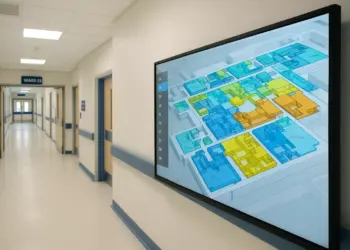
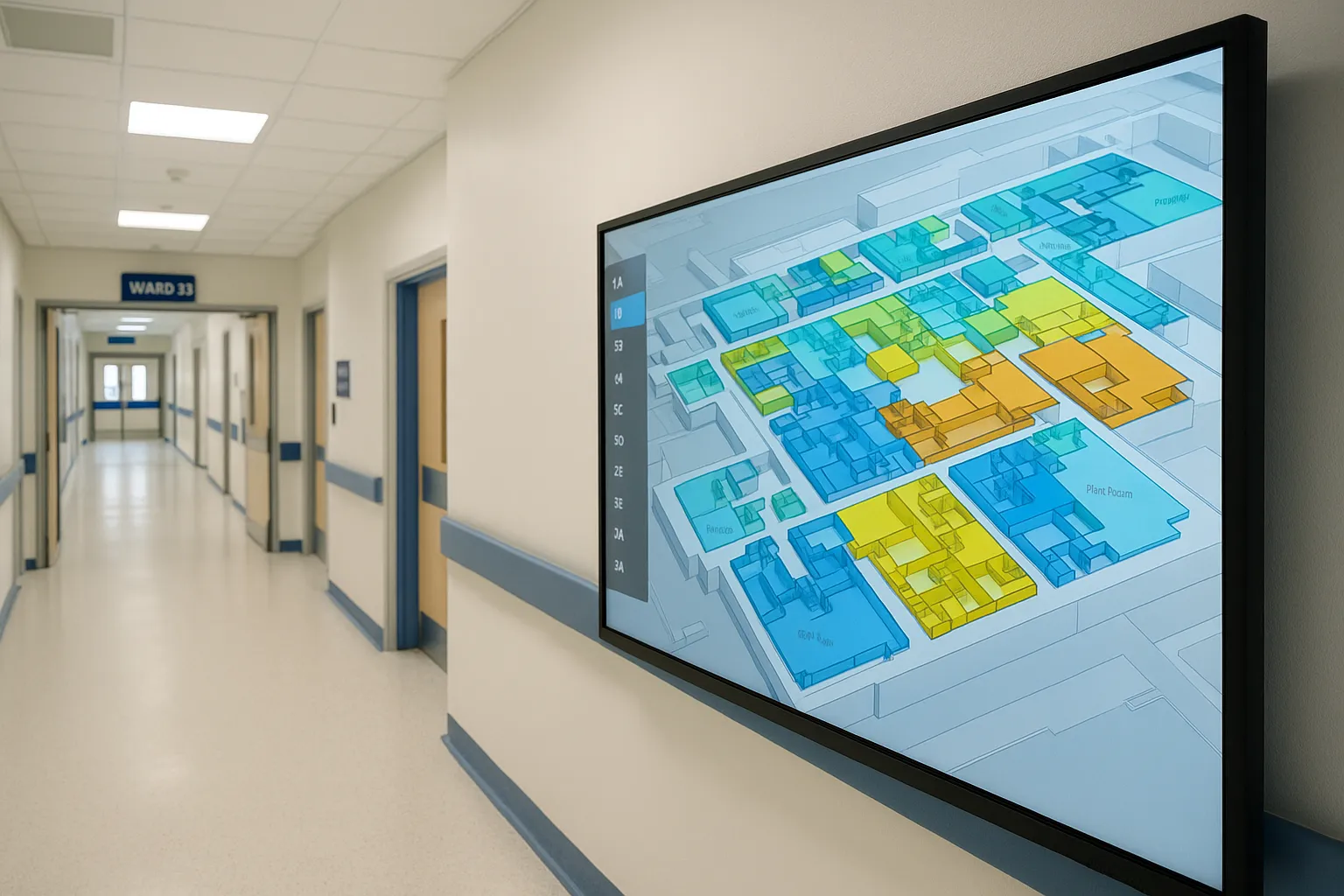
The digital twin encompasses six hospitals and an expansive 274,000 square metres of floor space, designed to centralise estates data and enhance operational workflows and decision-making processes. This 3D model is a crucial step in MFT’s digital transformation journey, aiming to boost both efficiency and patient safety.
**Challenges in Estates Management**
The estates and facilities teams play a crucial role in maintaining the functionality, safety, and efficiency of hospitals. However, the challenge lies in the scattered nature of the data these teams rely on, often trapped within outdated systems, paper documents, and isolated departments. MFT recognised the need for a unified data platform—their quest for a ‘single source of truth’ aimed to streamline access to vital information concerning:
– Potential areas for repurposing
– Locations of hazardous materials like asbestos and RAAC (Reinforced Autoclaved Aerated Concrete)
– Prioritisation of maintenance tasks
– Inventory details of assets within specific rooms
Previously, obtaining this information could take an unacceptably long time, spanning several days or even weeks, and the results often lacked completeness.
**The Role of Location Technology**
In healthcare, every operational task has a geographical component, thereby positioning location and geospatial technology as the fundamental link in creating a comprehensive single source of estates data. Using Esri UK’s ArcGIS system, a digital twin was realised, integrating diverse data sets crucial for efficient hospital operations. This involved advanced indoor mapping and managing spatial data, coupled with mobile applications for collecting location-specific information.
Before establishing a digital twin, it was imperative to lay the groundwork with clean and well-managed data. BIS Consult contributed significantly to this phase by developing an effective data strategy, combining historical data from various legacy systems, enhancing data accuracy and consistency, and instituting ongoing governance measures to oversee data integrity.
**Transformational Impacts**
As it stands, MFT can now accurately visualise its facilities, including intricate details of buildings, floors, and rooms, along with pertinent operational information. This integrated system consolidates a vast array of data types, from operational statistics to clinical details, incorporating elements such as CAFM systems, CAD schematics, compliance records, maintenance schedules, and asset inventories.
Currently, a pilot project is underway utilising the digital twin to optimise space usage by quickly pinpointing areas where room occupancy could be improved. A full-scale implementation is set to equip all staff members with real-time data on occupancy rates and space requests, while clinicians will benefit from enhanced visibility regarding existing facilities, facilitating the planning of new service offerings.
Recent advancements also include implementing digital surveys for RAAC and asbestos management, using mobile devices that directly feed into the digital twin and visually represent varying risk levels. Such improvements have led to more timely and accurate data, bolstering maintenance strategies to enhance safety.
**Future Prospects**
What MFT has initiated is merely the beginning of a broader vision. The Trust is looking into expanded applications that exceed standard estates management, exploring advanced mapping techniques encompassing indoor navigation, real-time asset tracking, and patient contact tracing.
The integration of RFID technology enables swift localisation of essential equipment, from diagnostic scanners to wheelchairs, enhancing asset visibility and minimising unnecessary expenditure on lost items. In the complex environment of a hospital, advanced indoor mapping tools could drastically reduce missed appointments, streamline staff workflows, and ultimately enhance the overall patient experience.
Employing the same indoor positioning technology allows for efficient patient contact tracing, timely notifying individuals who may have been in contact with an infected person and providing them guidance on testing and self-isolation measures, thus helping mitigate the spread of illnesses.
**The Geospatial Advantage**
Adopting a geospatial perspective to craft a digital twin extends beyond mere visualisation of physical assets; it encompasses a holistic view of the surrounding context by amalgamating essential data, such as demographics, public transport logistics, traffic dynamics, and environmental factors like biodiversity or flood risks. This comprehensive insight transforms the digital twin into a strategic tool, essential for planning future services and guiding capital projects, including new hospital constructions.
**A Template for the Future**
As initiatives under the New Hospital Programme gain traction and healthcare trusts throughout the UK consider modernising their facilities, MFT’s achievements provide a compelling case study. Their digital twin is instrumental in shaping early-stage planning for the North Manchester General Hospital’s involvement in the NHP, allowing for strategic decision-making concerning renovations, disposals, or new constructions within their estate.
The NHS estate represents one of the most intricate built environments in the UK. However, with robust data foundations and innovative geospatial technologies, there exists a pathway toward evolving it into an intelligent ecosystem, capable of fulfilling both current and future healthcare demands.
David Bailey, Head of Digital Estates at MFT, emphasised the transformational potential of the digital twin: “Integrating all our existing data into a digital twin is driving new opportunities for efficiency gains. Moving from analogue to digital achieves a better understanding of our buildings and assets which helps improve their management and maintenance, as well as improving patient safety.”
Through MFT’s trailblazing efforts, it becomes evident that embracing digital transformation represents more than just a technological upgrade; it is a fundamental strategic advancement. The insights gained from their digital twin offer a promising template for the future of healthcare environments—an ambitious blueprint for constructing smarter, safer, and more efficient hospitals.
Our Thoughts
The article highlights the transition at Manchester University NHS Foundation Trust (MFT) towards a digital twin to enhance safety and efficiency in hospital management. To avoid potential safety mishaps during this transition, a robust training program for staff on the new systems should have been established prior to implementation, ensuring familiarity with the digital tools and data governance protocols.
Key safety lessons include the importance of data integrity and timely access to critical information regarding hazards like asbestos and RAAC (Reinforced Autoclaved Aerated Concrete), which can pose serious risks. Establishing a clear strategy for data governance can help manage these risks effectively.
The UK’s Health and Safety at Work Act 1974 mandates that employers ensure, as far as reasonably practicable, the health and safety of employees. Any lapses in maintaining accurate data and proper training could lead to violations of this regulation if they result in unsafe working conditions or hinder timely decision-making regarding health risks.
Similar incidents can be prevented by ensuring comprehensive risk assessments are conducted in conjunction with the new systems, and continuous monitoring of data accuracy and completeness is maintained to support ongoing safety and operational decisions.