














Story Highlight
– UK loses measles elimination status due to low vaccinations.
– Measles cases surged to 3,681 in 2024.
– Only 83.7% of five-year-olds received two vaccine doses.
– WHO calls for increased vaccination to ensure herd immunity.
– New MMRV vaccine introduced to boost childhood immunization.
Full Story
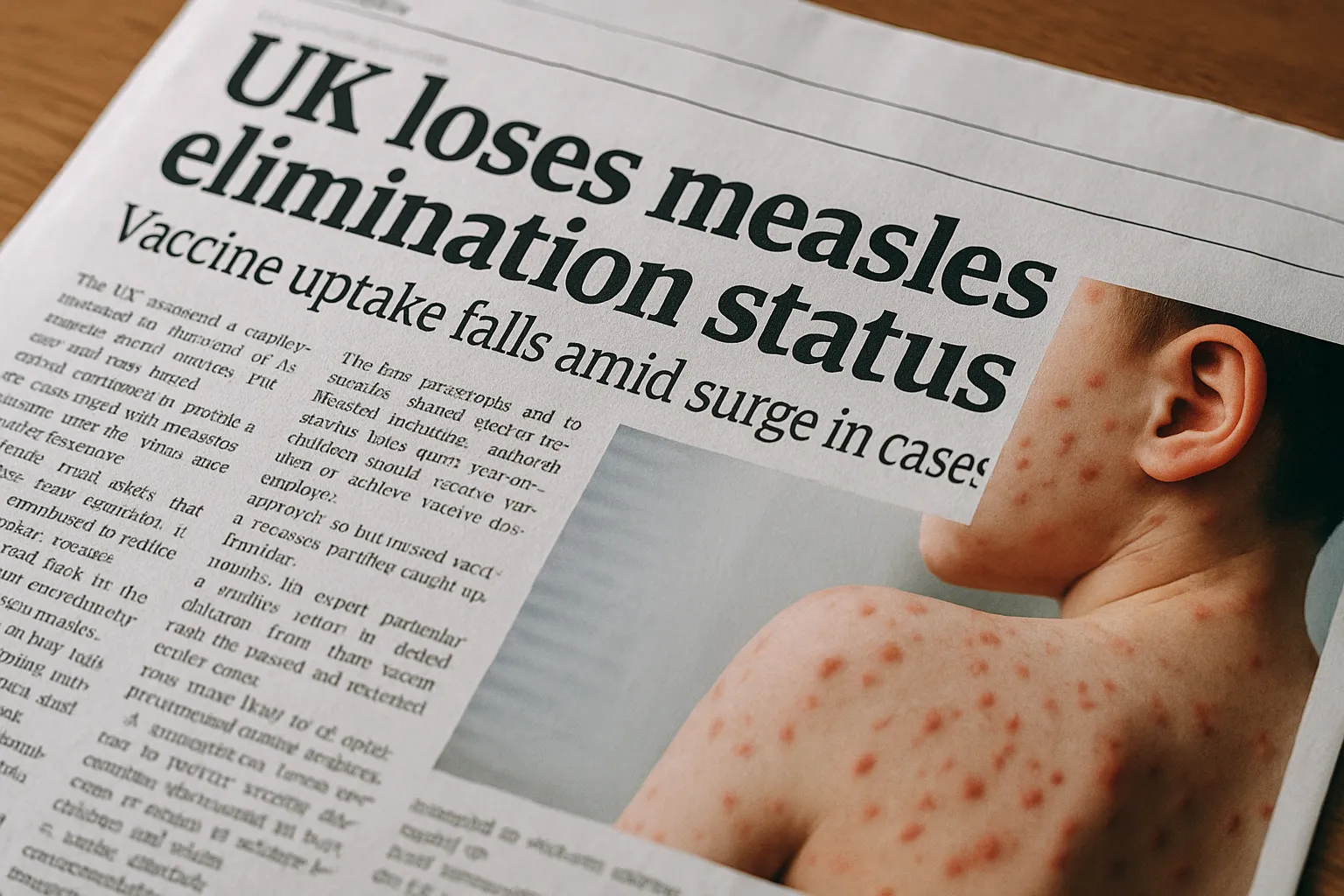
The United Kingdom has officially lost its measles elimination status as designated by the World Health Organization (WHO), following a significant rise in cases amid stagnant vaccination rates. This development marks a notable shift from the period between 2021 and 2023, during which the disease was considered eliminated within the nation. However, troubling trends emerged as measles transmission was reestablished in the country in 2024, leading global health officials to express deep concern.
Recent statistics indicate that the UK recorded an alarming 3,681 measles infections in 2024, underscoring a growing public health challenge. Vaccination rates among children have remained static, prompting the WHO to encourage nations to enhance inoculation efforts to halt the spread of this contagious disease, particularly among children who are most vulnerable. Alongside the UK, countries such as Spain, Austria, Armenia, Azerbaijan, and Uzbekistan have also lost their measles elimination status, signalling a widespread issue across various regions.
Dr Ben Kasstan-Dabush, an assistant professor at the London School of Hygiene and Tropical Medicine, commented on the situation, stating, “It is unsurprising the UK has lost its WHO measles elimination status, following nationwide outbreaks since 2024 and the preventable death of a child in 2025.” His remarks reflect the distressing implications of declining vaccination rates, which are critical for maintaining public health safety.
Data from the UK Health Security Agency (UKHSA) for the year 2024-25 reveals that only 83.7% of five-year-olds received both doses of the measles, mumps, and rubella (MMR) vaccine. This figure represents a slight decrease from the previous year’s 83.9% and is the lowest recorded level since the 2009-10 period. Additionally, 91.9% of children of the same age cohort had received at least one MMR dose, a rate that has remained unchanged since 2023-24 and is the lowest seen since 2010-11. The WHO recommends that to achieve herd immunity, vaccination coverage needs to reach at least 95%.
Dr Vanessa Saliba, a consultant epidemiologist at the UKHSA, highlighted the rapid return of infections in the wake of declining vaccination rates. She stated, “Infections can return quickly when childhood vaccine uptake falls. Measles elimination is only possible if all eligible children receive two MMR doses before school. Older children and adults who missed vaccination must be caught up.” To address this issue, the UK government has introduced a revamped vaccination schedule, whereby children are now being offered a combined MMRV vaccination, encompassing protection against measles, mumps, rubella, and chickenpox.
As of January, the new immunisation plan has commenced, with the first dose of the combined vaccine being administered at one year of age. The second dose has been advanced from the previous schedule at three years and four months to a new appointment set at 18 months of age. This change follows recommendations made by the Joint Committee on Vaccination and Immunisation (JCVI) in 2023, which aimed to improve childhood vaccination coverage.
The WHO responded to the UK’s change in measles status, suggesting that it reflects a broader challenge faced across Europe concerning vaccination rates for preventable diseases. A spokesperson pointed out that “Outbreaks of measles and other vaccine-preventable diseases are threats to health security in Europe.” This statement reinforces the growing concern among health officials regarding the resurgence of diseases that can be prevented through vaccination.
Dr Bharat Pankhania, a senior clinical lecturer at the University of Exeter Medical School, expressed alarm over the emergence of areas within the UK exhibiting low or nonexistent vaccine uptake. He underscored the urgency of addressing this situation to prevent further declines in public health. “It’s extremely concerning that in the UK we now have pockets of low or no vaccine uptake,” he said. His comments highlight the need for immediate corrective measures to stimulate higher vaccination rates.
As public health officials grapple with these escalating concerns, the implications for community health are becoming increasingly pronounced. With infectious diseases like measles poised to re-enter communities, the necessity for effective communication around vaccination benefits becomes critical. Local health departments are now focusing efforts on outreach to parents and guardians to bolster awareness and understanding of the importance of immunization schedules.
Experts emphasise that addressing misinformation around vaccines is crucial in rebuilding public confidence in childhood immunisation. Education campaigns and coordinated initiatives involving healthcare providers, schools, and community organisations are essential for reversing the trend of declining vaccination coverage.
In conclusion, the loss of measles elimination status for the UK serves as a wake-up call regarding the critical role of immunisation in safeguarding public health. The upward trajectory of measles cases requires immediate attention to address gaps in vaccination coverage, ensuring that all eligible children receive necessary immunisations to protect not only their health but that of their peers and wider communities. As health authorities work towards restoring the country’s standing in measles elimination, comprehensive strategies and community engagement become pivotal in preventing future outbreaks.
Our Thoughts
To address the surge in measles cases and the loss of elimination status, several measures could have been taken to enhance vaccination rates and ensure compliance with UK health and safety regulations.
Firstly, there could have been more robust public health campaigns to raise awareness about the importance of the MMR vaccine, coordinated through the Health and Safety at Work Act 1974, which mandates the provision of information and training to protect public health. Additionally, better outreach to communities with historically low vaccination uptake could have increased awareness and accessibility.
Furthermore, the failure to achieve the recommended 95% vaccination coverage breaches the Public Health (Control of Disease) Act 1984, which aims to safeguard public health by preventing the spread of communicable diseases. Proactive measures, such as school-based vaccination programs and follow-up on missed doses for older children and adults, could help in raising these rates.
Key lessons include the necessity of maintaining high vaccination uptake to prevent outbreaks and the urgent need for a coordinated response during declines in vaccine coverage. Ongoing education and community engagement are critical to preventing similar incidents in the future.