
















Story Highlight
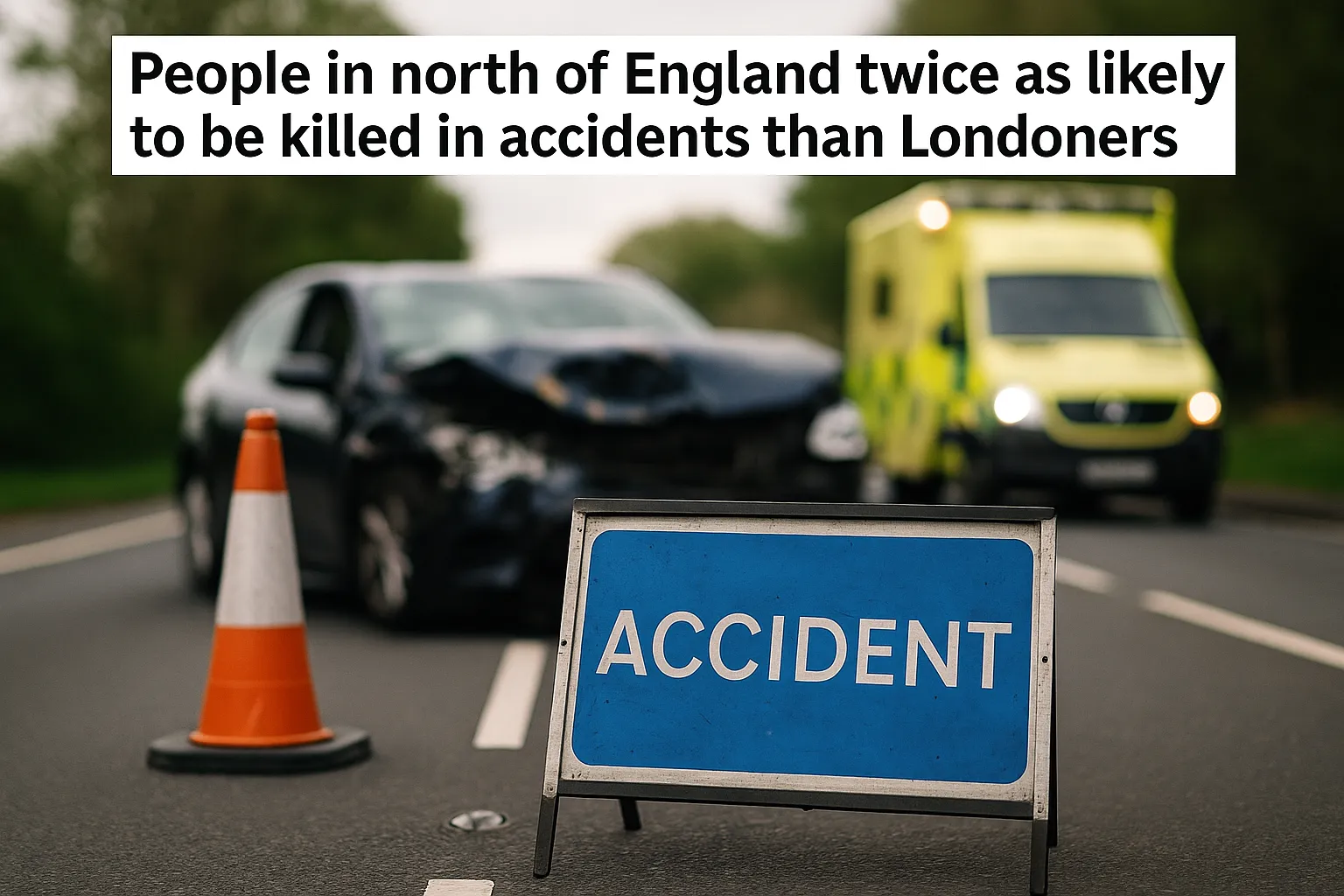
– North England faces double accidental death rate vs. London.
– North-east has highest accidental death rate in England.
– Deprivation linked to increased risk of accidental deaths.
– 23,000 annual deaths attributed to accidents in UK.
– RoSPA calls for National Accident Prevention Strategy urgently.
Full Story
A recent report has revealed alarming disparities in accidental death rates across different regions of England, with individuals in the north experiencing a significantly higher risk compared to those in London. According to the findings from the Royal Society for the Prevention of Accidents (RoSPA), people in northern parts of the country are twice as likely to succumb to fatal accidents as those living in the capital.
The analysis indicates that the north-east region holds the highest accidental death rate in England, registering a disturbing 44 deaths per 100,000 individuals. This figure starkly surpasses the national average of 32 deaths per 100,000. Following closely is the north-west, which reports a death rate of 38 per 100,000. Furthermore, the report highlights Scotland as the most perilous among the devolved nations, with an accidental death rate of 51 per 100,000. Wales mirrors the north-east’s figures, while Northern Ireland’s rate of 39 per 100,000 also exceeds the average for England.
In contrast, London stands out as the safest area within the UK, boasting an average of just 19.5 accidental deaths per 100,000 inhabitants. The stark regional variations are further emphasised when examining local authorities, with Redcar and Cleveland, Middlesbrough, and Blackpool noted for particularly high rates of accidental deaths across England and Wales.
The report underlines a strong correlation between deprivation levels and accidental fatalities. Data shows that individuals residing in the most deprived areas of England are nearly twice as likely to experience accidental deaths compared to those in more affluent regions. This pressing issue calls for further investigation into the underlying reasons for this disparity.
Matilda Smith, the report’s lead author, expressed the need for deeper exploration into the connections between accidents and socio-economic status. “More research needs to be done to better understand the links between accidents and deprivation,” she stated, emphasising the importance of this topic. “I think the findings of the report are really rather shocking. It is an unfortunate truth that where you live, and the deprivation of your area, has an impact on the risk that you have in terms of whether or not you’re going to die in an accident.”
Smith further stated that the continued prevalence of accidental deaths, particularly in the north of England, is deeply concerning. “What is also really clear is that deprivation is inherently linked to your risk, and that means that people living in poorer areas are facing the realities of greater risk, and a greater risk of dying in really sudden, shocking and horrible accidents,” she explained.
The report also identifies an overall increase of 8% in the rate of accidental deaths, emphasising the role of falls, poisonings—including those associated with alcohol and narcotics—and road traffic accidents as the leading causes. Notably, poisonings alone accounted for over a quarter of all accidental fatalities, reflecting a concerning 10% rise in per capita rates in just one year.
Hospital admissions related to accidents have likewise surged, with an overall increase of 3% across Great Britain. This includes a significant 17% uptick in cases related to animal-related incidents and a 6% rise in poisonings. RoSPA’s data reveals that approximately 23,000 individuals—more than the total capacity of large venues such as the O2 Arena in London or the Co-op Arena in Manchester—lose their lives to accidents annually. Additionally, nearly 900,000 people require hospitalisation due to accidents, equivalent to the entire population of Devon.
Becky Hickman, Chief Executive Officer of RoSPA, remarked on the profound impact that accidents have on lives. “Accidents devastate lives in an instant. They are often sudden, violent, and shocking, leaving families and communities to cope with consequences that can last a lifetime. What makes this devastation even harder to bear is the knowledge that so many of these incidents are entirely preventable,” she stated.
Hickman further highlighted the enduring issue of preventable harm and life-altering injuries, expressing concern that the current efforts to mitigate such risks are insufficient. “From our roads to our workplaces, the homes we live in to where we spend our leisure time, people in Britain are at increasing and unacceptable risk of suffering a serious accident. And it is those who are already vulnerable—young children, the elderly, and people in deprived communities—who are in the greatest danger,” she added.
In light of these findings, RoSPA is advocating for the implementation of a National Accident Prevention Strategy to address the ongoing public health crisis caused by accidents. This initiative is proposed not only as a means to safeguard lives but also to alleviate pressures on the economy and the National Health Service.
Dr Sally-Anne Wilson, Vice-President of the Royal College of Emergency Medicine, commented on the rising trends in accidental injuries, particularly among older adults. “Emergency departments see first hand the rising impact of accidental injuries, particularly among older people. The patients I worry about most are those who fall from standing height, often in their own homes, and arrive in the ED with serious injuries such as hip or rib fractures. These seemingly simple accidents can have devastating consequences,” Wilson noted.
She also addressed the challenges that crowding in emergency departments poses for older patients, linking it to longer hospital stays and increased mortality rates. “Prevention must be a priority,” Wilson concluded, highlighting the urgent need for action to combat the ongoing crisis in accidental deaths.
Our Thoughts
The findings of the RoSPA report indicate significant regional disparities in accidental deaths across the UK, particularly highlighting the elevated risks associated with deprivation. To mitigate such incidents, a more robust application of the Health and Safety at Work Act 1974 is essential, which mandates employers to provide a safe workplace and protect public health. A national accident prevention strategy, as suggested, would promote targeted interventions in high-risk areas.
Key safety lessons include the need for comprehensive community safety programs, focusing on education around common hazards like falls and poisoning, particularly in deprived areas. Additionally, enhancing accessibility to safety resources and emergency response services in high-risk regions may reduce incident rates.
The noticeable increase in accidental deaths underscores potential breaches of the Management of Health and Safety at Work Regulations 1999, which require risk assessments and the implementation of safety measures. Local authorities should prioritize engaging with communities to address underlying factors contributing to these disparities, ensuring that vulnerable populations receive adequate support and resources to prevent accidents.