











COSHH Basics: A Practical Guide to Control of Substances Hazardous to Health
Last updated: 7 September 2026
Author: Jade Anderson, Senior Reporter, UK-Safety.News
Reading time: about 13 minutes
What this guide covers
- Why COSHH matters
- What COSHH covers and routes of exposure
- The law and who has duties
- CLP pictograms and safety data sheets
- The eight steps of COSHH
- The eight principles of good control
- Workplace exposure limits
- The control hierarchy
- LEV and RPE
- Health surveillance, training and records
- COSHH Essentials
- Case study
- Common mistakes
- Frequently asked questions
- Further resources

Why COSHH matters
Ill health from substances usually arrives years after the exposure that caused it. HSE’s headline figures for 2024/25 estimate 1.9 million working people in Great Britain suffering from a work related illness, alongside an estimated 11,000 lung disease deaths each year linked to past exposures at work.
HSE’s disease reporting schemes show where the harm still comes from: flour and isocyanates are the most commonly cited causes of occupational asthma (SWORD), soaps, cleaners and wet work the most common causes of contact dermatitis (EPIDERM), and dust from stone, cement, brick and concrete the largest single agent behind new breathing and lung problems. These are the everyday exposures of bakeries, body shops, cleaning teams and construction sites.
What COSHH covers, what it does not, and routes of exposure
Regulation 2 of COSHH defines a substance hazardous to health as one that:
- is classified as very toxic, toxic, harmful, corrosive or irritant (in practice, anything with a health hazard pictogram);
- has a workplace exposure limit (WEL) approved by HSE;
- is a biological agent;
- is dust of any kind at 10 mg/m3 or more of inhalable dust, or 4 mg/m3 or more of respirable dust, as an 8 hour time weighted average;
- creates a risk to health because of its properties and the way it is used or present at work.
The last point is the one people miss. Wood dust, welding fume, silica, diesel exhaust and flour are COSHH substances because the work creates them, label or no label.
Not covered. Lead, asbestos and radioactive substances have their own regulations: the Control of Lead at Work Regulations 2002, the Control of Asbestos Regulations 2012 (see our asbestos essentials guide) and the Ionising Radiations Regulations 2017. Fire and explosion risks sit under DSEAR 2002, so the same product often needs both assessments.
Routes of exposure. Schedule 2A requires you to consider all three: inhalation of dust, fume, mist, vapour and gas (the route WELs are written for); skin contact and absorption, which causes dermatitis and burns and, for substances marked “Sk” in EH40, carries the chemical into the body; and ingestion, usually from contaminated hands, food and cigarettes.
The law: COSHH 2002 and who has duties
The Control of Substances Hazardous to Health Regulations 2002 (as amended) require employers to plan, manage and monitor work with hazardous substances. The Approved Code of Practice is L5; regulations 6 to 13 carry the operational duties.
| Reg | Duty | On the ground |
|---|---|---|
| 6 | Assessment of the risk to health | Suitable and sufficient assessment before work starts; recorded if five or more employees; reviewed regularly |
| 7 | Prevention or control of exposure | Prevent, or adequately control; substitution by preference; PPE only in addition to other measures |
| 8 | Use of control measures | Employers ensure controls are used; employees use them properly and report defects |
| 9 | Maintenance, examination and testing | LEV thoroughly examined and tested at least every 14 months; records kept 5 years |
| 10 | Monitoring exposure | Air monitoring where needed; records kept 5 or 40 years |
| 11 | Health surveillance | Where a detectable disease is linked to the exposure; health records kept 40 years |
| 12 | Information, instruction and training | Workers know the hazards, controls, monitoring results and emergency actions |
| 13 | Accidents, incidents and emergencies | Procedures, first aid and drills for spills and releases |
Duties fall on the employer and extend, so far as is reasonably practicable, to anyone else affected by the work. Self employed people carry the same duties except monitoring and health surveillance. Employees must use the controls provided. Suppliers must classify, label and supply safety data sheets under REACH and CLP.
CLP pictograms and safety data sheets
Supplied chemicals are labelled under the GB CLP Regulation with a signal word (“Danger” or “Warning”), hazard (H) and precautionary (P) statements and one or more of nine pictograms, each a red bordered diamond.
| Pictogram | Symbol | What it tells you |
|---|---|---|
| Acute toxicity | Skull and crossbones | Fatal or toxic in small amounts |
| Serious health hazard | Health hazard (silhouette with starburst) | Carcinogen, mutagen, reproductive toxin, respiratory sensitiser, organ damage |
| Health hazard | Exclamation mark | Irritant, skin sensitiser, harmful, narcotic |
| Corrosive | Corrosion | Severe skin burns and eye damage; may corrode metals |
| Flammable | Flame | Flammable gas, aerosol, liquid or solid |
| Oxidising | Flame over circle | May cause or intensify fire |
| Explosive | Exploding bomb | Explosion hazard |
| Gas under pressure | Gas cylinder | May explode if heated |
| Hazardous to the environment | Dead tree and fish | Toxic to aquatic life |
No pictogram does not mean no hazard, and process generated substances have no label at all.
Safety data sheets
Suppliers must provide a current SDS under REACH. It always has 16 sections: 1 identification; 2 hazards; 3 composition; 4 first aid; 5 fire fighting; 6 accidental release; 7 handling and storage; 8 exposure controls and personal protection; 9 physical and chemical properties; 10 stability and reactivity; 11 toxicological information; 12 ecological information; 13 disposal; 14 transport; 15 regulatory information; 16 other information.
Read sections 2, 3, 8 and 11 first: hazards, the ingredients driving them, recommended limits and controls (including glove material and breakthrough time), and effects on the body. Sections 4, 6 and 7 feed your emergency plan. HSE is blunt: an SDS is not a risk assessment. It describes the substance as supplied and knows nothing about your quantities, durations or people.
The eight steps of COSHH
HSE summarises regulations 6 to 13 as eight steps. Treat them as a cycle.
- Assess the risks. List every product and process that generates a hazardous substance. For each, identify who is exposed (including maintenance staff, cleaners and visitors), by which route, how much and for how long. Read the SDS and check EH40 for a WEL.
- Decide what precautions are needed. Compare exposure with the legal standard: below the WEL, and as low as is reasonably practicable for carcinogens, mutagens and asthmagens.
- Prevent or adequately control exposure. Remove the substance or change the process if you can, then work down the hierarchy applying the Schedule 2A principles. Write down the controls for each task.
- Ensure control measures are used and maintained. Supervise: is the extraction on, the lid closed, the right gloves worn? Maintain LEV, RPE and enclosures.
- Monitor exposure. Measure airborne concentrations where you need proof a WEL is not exceeded, where control failure could be serious, or where Schedule 5 requires it.
- Carry out appropriate health surveillance. Where the substance is linked to an identifiable disease and there is a valid way to detect it early.
- Prepare plans for accidents, incidents and emergencies. Spill kits, eyewash, first aid tailored to the substances on site, and drills where a release would be serious.
- Ensure employees are informed, trained and supervised. Everyone near the substance understands the hazard, the controls and what to do if it goes wrong.
With five or more employees the significant findings must be recorded. Review the assessment regularly, and immediately if it may no longer be valid, the work changes significantly, or monitoring suggests a problem.
The eight principles of good control practice
Schedule 2A defines “adequate control”: under regulation 7(7) control is only adequate if these principles are applied.
- Design and operate processes and activities to minimise emission, release and spread of substances hazardous to health.
- Take into account all relevant routes of exposure (inhalation, skin absorption and ingestion) when developing control measures.
- Control exposure by measures that are proportionate to the health risk.
- Choose the most effective and reliable control options which minimise the escape and spread of substances hazardous to health.
- Where adequate control of exposure cannot be achieved by other means, provide, in combination with other control measures, suitable personal protective equipment.
- Check and review regularly all elements of control measures for their continuing effectiveness.
- Inform and train all employees on the hazards and risks from the substances with which they work and the use of control measures developed to minimise the risks.
- Ensure that the introduction of control measures does not increase the overall risk to health and safety.
Principle 8 bites when a water based substitute grows bacteria, or an enclosure creates a confined space.
Workplace exposure limits and EH40
Workplace exposure limits are approved by HSE, published in EH40/2005 (fourth edition, 2020) and legally binding under COSHH. Only around 500 substances have one, so the absence of a WEL never means a substance is safe.
The long term limit is an 8 hour time weighted average (TWA) and protects against the effects of prolonged exposure. The short term limit uses a 15 minute reference period and protects against acute effects such as irritation.
| Substance | Long term (8 hour TWA) | Short term (15 minute) | Typical source |
|---|---|---|---|
| Respirable crystalline silica | 0.1 mg/m3 | None listed | Cutting concrete, stone, brick |
| Hardwood dust | 3 mg/m3 | None listed | Joinery, furniture, sanding |
| Flour dust | 10 mg/m3 | 30 mg/m3 | Bakeries, food manufacturing |
| Isocyanates (as NCO) | 0.02 mg/m3 | 0.07 mg/m3 | Two pack paint spraying, foams |
| Carbon monoxide | 20 ppm | 100 ppm | Engine exhaust, gas appliances |
| Toluene | 50 ppm | 100 ppm | Solvents, adhesives, printing |
| Sodium hydroxide | None listed | 2 mg/m3 | Caustic cleaning, chemical plants |
For carcinogens, mutagens and asthmagens (silica, hardwood dust, flour and isocyanates all qualify) meeting the WEL is not enough: exposure must be as low as is reasonably practicable. Check the current EH40 before relying on any figure.
The control hierarchy in practice
Regulation 7 sets the order: prevent, substitute by preference, then engineering controls, then control at source, and only then PPE in addition to the rest. HSE’s practical version in INDG136 runs like this.
| Level | Control | Practical examples |
|---|---|---|
| 1 | Eliminate the harmful substance and use a safer one | Water based paint instead of solvent based; mechanical fixing instead of adhesive |
| 2 | Use a safer form of the product | Paste or pellets rather than powder; ready mixed rather than mixed on site |
| 3 | Change the process to emit less | Lower spray pressure; wet cutting; block splitters instead of cut off saws |
| 4 | Enclose the process | Spray booth, glove box, closed transfer systems, sealed mixing vessels |
| 5 | Extract emissions near the source | LEV hoods on saws and sanders, on tool extraction, welding fume extraction |
| 6 | Keep as few workers in harm’s way as possible | Segregated areas, shorter task durations, dusty work out of hours, restricted access |
| 7 | Provide PPE | Correct glove type for the chemical, fit tested RPE with the right APF, coveralls, eye protection |
Use the levels in combination. PPE alone is never adequate control for a serious hazard: it protects one person and fails silently.
LEV and RPE
Local exhaust ventilation
LEV captures the contaminant at source, but only if the hood is close enough, the airflow is right and the system is maintained. HSE’s guidance is HSG258.
- Insist on a commissioning report recording design performance, a user manual and a logbook. The report is the benchmark every later test is measured against.
- Record routine daily and weekly checks: hood position, damage, airflow indicator, filter status.
- Thorough examination and test. Regulation 9(2) requires LEV to be thoroughly examined and tested by a competent person at least once every 14 months, or more often for the processes in Schedule 4. Keep the report at least 5 years and fix what it finds.
Respiratory protective equipment
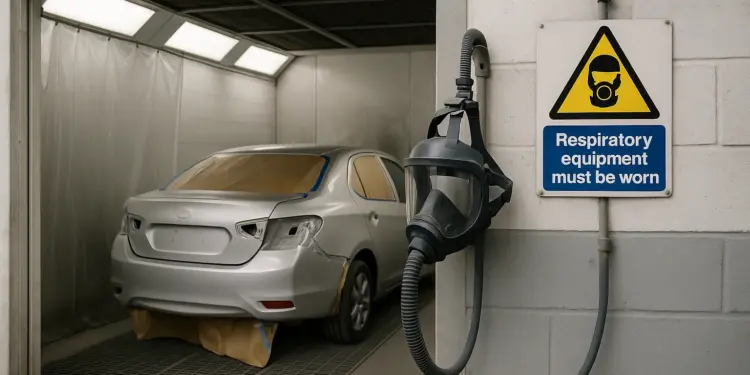
RPE is the last line, for where other controls cannot get exposure low enough, maintenance and emergencies, or while better controls are installed. HSE’s guidance is HSG53.
Adequacy: the assigned protection factor. The APF is the ratio of the concentration outside the mask to the concentration inside it. HSG53 gives FFP1 an APF of 4, FFP2 an APF of 10, FFP3 and half masks with P3 filters an APF of 20, and powered hoods 20 (TH2) or 40 (TH3). Divide the exposure by the WEL to find the factor you need.
Suitability: fit and the wearer. Tight fitting facepieces (disposable, half and full face masks) only work if they seal to the face, so each wearer needs a face fit test for each model they use, by a competent person (HSE points to the BSIF Fit2Fit scheme). Repeat it when the face changes and at a set interval. Stubble and beards make a seal impossible: clean shaven, or a loose fitting powered hood. Non disposable RPE must be examined and tested at suitable intervals under regulation 9(3), with records kept 5 years.
Health surveillance, training and records
Health surveillance (regulation 11)
Required where an identifiable disease is linked to the substance, it is reasonably likely under your conditions of work, and there is a valid low risk technique for detecting it. In practice:
- Skin checks for regular wet work and contact with irritants and sensitisers. A trained responsible person can do routine checks; abnormal findings go to occupational health.
- Respiratory questionnaires and lung function tests for asthmagens such as isocyanates, flour and wood dust, and for silica.
- Medical surveillance by an HSE appointed doctor at intervals not exceeding 12 months for the substances and processes in Schedule 6.
Information, instruction and training (regulation 12)
People need the names of the substances and their risks, the significant findings of the assessment, what they personally must do with controls and PPE, the results of monitoring and anonymised health surveillance, and the emergency procedures. Make it task specific and record it. Contractors need the same before they start; see our guide to managing contractors under CDM 2015.
Record keeping periods
| Record | Minimum retention | Source |
|---|---|---|
| LEV and RPE examination and test reports | 5 years from the date made | Regulation 9(4) |
| Exposure monitoring, general or static | 5 years from the last entry | Regulation 10(5) |
| Exposure monitoring, personal exposures of identifiable employees | 40 years from the last entry | Regulation 10(5) |
| Health surveillance health records | 40 years from the last entry | Regulation 11(3) |
If the business closes, regulation 11 requires you to notify HSE and offer it the health records. The 40 year periods exist because these diseases can take decades to appear.
COSHH Essentials
COSHH Essentials is HSE’s free tool for organisations without a chemist or hygienist. It produces control guidance sheets: direct advice sheets for specific industries (baking, woodworking, welding, motor vehicle repair and others) and generic sheets for common tasks, each setting out a control approach with the equipment, checks, maintenance and training needed. It does not replace an assessment, but for a small business using supplied chemicals it is a fast, defensible way to identify the standard HSE expects.

Case study: a wood dust prosecution
In April 2024 Target Furniture Limited of Kingsthorpe, Northampton, pleaded guilty at Leicester Magistrates’ Court to breaching regulation 7(1) of the Control of Substances Hazardous to Health Regulations 2002 and was fined £14,700 with £4,869.46 costs.
HSE had visited four times over six years and had served an Improvement Notice. Inspectors still found significant wood dust deposits throughout the sawmill, inadequate extraction, workers dry sweeping despite vacuum equipment being available, and insufficient respiratory protection.
Nobody was injured: the prosecution rested entirely on exposure, which is the point of regulation 7. Repeated advice and an Improvement Notice count heavily against a company that has not acted, and the failures were basic: LEV that did not capture, cleaning that re suspended the dust, and RPE used instead of control rather than in addition to it. The same regulation produced a £3.8 million fine for Industrial Chemicals Limited at Southwark Crown Court in April 2026 after two employees suffered severe caustic soda burns.
Common mistakes
- Assessing substances instead of tasks. One sheet per product, with no thought about how it is used, how much or by whom.
- Ignoring process generated substances. Wood dust, silica, welding fume and diesel exhaust have no label and are among the most prosecuted exposures.
- Treating the WEL as a target. For sensitisers and carcinogens the duty is ALARP.
- RPE without fit testing. A mask leaking around a beard gives a false sense of protection.
- LEV without a benchmark or logbook. No commissioning report means the 14 month test has nothing to compare against.
- Dry sweeping and compressed air blow down. Both put captured dust straight back into the air.
See also 10 workplace safety failures.
Frequently asked questions
We only use domestic cleaning products. Does COSHH really apply?
Yes. If a product carries a health hazard pictogram it is a substance hazardous to health, and bleach, descalers and oven cleaners usually do. The assessment can be short, but wet work is a leading cause of dermatitis, so cover the skin route.
Do I need to write the assessment down?
With five or more employees you must record the significant findings and the steps taken to meet regulation 7. Below five it is not required, but it is the only practical way to show an inspector what you decided and why. There is no prescribed form.
How often must LEV be tested?
At least once every 14 months by a competent person under regulation 9(2), more often for Schedule 4 processes, plus your own routine checks in the logbook. Keep reports at least 5 years.
Does everyone who wears a dust mask need a face fit test?
Anyone relying on a tight fitting facepiece, including disposable FFP masks, needs a fit test for each model they use. Loose fitting powered hoods do not.
Is a case of occupational asthma or dermatitis reportable?
Yes. Both are reportable diseases under RIDDOR once a doctor has diagnosed them in writing and the work involves the relevant exposure. See our guides to understanding RIDDOR and reporting safety incidents.
Further resources
- HSE: COSHH basics
- HSE: INDG136 Working with substances hazardous to health
- HSE: EH40/2005 Workplace exposure limits
- HSE: HSG258 Controlling airborne contaminants at work
- HSE: HSG53 Respiratory protective equipment at work
- HSE: CLP hazard pictograms
- legislation.gov.uk: COSHH Regulations 2002
- HSE: Work related ill health statistics
- UK-Safety.News: Asbestos in the workplace
This guide is general information for Great Britain and is not legal advice. Check the current HSE guidance before acting on a specific case.
About the author: Jade Anderson specialises in turning regulations into practical steps for supervisors and safety leads.