
Health officials warn of rising rabies risks in the US
Federal health officials have raised alarm over a spike in encounters with potentially rabid animals this year, as the CDC...
Read moreDetailsFederal health officials have raised alarm over a spike in encounters with potentially rabid animals this year, as the CDC...
Read moreDetails




Last updated: 7 September 2026
Author: Jade Anderson, Senior Reporter, UK-Safety.News
Reading time: about 13 minutes
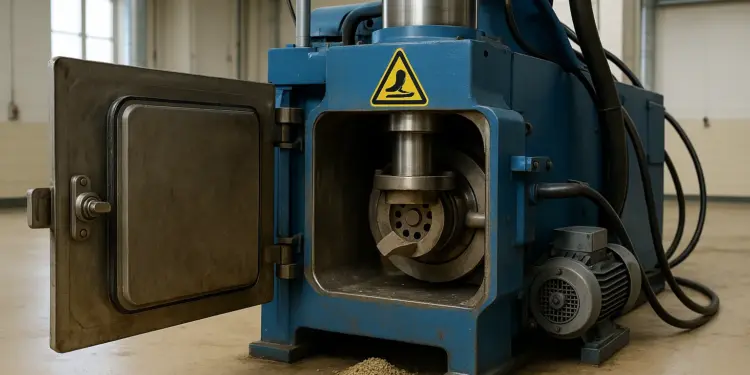
Most machinery injuries happen not in normal production but when a machine is being cleaned, unblocked, adjusted or repaired, and somebody else assumes the job is finished. In 2024/25 HSE’s provisional RIDDOR figures record 13 workers killed by contact with moving machinery in Great Britain and 2,088 non fatal injuries to employees from the same cause.
Behind almost every one of those incidents is the same short story: the equipment was stopped but not isolated, isolated but not locked, or locked but never proved dead. LOTO closes those three gaps with a physical padlock rather than a promise.
LOTO is a system of work, not a piece of kit.
British practice uses the same principles under the headings “safe isolation” and “lock off”. HSE’s maintenance guidance is blunt: plant and equipment must be made safe before maintenance starts, and machines must be locked off if there is a chance the power could be accidentally switched back on. Pressing an emergency stop, opening an interlocked guard or switching off at a control panel does not separate the equipment from its supply and is not isolation.
There is no regulation in Great Britain called “lock out tag out”. The requirement is assembled from several instruments.
Section 2 requires every employer to ensure, so far as is reasonably practicable, the health and safety of employees, including safe systems of work. Most isolation prosecutions are brought under section 2(1).
L22, Safe use of work equipment, is the Approved Code of Practice.
HSR25 is the HSE guidance on the regulations. HSG85, Electricity at work: safe working practices (third edition), sets out the safe isolation sequence for electrical work, including proving dead with an instrument that is itself proved before and after use. For process plant, HSG253, The safe isolation of plant and equipment, was written for oil, gas and chemical operations but is the reference point for any site with pressurised or hazardous systems.
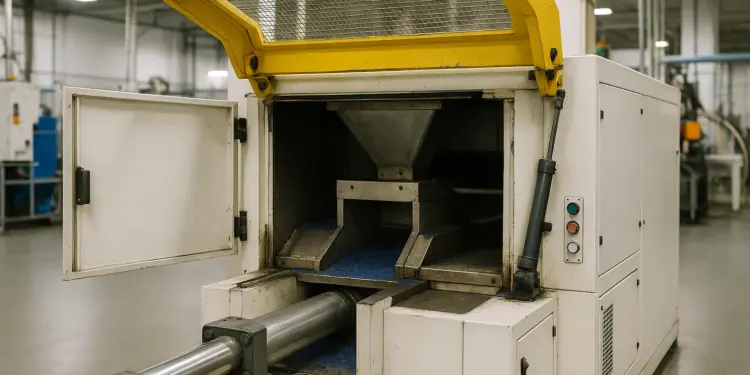
The most common failure in a written procedure is that it lists the electrical breaker and nothing else.
| Energy source | Typical examples | How to isolate | How to prove or release |
|---|---|---|---|
| Electrical | Motors, heaters, control circuits, batteries, UPS, capacitor banks | Open the main isolator or breaker and lock it off; lock plugs where fitted | Attempt start at every control point; for electrical work, test with a voltage indicator proved before and after (HSG85) |
| Mechanical | Flywheels, rotating drums, conveyor belts, blades, springs | Isolate the drive, then block or pin moving parts | Wait for rotation to stop completely and confirm visually |
| Hydraulic | Presses, injection moulders, lifting tables, balers | Stop the pump, lock the isolating valve, lock the pump supply | Bleed to zero at the gauge; support any raised part on a mechanical prop, never on the hydraulics |
| Pneumatic | Cylinders, air knives, clamps, actuators | Lock the air supply valve; use a lockable dump valve that vents downstream | Confirm zero on the gauge; cycle actuators to release air trapped behind check valves |
| Thermal | Ovens, steam lines, extruder barrels, hot oil systems | Isolate the heat source and lock the steam or fuel valve | Allow cooling to a measured safe temperature |
| Chemical | Process pipelines, CIP systems, gas supplies | Double block and bleed, spade or blank the line, lock the valves (HSG253 sets out the standards) | Drain, vent and purge; test atmosphere where entry is involved |
| Gravity | Raised platens, hoppers, counterweights, vertical conveyors, tipping bodies | Lower to the rest position where possible; otherwise fit a rated mechanical prop or pin | Confirm the load is on the prop before entering beneath it |
| Stored energy | Capacitors, accumulators, tensioned springs, pressurised vessels, wound conveyors | Isolate the source, then discharge, bleed or relax the stored element | Measure zero volts, zero bar, spring at rest; record on the certificate |
An isolation is only as good as its weakest energy source: a locked breaker does nothing about a platen held up by a leaking hydraulic valve.
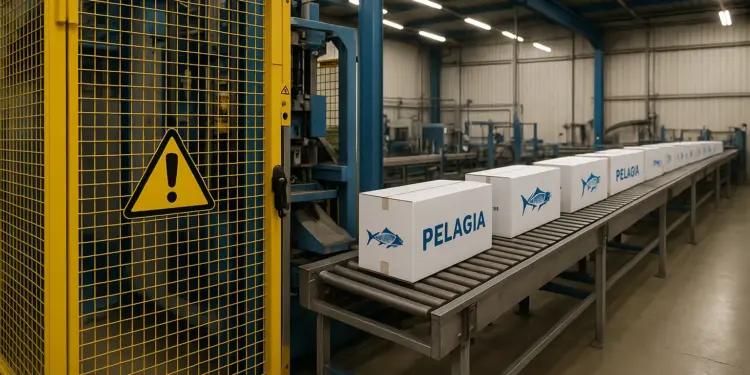
When several people work on one machine, or a machine has a dozen isolation points, personal padlocks on every device become unmanageable. The answer is group lockout.
Group lockout gives you one place to count locks against people, which is exactly what fails in most restart incidents. Keep the lock box at the machine.
Rule of thumb: LOTO always; a permit for hot work, confined space entry, pressurised or hazardous process systems, contractors on live plant, or isolations shared across teams. The permit does not replace the lock; it should list every lock applied. For confined spaces see our guide to safe entry under the Confined Spaces Regulations 1997.
Contractors do not know your plant. Induct them on the site procedure, show them the isolation points for the equipment they will touch, and require personal locks alongside your departmental lock. Never let a contractor rely on an operator saying “it’s off”. See managing contractors under CDM 2015.
A task that runs past the end of a shift is a classic restart trap. The outgoing worker must not remove their lock until the incoming worker has applied theirs, or a departmental lock bridges the gap under the supervisor’s control. Record the handover on the isolation certificate.
Interlocked guards satisfy PUWER regulation 11 during normal operation. But an interlock is a control circuit function, not an isolation: it can be defeated with a spare actuator, bypassed for fault finding and never reinstated, it does nothing about hydraulic, pneumatic or gravitational energy, and anyone closing the guard resets it. Use interlocks only for the minor routine tasks the machine’s risk assessment specifically allows behind them. For anything that places a body part where a restart would injure it, isolate and lock.
Retrofitting lockable isolators or plug lockouts to older machines is cheap; tag only isolation should trigger a purchase order, not a permanent workaround. At the other extreme, robot cells, PLC controlled lines and timed equipment can start without anyone pressing a button, so proving must include waiting through the cycle.

On 24 March 2023 an employee of Stonegrave Aggregates Limited, part of the Ashcourt Group, was cleaning a waste picking line at Aycliffe Quarry in Aycliffe Village, County Durham. A senior supervisor restarted the machinery, having mistaken the worker for a colleague who was wearing similar clothing. The employee was trapped and suffered a fractured shoulder, torn ligaments and a broken finger.
HSE’s investigation found that the company failed to ensure an isolation procedure was correctly implemented while employees were cleaning machinery. The company pleaded guilty to breaching section 2(1) of the Health and Safety at Work etc. Act 1974 and was fined £270,000 with £15,637 in costs at Teesside Crown Court in October 2025. HSE noted that a 2015 incident at the same site, in which one worker died and others were seriously injured, had also involved isolation failures. The inspector said incidents like this can and should be prevented by following robust lock off procedures, and that effective monitoring, auditing and review of isolation systems is essential to demonstrate that they are working.
Cleaning is maintenance for isolation purposes, and “I thought it was someone else” only becomes possible when a restart depends on human recognition rather than on a padlock that the worker alone can remove.
Use this table for a quarterly walk round and score each line yes, partly or no, with evidence.
| Area | Check | Evidence to look for |
|---|---|---|
| Procedure | Is there a current site isolation procedure covering all energy types, group lockout, lock removal and contractors? | Controlled document, review date, sign off |
| Machine instructions | Does every machine with more than one energy source have a specific isolation instruction with photographs of the isolation points? | Laminated sheet at the machine matching the plant as it is today |
| Hardware | Are all isolation devices lockable, labelled and accessible, and are locks, hasps, tags and lock boxes available where work happens? | PUWER regulation 19 walk round; stock check of LOTO stations |
| Personal locks | Does each authorised person hold uniquely keyed locks, and is there a register of lock numbers against names? | Lock register; no shared or master keyed isolation locks |
| Proving | Is try out or test for dead performed and recorded every time, with proving units used for electrical tests? | Completed isolation certificates; calibrated test instruments |
| Competence | Are authorised persons trained, assessed and refreshed, and are new starters and contractors inducted before touching plant? | Training matrix; induction records; observed practice |
| Lock removal | Is there a documented forced removal procedure and has every instance been recorded and reviewed? | Removal log; no unexplained cut locks |
| Behaviour | During unannounced observation, are stopped machines locked before anyone reaches in, including for short blockages? | Observation notes; near miss reports involving isolation |
See also our summary of 10 workplace safety failures, and for what to do when an isolation incident does occur, our complete guide to reporting safety incidents.

The words are not, but the substance is. PUWER 1998 regulations 19 and 22, the Electricity at Work Regulations 1989 regulations 12 and 13, and section 2 of the Health and Safety at Work etc. Act 1974 together require secure isolation from every energy source, precautions against re energising and a safe system of work. A padlocked, proved isolation is how those duties are met.
Only where the device physically cannot accept a lock, and then with extra measures such as removing a fuse or plug and keeping it with the worker. If your isolators cannot be locked, fit ones that can.
Only the person who applied it. Forced removal in their absence is permitted only under a written procedure authorised by a named senior manager, after confirming the person is clear and inspecting the machine, and must be recorded and reviewed as a near miss.
No. An interlock is a legitimate control for the specific minor tasks the risk assessment allows behind it, but it does not disconnect the supply, does not deal with stored or gravitational energy, and can be reset by anyone. If a restart would injure the person, lock off.
Follow HSG85: after isolating and locking, prove a suitable voltage indicator on a proving unit, test between all conductors and to earth, then prove the indicator again. A non contact voltage pen is not adequate.
Anyone who may reach into a machine, including operators clearing blockages and cleaners, must be either trained and authorised to isolate or trained to stop and call someone who is. Everyone else needs to know what a lock and tag mean and that they must never be touched.
This guide is general information for Great Britain and is not legal advice. Check the current HSE guidance before acting on a specific case.
About the author: Jade Anderson specialises in turning regulations into practical steps for supervisors and safety leads.

Copyright © 2026 UK Safety News