














Story Highlights
– Apprentice fell 11 feet through fragile roof.
– Tristan G Murless Limited failed to plan safety measures.
– Ellis and Partners failed to provide requested documents.
– Both companies fined for health and safety breaches.
– Poor planning highlighted as cause of similar incidents.
Full Story
Two construction companies have faced legal consequences following an incident where an apprentice suffered serious injuries after falling from a height while working on CCTV installation in Weymouth. The incident occurred on 13 July 2022, involving a then 20-year-old electrical apprentice employed by Tristan G Murless Limited at a commercial site located on Lynch Lane.
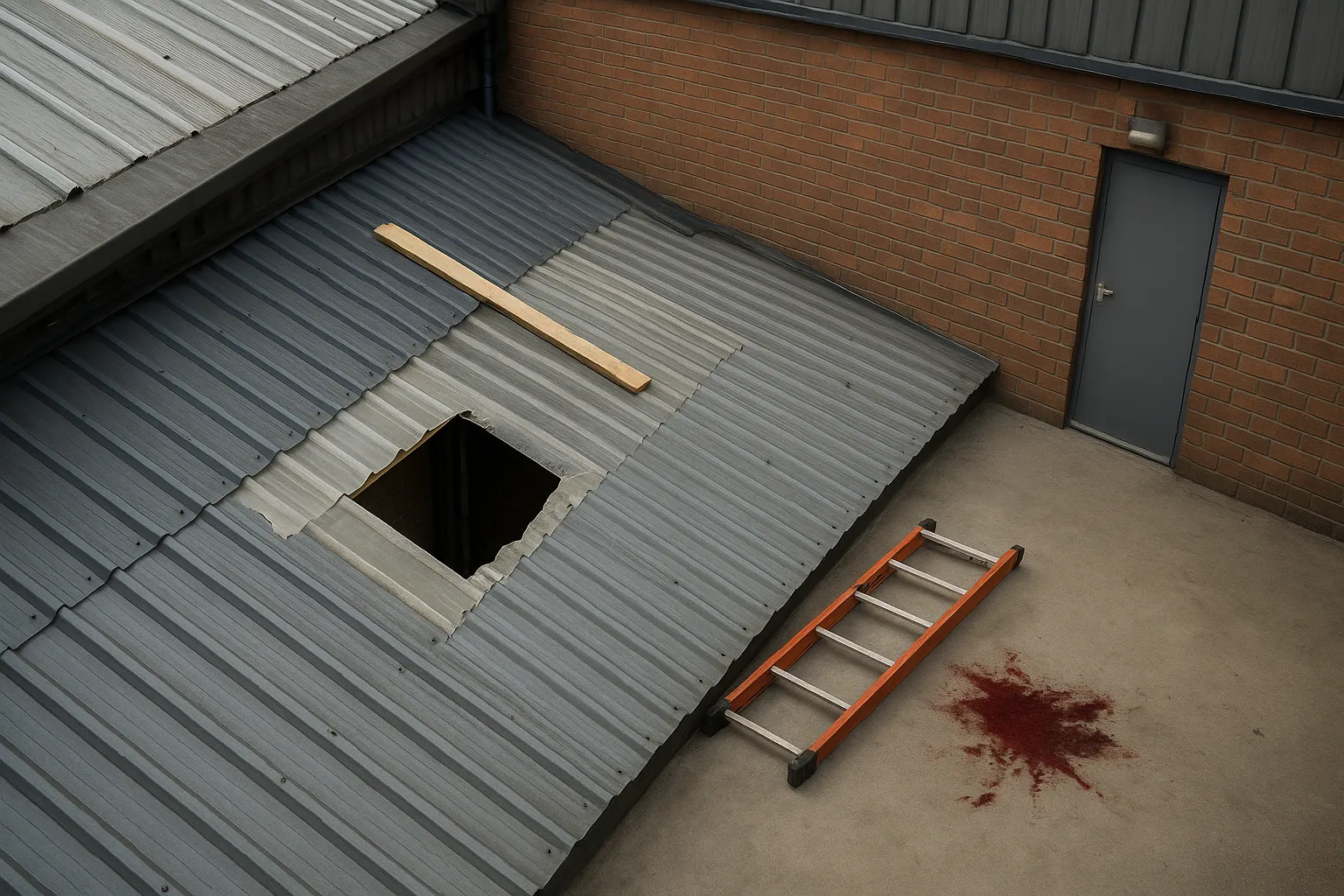
The apprentice was engaged in the installation of electrical equipment, specifically laying cables and conduit around the perimeter of a warehouse when the accident transpired. At the time, he was utilising an improvised crawling board, which provided inadequate support. The apprentice fell approximately 11 feet through a fragile section of the roof, landing on the concrete floor below. Upon the arrival of emergency services, he had lost consciousness and reported an inability to feel his body. The fall resulted in significant back injuries, including muscular tissue damage that necessitated physiotherapy, forcing the young worker to temporarily lose the ability to walk.
Following the fall, the Health and Safety Executive (HSE) undertook an investigation into the circumstances surrounding the incident. Their findings revealed that Tristan G Murless Limited did not adhere to essential health, safety, and welfare protocols required to ensure a safe working environment for its employees. The company failed to adequately plan the work and provide suitable equipment to mitigate the risks associated with working on the fragile roof.
Working at height ranks as one of the major contributors to workplace injuries and fatalities. The HSE emphasises that there are specific guidelines that employers must follow when appointing tasks that involve heights. Employers are obligated to ensure that such work is properly planned, adequately supervised, and conducted safely. Important considerations in these plans must include the appropriate selection of work equipment.
In situations where falls from heights could occur, employers are responsible for taking thorough and sufficient measures to prevent such incidents. The HSE specifically notes that working on fragile roofs should be avoided whenever possible. If such work cannot be avoided, employers must implement essential safety measures such as edge protection, appropriate roofing materials, and staging or scaffolding, alongside personal fall protection measures when required.
In addition to Tristan G Murless Limited, a second company, Ellis and Partners (Bournemouth) Limited, was also penalised. This arose from their non-compliance with a HSE request for documents necessary for the criminal investigation into the incident. Inspector Rebecca Gittoes, a representative from the HSE, issued the request under section 20 of the Health and Safety at Work etc. Act 1974, which mandates compliance from companies in these circumstances.
At a hearing held at Bristol Magistrates Court on 28 November 2025, Tristan G Murless Limited pleaded guilty to violating Regulation 2(1) of the Health and Safety at Work etc. Act 1974 and was subsequently fined £16,000, alongside additional costs amounting to £4,168. Ellis and Partners (Bournemouth) Limited faced similar scrutiny when they pleaded guilty to breaching Regulations 20(2)(k) of the same act, resulting in a fine of £6,000 and costs of £1,200.
After the proceedings, HSE inspector Rebecca Gittoes commented on the severity of the issue surrounding workplace safety during height-related tasks. She pointed out that each year, a substantial number of serious and fatal incidents occur due to inadequate planning for work at height. “In this case, a young man at the start of his career was failed by his employer,” Gittoes remarked. She stressed that if Tristan G Murless Limited had conducted a thorough risk assessment, provided appropriate work equipment, and implemented a safe working system, the accident could have been entirely avoided.
Furthermore, Gittoes underlined the importance of compliance within the industry, stating, “The case brought against Ellis and Partners (Bournemouth) Limited should underscore to everyone that the HSE and the courts take a failure to comply with section 20 very seriously.” She affirmed that the regulatory body would not hesitate to pursue companies that fail to cooperate, especially in the event of document requests for investigations.
This case highlights ongoing concerns about safety regulations in construction and similar industries, particularly regarding work at height. The HSE plays a crucial role as the national regulator for workplace health and safety in Britain, committed to ensuring safe working conditions across various sectors. Their investigations and enforcement actions serve to protect workers and to hold employers accountable for lapses in safety measures that can lead to preventable accidents and injuries.
For more information about workplace safety regulations, the HSE has resources available that detail legislation applicable to this case and other safety practices to ensure a safe working environment. The HSE does not set penalties or sanctions but follows court guidelines in cases of health and safety offenses, ensuring that justice is served in accordance with legal standards.
Our Thoughts
The incident involving the apprentice falling through a fragile roof highlights significant failures in health and safety management by both Tristan G Murless Limited and Ellis and Partners (Bournemouth) Limited. To avoid such occurrences, proper planning, risk assessments, and the provision of suitable equipment are critical. Specifically, Regulation 2(1) of the Health and Safety at Work etc. Act 1974 requires employers to ensure the health, safety, and welfare of employees; had appropriate safety measures been implemented, including the use of stable working platforms or personal fall protection systems, this incident could have been prevented.
Furthermore, Ellis and Partners’ failure to produce requested documents violated Regulation 20(2)(k) of the same act, underscoring the importance of cooperation during investigations.
Key safety lessons from this case include the necessity of thorough risk assessments when working at height and the imperative of utilizing safe work practices in environments with fragile structures. Enhanced training and awareness of the risks associated with working at height, alongside adherence to HSE guidelines, could mitigate similar incidents in the future.