














Noise & Vibration at Work: Practical Controls (2005 Regulations)
Last updated: 7 September 2026
Author: Jade Anderson, Senior Reporter, UK-Safety.News
Reading time: about 13 minutes
What this guide covers
- Why noise and vibration matter
- The Control of Noise at Work Regulations 2005
- The Control of Vibration at Work Regulations 2005
- Step by step: assessing exposure
- Typical tool vibration magnitudes and trigger times
- The control hierarchy in practice
- Health surveillance
- RIDDOR and record keeping
- Case study: Stonewater Limited
- Common mistakes
- Special cases
- Frequently asked questions
- Further resources

Why noise and vibration matter
Noise induced hearing loss and hand arm vibration syndrome (HAVS) build up over years, the early symptoms are easy to dismiss, and by the time a worker complains the damage cannot be undone. HSE puts it plainly: hearing loss caused by work is preventable, but once your hearing has gone it will not come back. The same is true of the nerve and blood vessel damage behind HAVS.
HSE’s latest statistics show that in 2024 there were 220 new cases of hand arm vibration syndrome, 105 of carpal tunnel syndrome and 50 of occupational deafness assessed for Industrial Injuries Disablement Benefit. Those figures capture only formally assessed cases; the Labour Force Survey estimate for work related hearing problems is around 15,000 workers averaged over 2022/23 to 2024/25.
HAVS prosecutions in 2025 and 2026 produced fines of £32,000, £40,000 and £140,000 against organisations that never measured exposure. This guide sets out what the regulations require, how to work out where you stand, and the controls that reduce exposure rather than merely document it.
The Control of Noise at Work Regulations 2005
The Noise Regulations came into force on 6 April 2006 (6 April 2008 for music and entertainment) and apply to every employer whose employees may be exposed to noise at work. HSE’s guidance is L108, Controlling noise at work (third edition, 2021).
The three thresholds
Daily or weekly personal exposure, in dB(A), captures average exposure over a working day or week. Peak sound pressure, in dB(C), captures single loud impacts such as a cartridge tool or a hammer blow on steel. Each threshold has both.
| Threshold | Daily or weekly exposure | Peak sound pressure | What the employer must do |
|---|---|---|---|
| Lower exposure action value | 80 dB(A) | 135 dB(C) | Assess the risk. Provide information, instruction and training. Make hearing protection available to anyone who asks. Provide health surveillance for anyone at particular risk. |
| Upper exposure action value | 85 dB(A) | 137 dB(C) | Reduce exposure by technical and organisational means on a written programme. Provide hearing protection and make sure it is worn. Mark hearing protection zones with signs. Provide health surveillance (hearing checks). |
| Exposure limit value | 87 dB(A) | 140 dB(C) | Must not be exceeded. Unlike the action values, the limit takes account of the reduction provided by hearing protection. If exceeded, reduce exposure below it immediately and find out why the controls failed. |
The action values are measured without hearing protection, so you cannot avoid the duty to reduce noise at source by handing out ear defenders. And the gap between 85 and 87 dB(A) is larger than it looks, because every 3 dB roughly doubles the sound energy.
Hearing protection zones
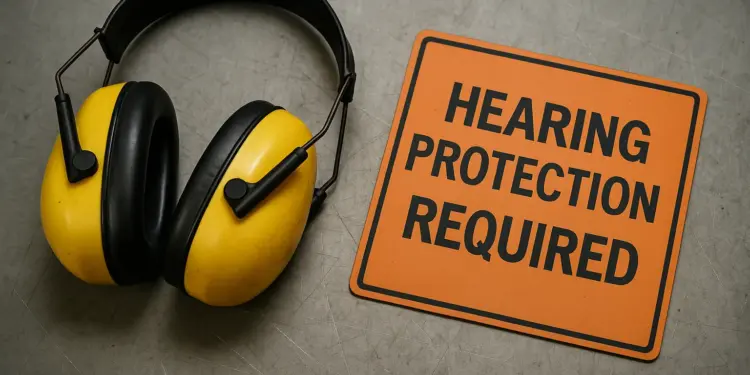
Wherever exposure is likely to reach the upper action value, the area must be designated a hearing protection zone, marked with the mandatory sign, and nobody should enter without protection. Keep zones as small as the noise allows; zoning a whole workshop for one loud machine encourages people to take protection off.
Choosing protection
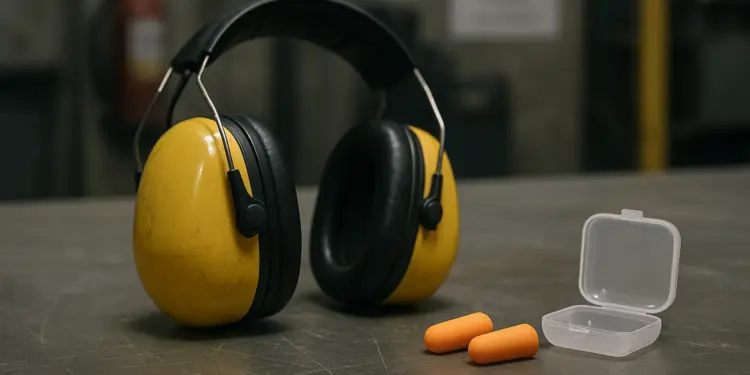
Match the protector to the noise. HSE’s guide is that 85 to 90 dB calls for a single number rating (SNR) of 20 or less, 90 to 95 dB for 20 to 30, and 95 to 100 dB for 25 to 35. Protectors that bring the level at the ear below 70 dB should be avoided: over protection hides speech and warning sounds and is the main reason people remove them.
The Control of Vibration at Work Regulations 2005
The Vibration Regulations came into force on 6 July 2005 and cover two hazards. Hand arm vibration (HAV) comes through the hands from tools or workpieces and causes HAVS and carpal tunnel syndrome. Whole body vibration (WBV) comes through the seat or feet of people driving mobile machinery and is a risk factor for back pain. HSE’s guidance is L140, Hand-arm vibration (second edition, 2019) and L141, Whole-body vibration (2005).
Exposure is expressed as an eight hour energy equivalent, written A(8), in metres per second squared (m/s2).
| Hazard | Exposure action value (EAV) | Exposure limit value (ELV) | Duties |
|---|---|---|---|
| Hand arm vibration | 2.5 m/s2 A(8) (100 exposure points) | 5 m/s2 A(8) (400 exposure points) | At or above the EAV: technical and organisational measures to reduce exposure, information and training, and health surveillance. The ELV must not be exceeded. |
| Whole body vibration | 0.5 m/s2 A(8) | 1.15 m/s2 A(8) | At or above the EAV: technical and organisational measures to reduce exposure, information and training. The ELV must not be exceeded. |
Below the EAV the general duty to reduce risk so far as is reasonably practicable still applies.
The HSE points system
Because A(8) arithmetic is awkward on site, HSE publishes a ready reckoner and a free exposure calculator that convert vibration magnitude and time into exposure points. One hundred points a day is the EAV, 400 is the ELV. Points from different tools add together, and they rise with the square of the magnitude, so doubling the vibration quadruples the points per hour.
Step by step: assessing exposure
Both regulations require a recorded risk assessment by a competent person, reviewed when anything changes. The steps below serve for either hazard.
- Decide whether you have a problem. For noise, use HSE’s INDG362 screening questions: is the noise intrusive (as loud as a busy road or a vacuum cleaner), do people have to raise their voices to talk at about two metres apart, do they use noisy powered tools for more than half an hour a day, are there impact noises? For HAV, HSE’s rule of thumb is that hammer action tools used for more than about 15 minutes a day, or rotary tools for more than about an hour, are likely to exceed the EAV.
- List the sources and the people, including maintenance staff, apprentices and agency workers.
- Get the emission data. Manufacturers must declare noise and vibration values in the handbook. Treat them as a starting point: real use is often higher, particularly with worn consumables. HSE’s table of typical field values (below) is a better planning guide.
- Measure the time that matters. For HAV this is trigger time, the minutes the hands are on a running tool, not the length of the task. Watch the job with a stopwatch; HSE notes that trigger time may be only a few minutes in several hours of work.
- Calculate exposure. Use HSE’s noise and vibration exposure calculators or the points system. Where the result is close to a threshold or the work is variable, commission measurement by a competent person.
- Record the outcome and write the action plan. For each role, state whether exposure is below the lower action value, between the action values, or above the upper action value or ELV, and what will be done. Every action needs an owner and a date.
- Review when tools, processes or shift patterns change, and when health surveillance shows a problem.
Typical tool vibration magnitudes and trigger times
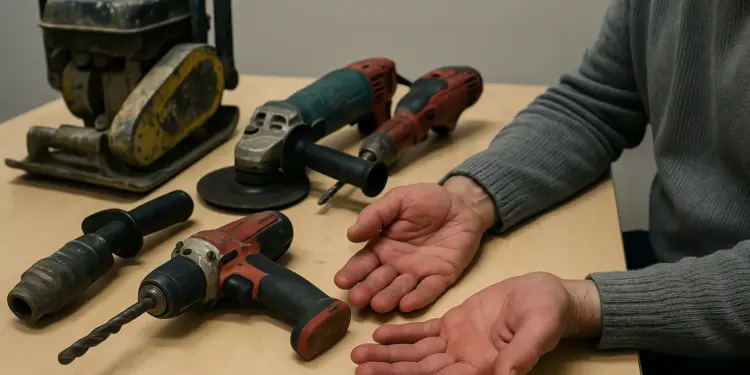
The magnitudes below come from HSE’s table of typical field values on its vibration risk assessment pages. The times to reach 100 points (EAV) and 400 points (ELV) are calculated from the A(8) definition using the top of each range, rounded, so they are cautious planning figures for a worn or hard driven tool.
| Tool | Typical magnitude (m/s2) | Trigger time to EAV | Trigger time to ELV |
|---|---|---|---|
| Chipping hammer (weld chipping) | 20 to 32 | About 3 minutes | About 12 minutes |
| Pneumatic hammer | 10 to 29 | About 4 minutes | About 14 minutes |
| Needle scaler (not vibration reduced) | 12 to 26 | About 4 minutes | About 18 minutes |
| Demolition or rotary hammer | 10 to 21 | About 7 minutes | About 27 minutes |
| Breaker | 7 to 18 | About 9 minutes | About 37 minutes |
| Hedge trimmer | 3 to 14 | About 15 minutes | About 1 hour |
| Angle grinder (100 to 180 mm) | 3 to 10 | 30 minutes | 2 hours |
| Hand guided mower | 3 to 8 | About 47 minutes | About 3 hours |
| Chainsaw | 3 to 7 | About 1 hour | About 4 hours |
| Strimmer or brushcutter (strimmer head) | 2 to 7 | About 1 hour | About 4 hours |
| Standard drill | 2 to 5 | 2 hours | 8 hours |
Percussive tools reach the action value in minutes. Grounds maintenance tools sit lower on the scale but are used for far longer, which is why recent HAVS prosecutions involve mowers and strimmers as often as breakers.
The control hierarchy in practice
Both regulations require exposure to be reduced at source before personal protection is considered. HSE is explicit that the most effective way of controlling noise is by technical and organisational means that protect workers at source.
| Level | Noise examples | Vibration examples |
|---|---|---|
| Eliminate | Have steel cut to size off site; plastic instead of steel bins under a chute. | Redesign castings so no fettling is needed; machine mounted breaker instead of hand breakers. |
| Substitute | Electric rather than pneumatic tools; pressing instead of hammering. | Knock off guns instead of grinders in foundries; diamond core drilling instead of percussive drilling; resin anchors instead of hammered fixings. |
| Engineer | Damping on panels and chutes; silencers on exhausts; acoustic enclosures around compressors; screens and absorbent ceilings; anti vibration mounts under machines. | Buy low vibration tools; auto balancers on grinders; jigs and suspension arms that take the tool’s weight so grip force falls. |
| Maintain | Worn bearings, loose guards and blocked silencers raise noise. Put noise checks into planned maintenance. | Blunt chisels, worn discs and unbalanced spindles raise vibration and lengthen the job. Sharpen, replace, service to schedule. |
| Organise | Move noisy work away from other people; schedule it for quiet shifts; provide acoustic refuges; limit time in noisy areas. | Set trigger time limits per tool and per person from the points system; rotate jobs so points spread across the team; keep hands warm and dry. |
| Protect | Hearing protection selected for the noise level, fitted, maintained and worn. Never the only control above the upper action value. | There is no vibration equivalent of the ear defender. HSE states that anti vibration gloves are not particularly effective; warm gloves help circulation but do not reduce the dose. |
Job rotation costs nothing, but HSE’s foundry guidance calls it an inefficient way of reducing risk that should be considered only once other controls have been used. It spreads the same dose across more people, and without real trigger time data it can leave individuals well over the limit.
Buy quiet, buy low vibration
The cheapest control is made at purchase. Require declared noise and vibration values on every quote and give users a say. A grinder at 4 m/s2 instead of 10 m/s2 gives six times the trigger time before the EAV.
Health surveillance
Health surveillance is not a substitute for control. Its purpose is to catch damage early enough to stop it getting worse and to check that controls are working.
Noise: hearing checks
Required for anyone likely to be regularly exposed above the upper exposure action value, and for anyone at risk for another reason. It consists of audiometry in controlled conditions under the supervision of an occupational health professional. HSE recommends annual tests for the first two years of exposure, then every three years, with more frequent testing if a problem is found. Employers keep a fitness for work record, act on the provider’s recommendations, and use anonymised group results to judge whether the noise programme is working.
Hand arm vibration: the tiered scheme
Required for anyone likely to be regularly exposed above the EAV, for anyone occasionally exposed above it where the assessment indicates a risk, and for anyone with a HAVS diagnosis. L140 describes a tiered approach. The first step is a questionnaire based interview, on starting vibration work and then annually, designed to pick up early symptoms such as tingling, numbness or blanching of the fingers. Anyone reporting symptoms moves to a more detailed assessment by a suitably qualified nurse or doctor, and where HAVS or carpal tunnel syndrome is suspected a doctor makes the formal diagnosis. The scheme must include access to an occupational physician.
Doctors stage confirmed HAVS using the Stockholm Workshop scale, which grades the vascular (blanching) and sensorineural (numbness and dexterity) components separately. A diagnosis is reportable under RIDDOR, and a worker at the higher stages will usually need to leave vibration work altogether, so the earlier the scheme catches symptoms the more options everyone has. For WBV there is no equivalent test; a simple system for drivers to report back pain, with a review of their vehicle and exposure when they do, is the practical answer.
RIDDOR and record keeping
The Reporting of Injuries, Diseases and Dangerous Occurrences Regulations 2013 list hand arm vibration syndrome and carpal tunnel syndrome as reportable occupational diseases where a doctor has diagnosed the condition in writing and the worker’s job involves regular use of percussive or vibrating hand held tools, or holding materials that vibrate while being processed. Report as soon as the written diagnosis is received. Occupational deafness was removed from the list when RIDDOR was revised in 2013, so noise induced hearing loss found through health surveillance is no longer reportable, although it must still be acted on and recorded.
Keep the risk assessment and action plan, exposure calculations, maintenance and purchasing records, training records, and health surveillance records. Because claims for both conditions arrive decades after exposure, agree a long retention period with your occupational health provider. For the reporting process see Understanding RIDDOR and our guide to reporting safety incidents.
Case study: Stonewater Limited
Stonewater Limited, a social housing provider, was fined £140,000 at Birmingham Magistrates’ Court on 14 April 2025 after two estate assistants developed HAVS. Between 2018 and 2023 the men used mowers, leaf blowers, strimmers and hedge cutters for most of their working day; one estimated 90% of it. HSE found no vibration risk assessment, no record of exposure, no training and no health surveillance. The company pleaded guilty to breaching section 2(1) of the Health and Safety at Work etc. Act 1974 and paid £3,742 in costs.
Three lessons stand out. The tools were ordinary grounds maintenance equipment, not heavy plant. The failure was the absence of any assessment, so nobody knew the men were over the limit for years. And the case surfaced through symptoms rather than through any system, which is what health surveillance exists to prevent. Nottingham City Homes Limited (£32,000, November 2025) and Chesterfield Royal Hospital NHS Foundation Trust (£40,000, January 2026) were prosecuted on the same basis.
Common mistakes
- Treating hearing protection as the control. Above the upper action value the law requires a programme to reduce noise at source. Ear defenders cover what remains.
- Measuring task time instead of trigger time. A four hour job may involve forty minutes of trigger time or three and a half hours. Only a stopwatch tells you which.
- Job rotation with no data. Rotation without per person trigger time records is a paper control.
- Buying anti vibration gloves and calling it done. HSE does not regard them as effective vibration control.
- Forgetting peak values. A workplace averaging 78 dB(A) can still exceed 135 dB(C) from a single cartridge tool or hammer impact.
Special cases
Construction sites
Multiple employers and changing tools make assessment harder, not optional. The principal contractor should set site rules for hearing protection zones and tool selection; each employer remains responsible for its own workers’ exposure. See managing contractors under CDM 2015.
Mobile plant and whole body vibration
Forklift trucks, dumpers, tractors and earth moving machinery expose drivers to WBV on poor surfaces. The effective controls are unglamorous: repair the yard surface, fit and adjust suspension seats, set speed limits, and train drivers to avoid jolts. See our workplace transport guide.
Exceptional days
Regulation 6(5) of the Vibration Regulations allows the ELV to be exceeded on a particular day only where exposure is usually below the EAV but occasionally varies markedly, the weekly average stays below the ELV, and the affected workers get increased health surveillance. It is a narrow exception, not a planning tool.
Frequently asked questions
Do I need a noise survey with meters, or can I estimate?
The regulations require a suitable and sufficient assessment, not necessarily a measurement. For clear cut cases, published data and HSE’s calculators may be enough. Where exposure is close to an action value or the work is variable, commission measurements from someone competent in noise assessment.
Can a worker refuse hearing protection between 80 and 85 dB(A)?
Yes. Between the lower and upper action values the employer must make protection available on request but cannot insist on it. Above the upper action value, and inside any hearing protection zone, use is compulsory and employees have a duty to wear it as instructed.
What does 100 exposure points actually mean?
It is HSE’s shorthand for the hand arm vibration exposure action value of 2.5 m/s2 A(8). Points from each tool add together across the day. At 100 points controls, training and health surveillance are required; at 400 points, the exposure limit value of 5 m/s2 A(8), work must stop until exposure is brought down.
A worker has been diagnosed with HAVS. What must I do?
Report it under RIDDOR as soon as you receive the written diagnosis. Follow the occupational health advice on whether the person can continue with reduced exposure or must stop vibration work. Review the risk assessment for everyone doing the same job, because one diagnosis usually means others are at risk.
Is occupational deafness reportable under RIDDOR?
No. Occupational deafness was removed from the reportable disease list in the 2013 revision of RIDDOR. Hand arm vibration syndrome and carpal tunnel syndrome from vibrating tools remain reportable. Hearing loss found through health surveillance should still be acted on and recorded.
Further resources
- HSE: Noise at work, what employers must do
- HSE: Health surveillance for noise
- HSE: L108 Controlling noise at work
- HSE: Vibration risk assessment and typical tool values
- HSE: Protecting workers from hand arm vibration
- HSE: L140 Hand-arm vibration
- HSE: RIDDOR reportable occupational diseases
- UK-Safety.News: Understanding RIDDOR
- UK-Safety.News: 10 Workplace Safety Failures
- UK-Safety.News: Useful Documents
This guide is general information for Great Britain and is not legal advice. Check the current HSE guidance before acting on a specific case.
About the author: Jade Anderson specialises in turning regulations into practical steps for supervisors and safety leads.