














Story Highlight
– Building on King Street collapsed on March 24, 2026.
– Three people injured, two hospitalized; no life-threatening injuries.
– Concerns about structure raised 23 days before collapse.
– Building owner’s response included hiring a structural engineer.
– Investigations ongoing by council and Health and Safety Executive.
Full Story
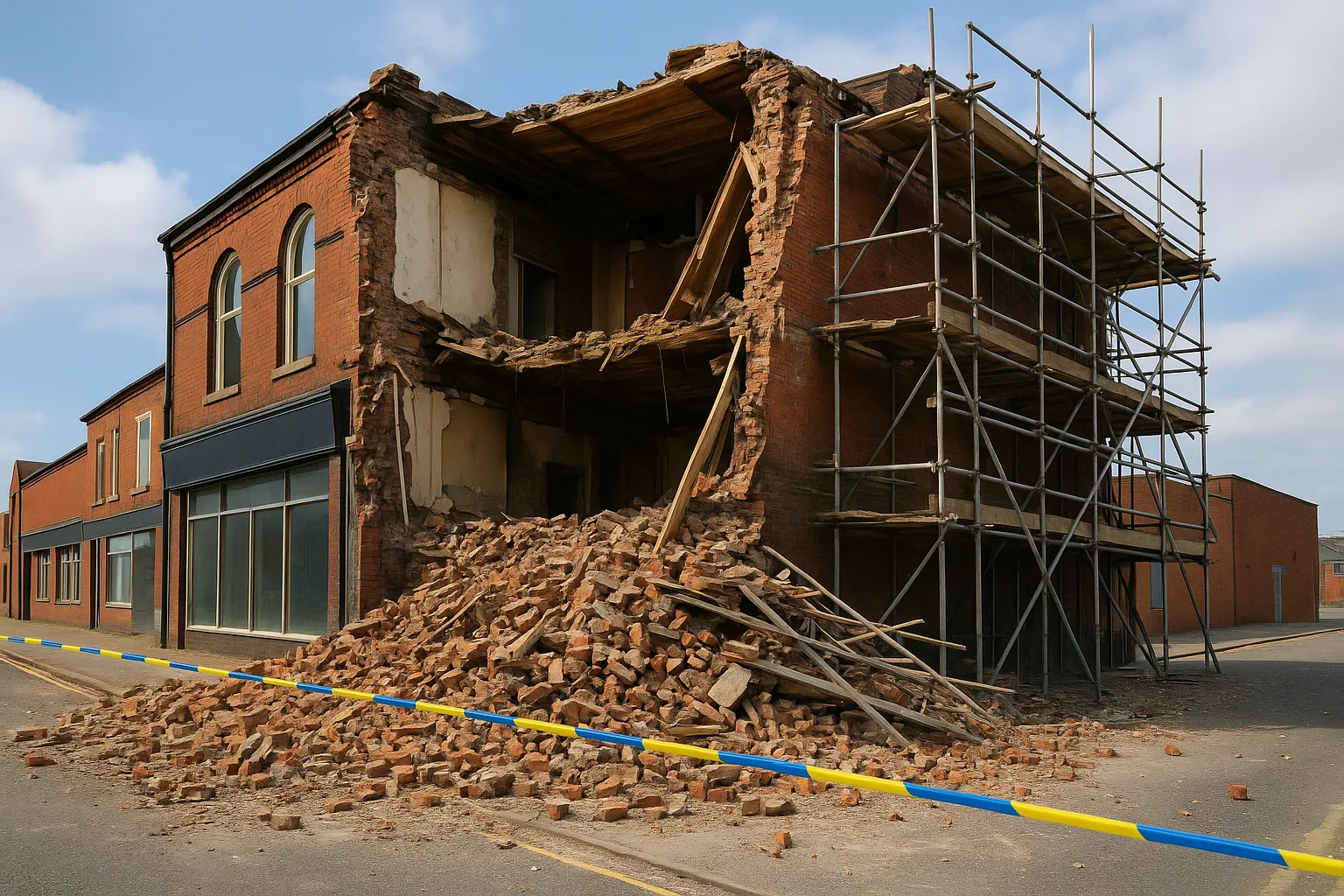
Authorities are investigating a building collapse in Oldham that left three individuals injured, occurring on the afternoon of March 24. Eyewitness accounts describe chaos as bricks and debris fell from a structure on King Street shortly after midday. People at a nearby bus stop and pedestrians were required to evacuate the area to avoid the falling rubble.
Prior to the incident, concerns regarding the stability of the building had already been raised. Reports reveal that a council surveyor had assessed the structure more than three weeks earlier, stating it posed “no immediate danger” of collapse. However, those who observed the building in the lead-up to the disaster noted visible signs of instability. One local worker, who contacted emergency services on March 1 after noticing cracks in the brickwork, remarked, “It was visually obvious the building wasn’t stable. If one brick was gone, the whole building would’ve gone like a domino effect.”
The building, situated at 31 King Street, housed a mini market and private rental properties. It is co-owned by Kamran Ghafoor, a local councillor, alongside his business partner, Sameer Zulqurnain, under the company KKS Investors. Following the emergency call on March 1, Greater Manchester Fire and Rescue Service, along with a building surveyor from the local council, arrived to evaluate the structure, resulting in the area being secured for safety inspections. While it was noted that large cracks had developed, the initial assessment led the surveyor to conclude that the structure did not require immediate action, and the responsibility for repair remained with the property owners.
After the assessment, KKS Investors reportedly engaged a structural engineer on March 2, the day after emergency services responded. A notice for building repairs was submitted to the council on March 9, and scaffolding was erected around the site in anticipation of forthcoming works. However, little progress was made between the initial assessment and the collapse, with no repairs having commenced prior to the incident.
In the aftermath of the collapse, two of the three injured individuals were treated for non-life-threatening injuries in hospital. The rapid descent of the building was shocking to local residents and passersby, many of whom described the scene as surreal. The collapse not only endangered those inside but also affected adjacent properties, prompting the evacuation of approximately 40 individuals who required temporary accommodations. Nearby residences were also left in a precarious state following the incident.
Councillor Ghafoor maintained that his company had adhered to all safety regulations and protocols throughout his ownership of the property. He expressed relief that no one sustained serious harm and asserted that they acted responsibly in managing the situation. “At no point would residents or tenants who have been allowed to occupy the building had any authority – including the council, building control, or fire services – deemed the property to pose a safety risk,” Ghafoor stated.
The day following the collapse, Ghafoor publicly commented on the events, wishing well to those affected and reiterating that “we did everything in our power, everything legally, and followed the right protocols.” He emphasized that preliminary works were in progress to address structural concerns related to the side wall of the property, which had been vulnerable since a nearby building was demolished years earlier. According to Ghafoor, appropriate measures were being taken to ensure the building’s safety, with experienced contractors engaged in the repairs.
As investigations continue, Oldham Council is collaborating with the Health and Safety Executive (HSE) to conduct a thorough inquiry into the circumstances surrounding the collapse. A spokesperson from the council said, “Right now, our focus is to support the people most affected by the collapse of the building. We are hopeful that the majority of the residents who live in the properties outside of the safety cordon will return home as soon as possible.”
The council has assured the public that all necessary steps will be taken to ascertain the causes of the collapse and to prevent similar events in the future. HSE inspectors, alongside local authorities, remain on-site conducting assessments and investigations with the aim of understanding how the incident occurred.
Residents in Oldham have expressed a mix of concerns and inquiries regarding the incident, eager to learn about the safety of nearby structures and the broader implications for housing in the area. As the investigation unfolds, local authorities are committed to maintaining transparent communication with the community to alleviate any fears and ensure safety measures are acted upon effectively.
The events of March 24 serve as a stark reminder of the critical importance of building safety and the need for rigorous oversight in structural maintenance. Ensuring the safety of residents and pedestrians alike will be the focus of ongoing assessments in the wake of this incident, as the community continues to grapple with the impact of the collapse.
Our Thoughts
The collapse of the building on King Street highlights significant lapses in safety management and compliance with UK health and safety legislation, particularly the Health and Safety at Work Act 1974. Key lessons include the need for timely and effective intervention when structural concerns are raised. Although a surveyor deemed the building not to be at “immediate danger,” escalating the situation could have prompted more stringent measures.
The fire service’s handover of the case to the owners did not ensure ongoing safety monitoring, indicating a gap in accountability. Regular inspections and proactive risk assessment by building owners, aligned with the Management of Health and Safety at Work Regulations 1999, should have been enforced to prevent such incidents.
Moreover, the landlord’s failure to act promptly on identified risks—despite having engaged a structural engineer—suggests insufficient urgency in addressing potentially life-threatening issues. Immediate remedial actions should have been taken as a priority, as outlined in the Construction (Design and Management) Regulations 2015, which emphasize safety considerations throughout construction projects.
To prevent similar incidents, stricter enforcement of regulations and continuous monitoring of building conditions should be instituted, alongside a clear protocol for responding to early warnings from concerned parties.