















Story Highlight
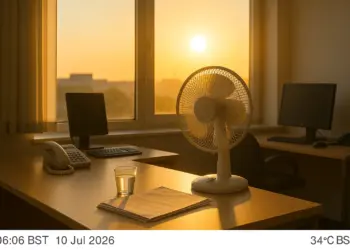
– Unions demand maximum workplace temperature regulations for safety.
– CCC recommends air conditioning in public services and homes.
– Climate change could cost UK £260 billion by 2050.
– Workplace heat limits endorsed to protect worker performance.
– Nature-based solutions essential for climate resilience and adaptation.
Full Story
Trade unions are advocating for the establishment of stringent maximum temperature limits in workplaces, urging government action to address the growing threats posed by climate change in the UK. The independent advisory body, the Climate Change Committee (CCC), has issued a wide-ranging set of recommendations aimed at shielding the public from the increased frequency and severity of extreme weather events such as heatwaves, floods, and droughts.
Among the CCC’s proposals are mandatory regulations to cap maximum temperatures for workers, alongside the installation of air conditioning systems in vital public facilities such as hospitals and care homes, as well as in the homes of at-risk individuals. Baroness Brown, a prominent figure at the CCC, has suggested that the timing of the academic year may need adjustment to prevent students from enduring challenging national examinations in the midst of oppressive summer heat when they might be fatigued and unable to perform at their best.
The committee has made it clear that the escalating impact of climate change may jeopardise various facets of British life—from individual health and economic stability to the National Health Service, recreational activities, and visits to heritage sites. In 2025, the UK recorded its hottest year to date, characterised by a succession of four significant heatwaves occurring between mid-June and mid-August.
Financially, the CCC estimates that the annual investment required to adapt the UK to climate change could reach approximately £11 billion by 2050. However, the current cost of climate-related issues is already substantial, with damages from flooding, agricultural losses, increased mortality rates, drops in productivity, and disruptions in transportation and healthcare systems tallying up to £60 billion annually. Projections indicate that, without decisive intervention, these costs could escalate to £260 billion a year by the middle of the century.
To address these challenges, the CCC underlines the necessity of incorporating air conditioning solutions as a critical component of public health strategies during heatwaves. This initiative should not only apply to public buildings but also to private residences. Advisors have called for government-led public information campaigns to educate the public on preventative measures they can take to stay cool, such as blocking sunlight with blinds and curtains during the day.
With the average global temperature having already risen by 1.4 degrees Celsius due to human activities, such as fossil fuel combustion, projections suggest a potential increase to 2 degrees Celsius above pre-industrial levels by 2050, with worst-case scenarios indicating a rise of up to 4 degrees Celsius by the year 2100. The CCC warns that if adaptive measures are not implemented, the risk of heatwaves reaching 40 degrees Celsius could lead to as many as 10,000 additional deaths annually by mid-century.
Further compounding the risks, heavy rainfall could become more intense by 2050, with sea levels anticipated to rise between 20 to 45 centimetres and peak river flows potentially nearly doubling, increasing the likelihood of flooding events. Simultaneously, a shift towards more frequent droughts could result in water shortages of over five billion litres per day, particularly if current patterns persist. Baroness Brown has emphasised the urgency of the situation, stating, “We are facing a potential world where in 2050 you could turn the tap on and nothing would come out.”
To mitigate these risks, the CCC outlines several key measures:
1. Implementing temperature caps in workplaces to ensure employee safety and encourage the adoption of cooling technologies by businesses.
2. Mandating the installation of cooling systems in hospitals and care facilities by 2035, gradually extending to educational institutions by 2050.
3. Providing support for vulnerable demographics to access cooling options, such as heat pumps that serve both heating and cooling functions.
4. Increasing funding for flood defence initiatives, aiming for an annual investment of £1.6 to £2.2 billion across the UK to support both natural and engineered defence mechanisms.
5. Ensuring that new housing developments are constructed outside flood-prone areas and designed with water efficiency in mind, while also regulating the placement of data centres to prevent exacerbation of drought conditions.
In light of these recommendations, trade unions have rallied behind the call for workplace temperature regulations. The GMB union has criticised the existing disparity concerning temperature standards, which currently stipulate minimum thresholds but fail to address maximum limits. Lib Whitfield, a senior organiser at GMB, expressed the union’s long-standing advocacy for a ceiling of 25 degrees Celsius. “While warm weather can be enjoyable in leisure contexts, it poses substantial dangers in a work environment,” she remarked.
Jon Richards, assistant general secretary at Unison, reiterated the necessity of maximum temperature guidelines, asserting that fluctuating temperature conditions under climate change expose workers to greater health risks and lower productivity. He stated, “Any decent employer would want their staff to be at their best to do their job efficiently,” highlighting the need for workplaces to be conducive to employee welfare.
Rob Miguel, national health and safety officer at Unite, acknowledged the CCC’s findings as a positive step yet cautioned that the regulations must accommodate specific work conditions, especially for roles requiring personal protective equipment. He insisted that robust enforcement mechanisms must accompany any new laws to safeguard workers against non-compliance.
In the realm of safety and well-being, Ruth Wilkinson, head of policy at the Institution of Occupational Safety and Health, emphasised the importance of incorporating climate-related dangers into health and safety legislation, promoting a culture of awareness and preparedness among the workforce.
Highlighting the cultural implications of climate change, Hilary McGrady, director-general of the National Trust, articulated the pressing need to consider the impact on heritage sites, noting challenges such as wildfires and agricultural hardships. McGrady stated, “What’s at stake is even greater than the sum of its parts – it’s our shared inheritance,” underscoring the interconnectedness of environmental wellbeing and historical preservation.
The variety of perspectives gathered reflects a consensus on the urgent need for comprehensive strategies to combat the adverse effects of climate change. Sam Alvis from the think tank IPPR warned that the challenges posed by extreme weather not only hinder government efforts to improve living conditions but also provide fertile ground for populist movements to exploit public discontent. He advocated for integrated long-term strategies that blend emissions reduction with immediate adaptive responses, ensuring community resilience against climate-related disruptions.
Amidst this multidimensional crisis, Eleanor Johnston, climate change manager at The Wildlife Trusts, pointed to nature-based solutions as a pathway to combat climate challenges effectively. She argued for a shift towards sustainable agricultural practices, robust ecosystems that mitigate flooding, and green urban landscapes to enhance comfort and health within local communities.
The urgent call for climate adaptation reflects the broader societal acknowledgment of the need to safeguard future generations. As leaders and experts rally for action, the commitment to tackling climate change emerges as a shared responsibility, essential for preserving the environment and public health for years to come.
Our Thoughts
The article highlights significant concerns regarding the lack of workplace temperature regulations in the UK, especially in light of increasing heatwaves due to climate change. To avoid potential health risks and maintain productivity, key measures could include the establishment of mandatory maximum temperature limits for workplaces as recommended by the Climate Change Committee (CCC). The absence of such regulations breaches health and safety obligations outlined in the Health and Safety at Work Act 1974 and related guidelines, which mandate a safe working environment.
Lessons learned from this situation emphasize the importance of proactive measures, such as the installation of cooling systems in workplaces, hospitals, and schools, to protect workers and vulnerable populations against extreme heat. Moreover, public information campaigns could equip individuals with strategies to mitigate heat exposure.
To prevent similar incidents, it is essential for the government to enforce regulations that consider climate-related risks within existing health and safety frameworks. Engaging employers to ensure compliance and fostering a culture where workers can report hazards without fear of retribution could also enhance workplace safety. Ultimately, legislative reform regarding workplace temperature standards is critical as climate impacts escalate.