
















Story Highlight
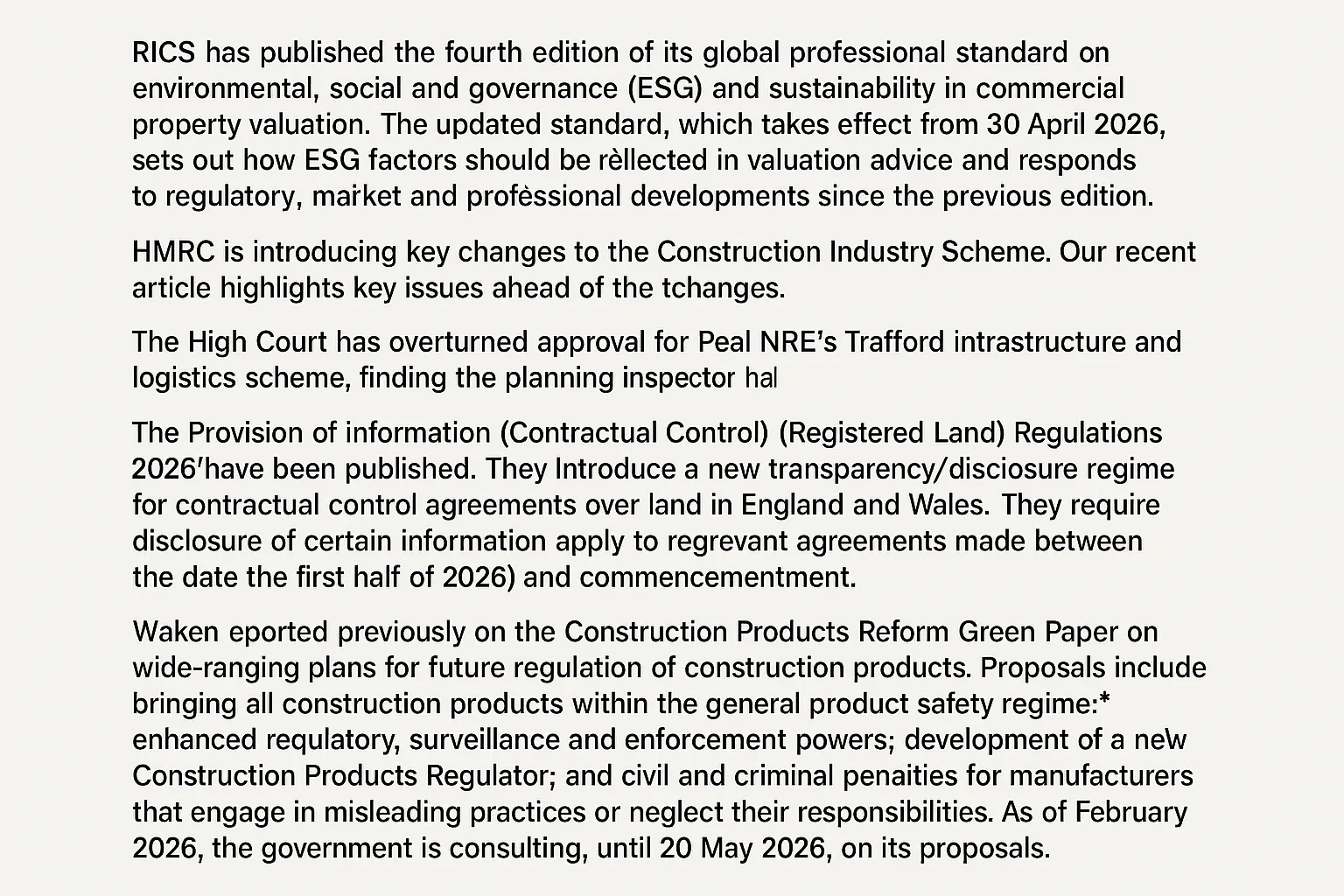
– RICS updates ESG standard for property valuation effective April 2026.
– Government plans 60-day payment cap in construction sector.
– HMRC to implement changes to Construction Industry Scheme.
– High Court overturns approval for Trafford logistics scheme.
– New land control regulations effective April 2027 introduced.
Full Story
The Royal Institution of Chartered Surveyors (RICS) has announced the release of the fourth edition of its global professional standards focused on environmental, social, and governance (ESG) criteria, as well as sustainability in the valuation of commercial properties. Effective from 30 April 2026, this revision delineates the incorporation of ESG elements within valuation practices and takes into account the myriad of changes and developments in regulatory, market, and professional contexts since the last publication.
In a related issue, the UK government has issued its findings in response to a consultation regarding late payments, titled “Time to Pay Up.” As per the government’s proposals, new legislation will be introduced to establish a cap on payment periods at 60 days, along with measures aimed at enhancing transparency. Additionally, it seeks to prohibit the practice of withholding retention payments particularly within the construction sector.
The tax authorities in the UK, HM Revenue and Customs (HMRC), are also making significant adjustments to the Construction Industry Scheme (CIS). Anticipated changes could have a notable impact on many stakeholders within the construction industry. An article addressing these upcoming modifications has been published, covering essential aspects that industry professionals should be aware of.
In the realm of planning and development, the High Court has recently rescinded the approval of Peel NRE’s Trafford infrastructure and logistics scheme. The court found that the planning inspector had not sufficiently considered the necessity for the developer to contribute financially to new road infrastructure in the area, raising questions about the adequacy of the previous planning decision.
New regulations concerning the provision of information about contractual control agreements over land in England and Wales have been introduced. The Provision of Information (Contractual Control) (Registered Land) Regulations 2026 will enforce a regime aimed at increasing transparency. This will necessitate the disclosure of specific information regarding contractual control rights to HM Land Registry and the public through a newly established database. These regulations are set to come into effect on 6 April 2027, although disclosure requirements will apply retroactively to agreements made between the expected enactment date in the first half of 2026 and the regulations’ commencement.
The Construction Products Reform Green Paper, discussed previously, outlines substantial reforms regarding the regulation of construction products in the UK. Among its proposals, the document advocates for all construction products to fall under the overarching product safety framework. Additionally, the government is considering enhancing regulatory powers, surveillance capabilities, and enforcement measures. A single Construction Products Regulator is proposed, along with both civil and criminal penalties for manufacturers that engage in fraudulent or negligent practices concerning product safety. The consultation period for these proposals is open until 20 May 2026, following its launch in February 2026.
In corporate news, Walker Morris has been nominated for the prestigious title of Real Estate Team of the Year at The Lawyer Awards 2026. This recognition reflects the firm’s exceptional performance in its Real Estate practice over the past year. The winners will be announced during a ceremony slated for June 2026 in London, highlighting the best in legal practice across multiple sectors.
All these developments underscore the dynamic nature of the UK’s construction and property sectors, with a heightened emphasis on regulatory compliance, payment practices, and the incorporation of sustainability factors into professional norms. As industries adapt to these evolving regulations and standards, it remains crucial for professionals within these fields to stay informed and proactive in their practices. With deadlines approaching for various legislative changes, stakeholders are encouraged to engage with the forthcoming regulations and assess their implications for operations moving forward.
Our Thoughts
The article does not present any incidents or accidents that require analysis related to health and safety. Therefore, there are no relevant safety lessons, regulatory breaches, or prevention strategies to discuss in this context.