













Story Highlight
– House collapse on King Street injures five, displaces over 40.
– Landlord denies responsibility, cites weather as a factor.
– Conflicting reports regarding maintenance actions and timeline.
– Previous tenant complaints lead to scrutiny of landlord.
– Health and Safety Executive investigation ongoing into collapse.
Full Story
Concerns over the responsibility for the collapse of a house on King Street, Oldham, continue to mount as residents, officials, and the property’s landlord present differing accounts of the events leading up to the disaster.
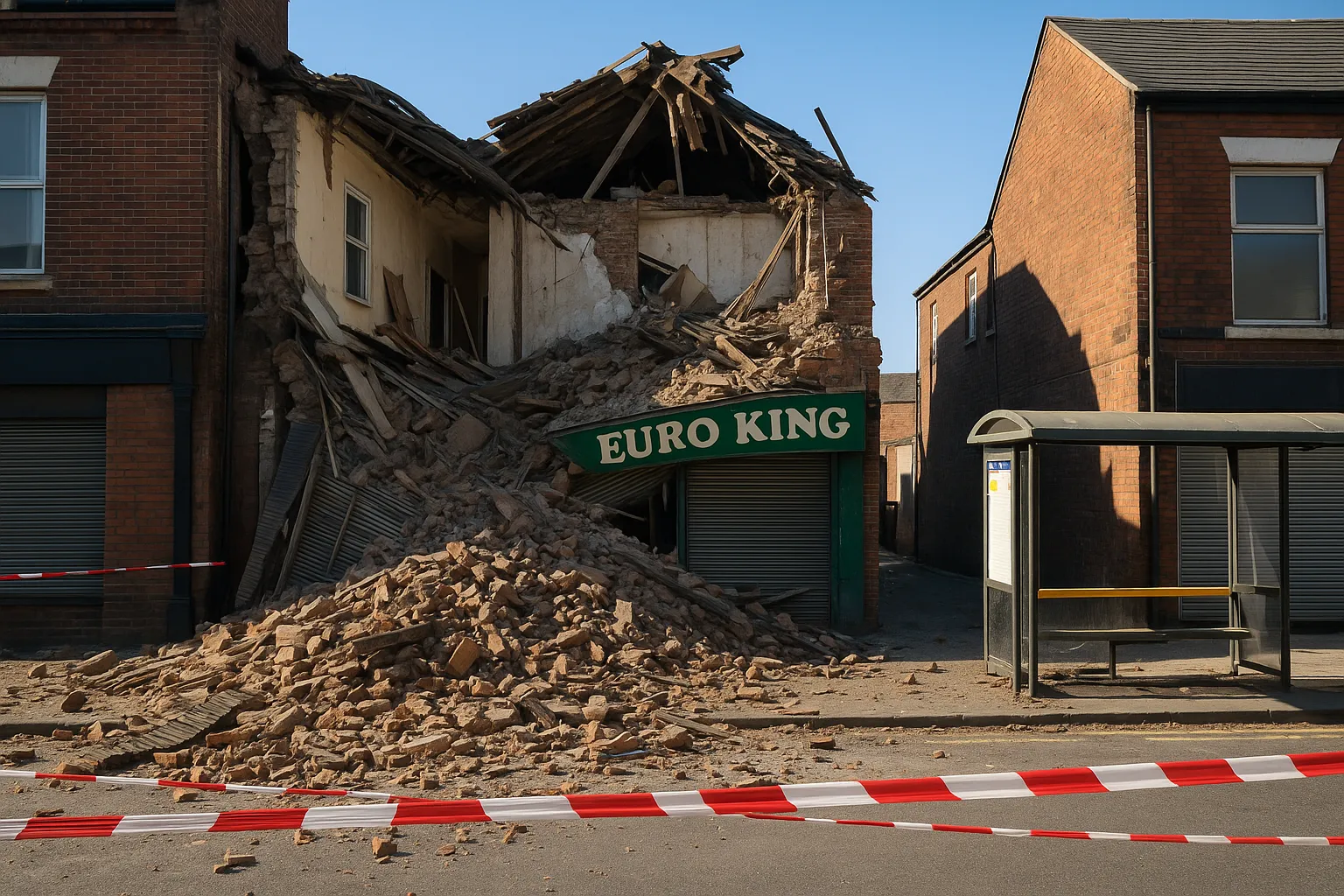
Locals had been expressing alarm over the building’s deteriorating state, with increasing cracks noted in its walls. Their worries became a stark reality when, following a dramatic failure of the structure, debris from the building tumbled onto the street below. The catastrophe not only resulted in a cascade of bricks and tiles but also damaged the Euro King Mini Market situated underneath and obliterated a nearby bus stop.
Footage caught by dashcams recorded the chaos, depicting vehicles veering to avoid the falling wreckage, while pedestrians and passengers who had recently disembarked from a bus fled the impending danger. The aftermath was grim; five individuals sustained injuries, over 40 people were displaced due to a gas leak, and the street remains sealed off as demolition efforts continue.
Three weeks after the event, critical issues linger: what triggered the collapse? Was it preventable? And who bears the blame?
Typically, UK property law places the onus on landlords to maintain their buildings. In this case, KKS Investors, a company run by local entrepreneurs Sameer Zulqurnain and Kamran Ghafoor—who also serves as an independent councillor—owns the property. Councillor Ghafoor has denied any mismanagement, asserting that KKS Investors has abided by all pertinent rules, regulations, and safety protocols. He has cited adverse weather conditions leading up to the collapse as a potential contributing factor.
However, numerous accusations of “rogue” and “slum” landlords have dogged Ghafoor for years, claims he vehemently disputes. His significant investments in houses of multiple occupation have led to him being dubbed the “HMO King” in local social media circles. He maintained that he does not interact with tenants on a daily basis and rejected the negative characterisation of his wider housing portfolio.
Despite his substantial real estate holdings—reportedly worth over £2 million—there have been multiple complaints regarding his properties throughout the years. Significantly, in May of last year, 24 vulnerable individuals—including eight children—were compelled to leave Ghafoor’s King Street housing due to severe maintenance issues. Emergency services were called when smoke was reported emanating from a light fixture.
At that time, Ghafoor’s firm was receiving a £7,000 monthly rate from the council to provide temporary accommodation to families facing homelessness—a contract totalling around £380,000 over five years. Since then, the council has attempted to avoid placing vulnerable individuals in Ghafoor’s housing, although they admitted the complexities of the system render complete assurance impractical.
Previously, in 2013, Ghafoor was fined for renting a flat deemed “unfit for human habitation,” having disregarded various notifications regarding serious maintenance failures. Such infractions are relatively rare among landlords; of the estimated 2.8 million private landlords in the UK, only a minuscule fraction faced penalties.
Nonetheless, Ghafoor has alleged that he is being unfairly targeted politically, particularly by the local council. These accusations have intensified following the house collapse, as he took offence at council and Health and Safety Executive inquiries directed at his tenants. His tactical approach to council affairs has led to heated exchanges and controversies, and there is speculation that political rivalry could influence the scrutiny he faces.
Nevertheless, inconsistencies regarding Ghafoor’s ownership and the condition of his properties raise eyebrows. During an investigation into his real estate, conditions varied widely; while some properties appeared well-maintained, others exhibited alarming signs of neglect.
One tenant allowed access to her home, revealing extensive water damage from leaks that had plagued her for months. Although Ghafoor claimed his team operates responsibly and addresses tenant concerns, the tenant expressed frustration over incomplete repairs.
Ghafoor’s response emphasized that the descriptor “crack” referred to superficial damage rather than any inherent structural failing. He maintained that external issues are attended to responsibly and that maintenance contracts involving third parties are being reviewed following reported concerns.
After the King Street incident, tenants affected by the collapse were temporarily housed in an emergency facility on Chamber Road. Reports indicated that this site lacked essential amenities such as heating and running water and had only bare mattresses for furniture. The council highlighted the rapid relocation of individuals facing health crises, although Ghafoor claimed the location was merely undergoing routine updates.
The ongoing investigation by the Health and Safety Executive aims to clarify the exact circumstances surrounding the King Street collapse. It is worth noting that the adjacent property was previously the scene of a similar incident, resulting from a prior owner’s violations of safety regulations.
KKS Investors obtained the property in 2019, but by 2023, concerns were raised regarding its structural integrity. A recent review of the building indicated visible deterioration leading up to the incident. After further investigation by local authorities, council inspectors deemed the property safe for occupancy, without immediate risk of collapse.
Ghafoor has suggested that any reinstatement of residence followed assurances from council officers, who were reportedly aware of ongoing requests for refurbishment. However, the council has indicated that critical work was not satisfactorily communicated, preventing necessary approvals.
Workers with scaffolding were observed at the site shortly before the collapse, and questions remain as to whether maintenance activities contributed to the structural failure. Some have pointed to the combination of scaffolding and severe weather as potential risks.
As the investigation unfolds, the pressure mounts on the individuals and entities involved. Those who inhabited the now-collapsed building grapple with the emotional and physical ramifications of the event. One resident, who was inside during the collapse, expressed feelings of trauma, conveying, “every time I try to sleep, it feels like a building is falling on top of me.”
While parties involved seek clarity and accountability, the effects of the collapse continue to impact residents profoundly. KKS Investors have voiced strong objections against the characterisation of their actions and insist they have acted with due diligence regarding tenant safety and welfare. The range of perspectives will likely complicate the investigation, which may take an extended period to conclude fully.
Our Thoughts
The King Street house collapse in Oldham raises significant safety concerns regarding landlord responsibilities and building maintenance under UK health and safety legislation. Key lessons include the necessity for timely structural assessments and repairs, particularly when signs of deterioration, such as wall cracks, are reported by residents. The landlord’s adherence to the Housing Act 2004, particularly regarding the duty to ensure properties are safe and habitable, appears to have been insufficient.
Evidence suggests that KKS Investors may have breached regulations by not acting on clear warnings about the building’s safety from the council. The Regulatory Reform (Fire Safety) Order 2005 also requires landlords to ensure that all aspects of property safety—structural integrity, in this case—are maintained to prevent hazards. Regular inspections and a proactive maintenance plan should have been implemented to mitigate risks.
To prevent similar incidents, it is vital to enhance enforcement of regulations governing landlord responsibilities, ensuring proper inspection protocols are followed, and fostering responsive communication between landlords and local authorities. Stricter penalties for neglect could help deter such oversights.