














Story Highlight
– Naked man jumps from Brooklyn Bridge, survives fall.
– Identified as 44-year-old Galymzhan Abaildayev.
– Hoisted Kazakhstan flag before jumping into East River.
– Faces multiple criminal charges; motives remain unclear.
– Incident raises concerns over public safety and security.
Full Story
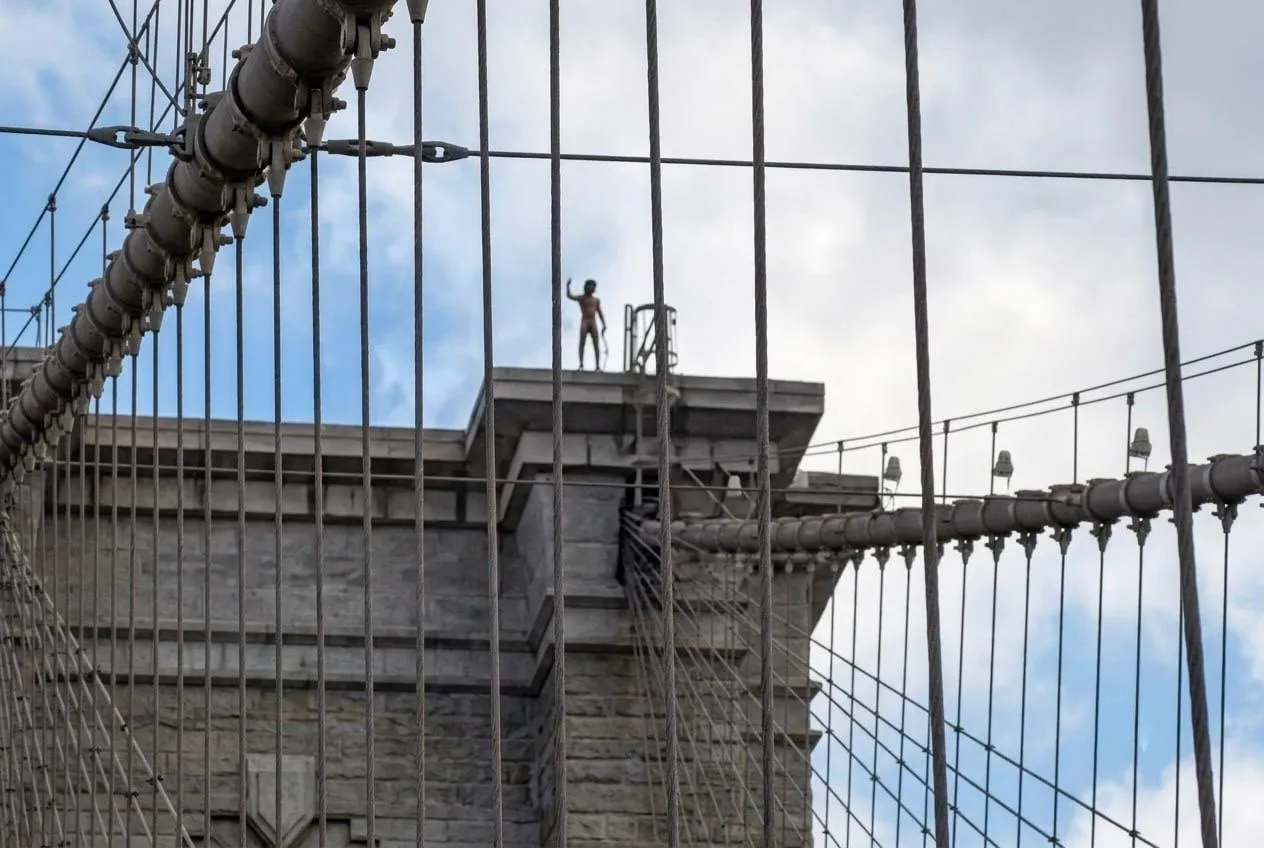
A dramatic incident unfolded on the iconic Brooklyn Bridge when a 44-year-old man, later named as Galymzhan Abaildayev, scaled one of its towering structures before making a harrowing leap into the East River. The sequence of events took place on a Sunday afternoon, leaving witnesses and social media viewers stunned. The man, who is now facing criminal charges, attracted attention not only for his daring act but also for unfurling a flag from Kazakhstan prior to his plunge. This puzzling act has sparked a flurry of speculation regarding his motivations, leading to broader discussions on mental health, public safety, and the security measures in place for such renowned landmarks.
Abaildayev, a resident of Brooklyn, was first spotted climbing the north tower of the bridge, which is located on the Manhattan side. He was observed carrying a backpack adorned with several flags, indicating a preparation far beyond a simple descent. Following an emergency call, members of a specialist unit from the New York Police Department (NYPD) were dispatched to the scene. However, before they could intervene, Abaildayev startled onlookers by discarding his clothing and executing the jump.
Witnesses captured the moment on their phones, with reports describing the scene as chaotic, as bystanders cried out in disbelief. Video footage reveals Abaildayev leaping off the tower, appearing to grasp a piece of fabric above him, reminiscent of a parachute. The height of his leap, estimated by local sources to be between 272 to 278 feet, accentuates the peril of both the jump and the circumstances leading to it.
Fortunately, members of a harbour rescue unit arrived at the scene swiftly and managed to retrieve Abaildayev from the water shortly after his plunge. He was transported to Bellevue Hospital where reports indicated that he was in stable condition, an unexpectedly fortunate outcome given the nature of his fall. Following this initial focus on his rescue and medical assessment, police later arrested Abaildayev after reviewing on-site footage and gathering witness statements. He is now facing multiple charges related to public order and safety violations.
The presence of the Kazakhstan flag during this incident has deepened the intrigue surrounding Abaildayev’s leap. Social media has erupted with commentary, with many users questioning whether this was meant as a protest, a plea for help, or an audacious attempt to gain viral fame. One Twitter user quipped, “Is he trying to star in the next Spider-Man?”—highlighting the bizarre nature of the event and the countless interpretations being explored online.
Security through public spaces, especially significant structures like the Brooklyn Bridge, is currently under scrutiny. The ease with which Abaildayev accessed the bridge’s towers has raised alarms about pedestrian safety and the potential for copycat incidents. Many commentators have voiced concerns regarding the adequacy of existing patrols and measures aimed at deterring individuals from climbing these monumental edifices.
This incident also mirrors discussions taking place in the UK regarding the responses of police and health services when individuals deliberately place themselves in harmful situations in high-visibility locations. The rapid dissemination of such events through social media means that local incidents can quickly gain an international audience, sparking wide-ranging dialogue about the intersections of personal crisis, public safety, and the role of mental health support systems.
Law enforcement agencies, mental health professionals, and local governments may need to reassess protocols in light of Abaildayev’s case. The challenge lies in finding a suitable balance that does not compromise public access while ensuring robust measures are in place to prevent individuals from embarking on dangerous acts that endanger themselves and others.
Public response to this incident has illuminated a keen interest in the underlying reasons individuals take such risks, especially within the context of urban environments where coping strategies and mental health resources can be critical. Discussions are emerging about the appropriateness of responses from emergency services, highlighting the necessity for collaboration among various sectors to safeguard individuals contemplating such extreme actions.
As authorities ponder the implications of Abaildayev’s leap, questions remain unanswered. What prompted this dramatic action? Could more be done to address mental health issues that manifest in high-risk behaviours? As the investigation continues and details come to light, the hope remains that such incidents will lead to enhanced dialogue and preventive measures aimed at reducing the frequency of dangerous actions on public infrastructure.
Our Thoughts
The incident involving Galymzhan Abaildayev on the Brooklyn Bridge highlights several safety lessons relevant to UK health and safety legislation. Key areas needing improvement include overall security measures for public infrastructure and mental health interventions.
To prevent similar incidents, authorities could implement stricter security measures such as barriers or surveillance systems to deter unauthorized access to bridge towers, aligning with the Health and Safety at Work Act 1974. This Act requires employers and duty holders to ensure the safety of individuals in public spaces, which includes effectively managing risks related to climbing or accessing tall structures.
Additionally, mental health support systems should be improved, particularly in areas with high foot traffic and tourist attractions. The Management of Health and Safety at Work Regulations 1999 requires employers to assess and manage risks, including psychological well-being.
There were breaches of public safety as evidenced by the ease of access to the bridge’s towers, which compromises both individual and public safety. Future preventative measures should incorporate thorough risk assessments and the adoption of appropriate control measures to protect not only individuals but also emergency responders.