












Story Highlight
– Glyncoch residents report shaking homes and damaged property.
– Residents demand pause on blasting due to safety concerns.
– Recent quarry incident caused flooding and forced evacuations.
– Heidelberg Materials UK defends quarry’s safety measures.
– Local MP seeks government review of quarry safety protocols.
Full Story
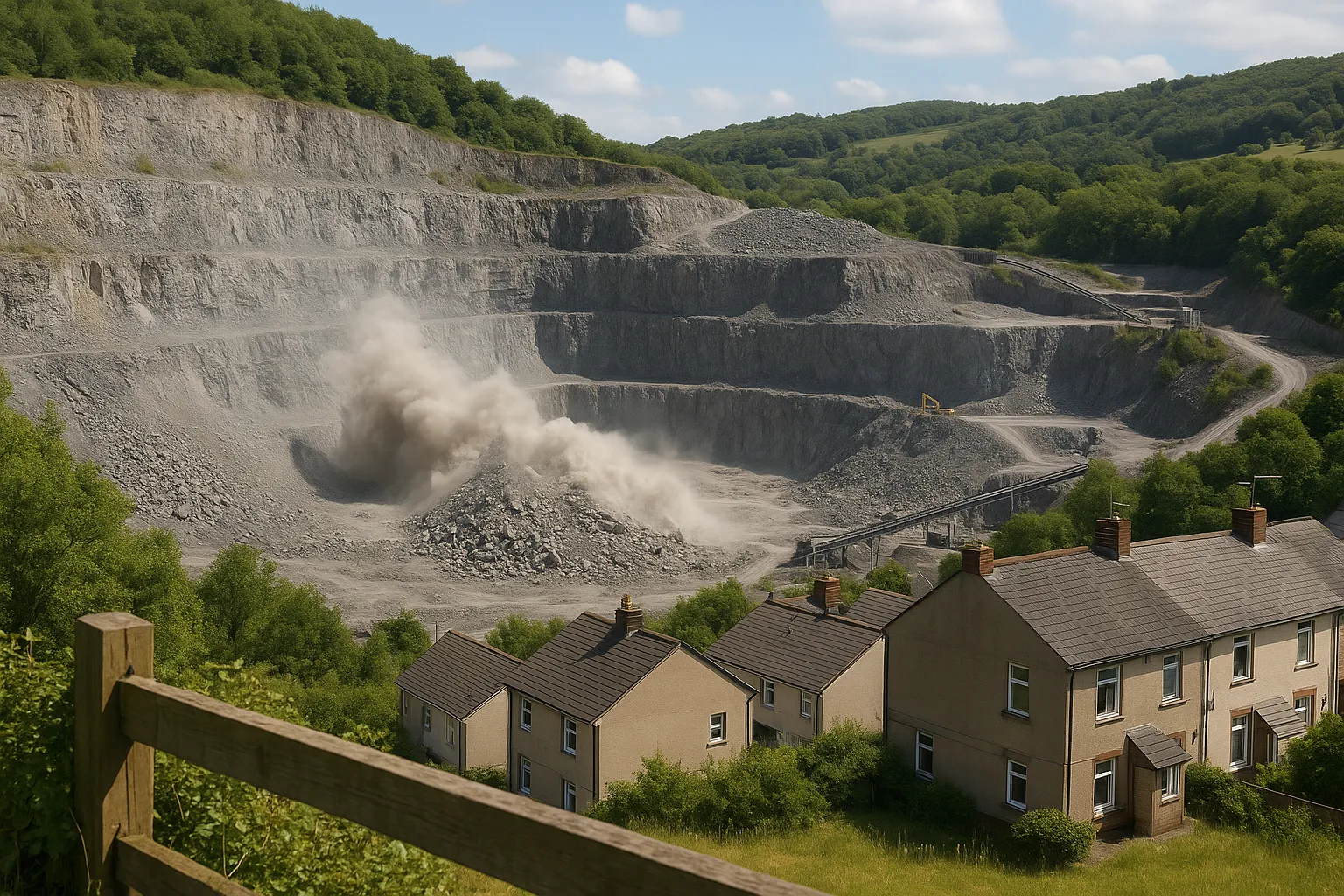
Residents of Glyncoch, located near Pontypridd in South Wales, have expressed deep concerns regarding the blasts at the nearby Craig yr Hesg quarry, which they say have been causing significant disturbances within their homes. The loud explosions not only shake their properties, but have also led to items falling from shelves and instilled fear in local children. In light of these events, the community is urging for a halt to the blasting activities driven by safety apprehensions.
This call for a pause comes on the heels of a serious incident at a different quarry located approximately six miles away, at Taff’s Well, which required residents to evacuate as a result of severe flooding triggered by quarry operations. There, an investigation by the Health and Safety Executive (HSE) determined that a planned blast released an unexpected volume of water from abandoned iron mines, resulting in damage to 15 homes.
Local residents in Glyncoch have voiced their frustrations and anger, particularly since permissions were granted for the quarry to expand its operations until 2047. Claire Allen, a lifelong Glyncoch resident, highlighted that the disturbances from blasting had intensified in recent years. “We shouldn’t have to be anxious waiting in our own homes just for someone to blast our mountain up,” Allen remarked, adding that many in the community have reported experiences of items being dislodged from their walls.
The impact on local children is particularly troubling for many families, as the noise and vibrations cause considerable distress. Allen elaborated, “The children are scared when it happens, and the dust is really thick. You could polish in the morning and then the dust comes back.” This issue of dust, which exacerbates respiratory conditions such as COPD and asthma, has become a major point of concern for local health. Allen remarked on the fright induced by the Taff’s Well flooding, stating, “Only once it needs to happen and now it has happened and we don’t need it to happen to another area.”
While the HSE has classified the flooding incident at Taff’s Well as an “isolated incident,” investigations regarding the implications and safety of quarry operations continue. Marius Klein, an area director for Heidelberg Materials UK, which manages the Craig yr Hesg site, defended their operations, stating, “We want to reassure local communities that each quarry’s geological profile is unique. Craig-yr-Hesg quarry has a very different geological profile from the quarry in Taff’s Well.” He emphasized the absence of significant bodies of water that could lead to similar flooding risks. Klein further stated that extensive assessments had been conducted to ensure the site was safe for operational expansion in line with regulatory requirements.
In stark contrast, concerned residents are pressing for immediate action from authorities. Chris Whiles, a prominent campaigner against the quarry expansion, voiced his distress, highlighting fears that a similar flooding incident could occur in Glyncoch. “There were properties with rushing water up to about five foot. That’s happened five, six miles from us due to a blast in a quarry,” he remarked. Whiles stressed that he wants to prevent his community from experiencing such frightful events, particularly for the sake of local children.
Alex Davies-Jones, the Member of Parliament for Pontypridd, has also reached out to the Welsh government, requesting assurances regarding safety measures at the Craig yr Hesg site. In her communication, she sought clarity on whether geological, hydrological, and flood-risk evaluations were current and whether the alarming incident at Taff’s Well would trigger an immediate reassessment of safety protocols at nearby quarries.
The Welsh government acknowledged receipt of Davies-Jones’s letter but noted that the regulation of existing mines and quarries falls under the purview of the UK government. Therefore, they refrained from making specific comments regarding the issue. Requests for commentary from the UK government have been made but as of now, responses are pending.
The local community’s situation underscores broader concerns regarding the management and oversight of quarrying activities near populated areas. Residents in Glyncoch are anxiously navigating the tension between operational needs and the potential hazards posed by quarry blasters, reflecting a growing discourse around the balance between industrial activity and community safety. The continuation of blasting activities is now at a crossroads as residents demand immediate government intervention, amidst fears that incidents like those that occurred at Taff’s Well could become a more common threat to their homes and wellbeing.
Our Thoughts
To reduce risks associated with quarry blasting, Heidelberg Materials UK could implement several measures. Key safety lessons include ensuring proper risk assessments, particularly focusing on geological and hydrological studies, to prevent flooding incidents similar to Taff’s Well. Regular monitoring of vibrations and dust levels should be conducted, complying with the Control of Noise at Work Regulations 2005 and the Health and Safety at Work Act 1974.
The company must also prioritize community engagement and transparency regarding blasting schedules to alleviate resident concerns, aligning with the requirements under the Management of Health and Safety at Work Regulations 1999.
Relevant regulations appear to have been breached regarding risk assessments and public safety communication. The recent incident underscores the importance of adhering to the Quarries Regulations 1999, which mandates safe operating procedures and risk management, particularly in proximity to populated areas.
To prevent similar incidents, the use of modern technologies for real-time monitoring and assessment of blasting impacts, along with revised operational protocols in alignment with the latest risk assessment practices, is essential.