
















Story Highlight
– Recent regulatory changes emphasize fire door specification importance.
– Complete doorsets are more reliable than individual components.
– Third-party certification ensures quality and compliance in doorsets.
– Installation accuracy is critical for fire doors’ effectiveness.
– Comprehensive documentation becomes essential for future maintenance.
Full Story
Recent fire safety regulations have prompted a reevaluation of the critical role that fire doors play in construction and safety protocols. With a focus on enhancing the standards for these essential safety features, various industry stakeholders are recognising the urgency of correctly specifying fire doors and doorsets in compliance with updated legislation and technical guidelines.
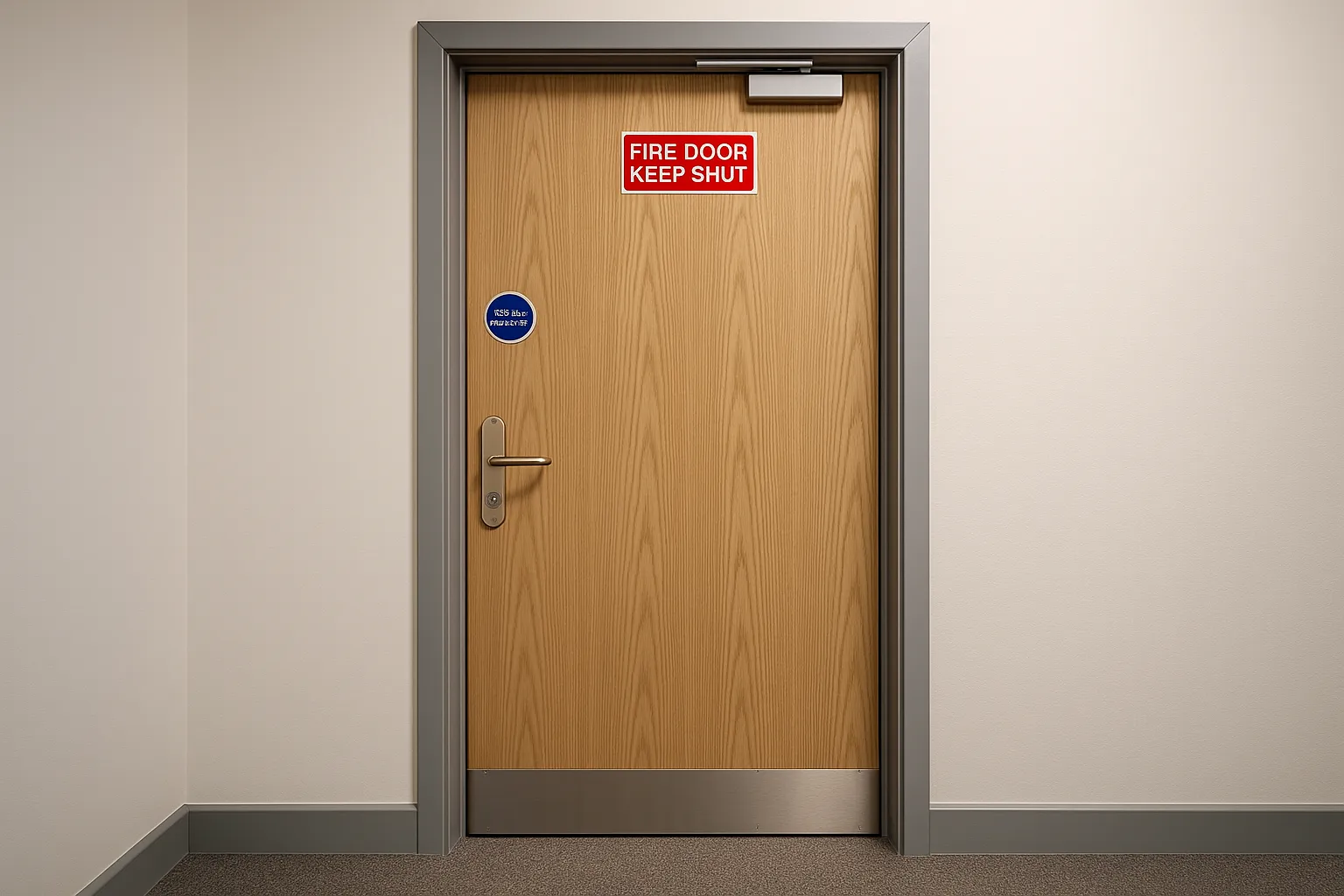
A comprehensive understanding of fire doors begins with their definition and function. Fire doors serve as integral components of passive fire protection systems in both residential and commercial structures. Featuring a fire-resistant core, typically made from solid timber, engineered timber, or mineral board, these doors are designed to withstand flames and smoke for a designated timeframe. This resistance is crucial in containing fires, thereby providing vital time for evacuation and emergency response teams. To ensure that fire doors remain closed, self-closing mechanisms are standard; in some instances, electronic hold-open devices that interact with fire alarm systems are also employed, releasing the door to close automatically during an alarm.
The distinction between what is commonly called a “door” and a “complete doorset” is crucial. A door, or door leaf, constitutes only the swinging panel, while a complete doorset includes the door leaf, frame, relevant hardware, and fittings. Complete doorsets are increasingly favoured over individually specified components due to the assurance they provide regarding compatibility and performance. A failure in just one component can negate the fire-resistant qualities critical for safety, highlighting the need for a holistic approach to fire door specification.
The impetus for these changes has largely stemmed from the heightened scrutiny following the Grenfell Tower fire in 2017. Since then, UK fire safety legislation has been significantly reformed to address long-term safety in residential buildings and to define clear responsibilities for building safety. The Fire Safety Act 2021 confirmed that external walls and flat entrance doors are now a component of fire risk management in multi-occupancy dwellings. The subsequent Fire Safety (England) Regulations 2022 necessitate regular inspections and maintenance of these safety features, making compliance a crucial aspect of the design and construction process rather than a mere post-installation consideration.
The Building Safety Act 2022 further expanded the responsibilities of those involved in building management, introducing a regime where a “golden thread” of safety information must be maintained throughout a building’s lifecycle. This “golden thread” emphasises the importance of having accurate and accessible safety data, which is crucial for residents, maintenance personnel, and emergency responders alike. Ensuring that all components of a building, including fire doors, are correctly documented fosters proactive risk management and enhances safety outcomes.
Fire door specifications must adhere to established regulations, with Part B of the Building Regulations acting as a foundational guidance document for fire safety. Relevant standards encompass not only fire resistance but also energy efficiency and security. These overlapping requirements create a complex landscape where achieving compliance necessitates an integrated approach to design, thereby making manufacturer-designed doorsets, which are tested as cohesive systems, a more dependable option.
Testing protocols for fire doors, governed by British and European standards, facilitate reliable performance assessments under fire conditions. The regulatory landscape remains somewhat convoluted, with varying references to British and European test standards. Among the key standards are BS 476-22, the British standard for fire resistance, and BS EN 1634-1, the corresponding European standard. The implications of these assessments are crucial, especially concerning the integrity and insulation properties that define a doorset’s performance during a fire incident.
In today’s safety-conscious environment, third-party certification of fire doors is indispensable. It assures that products have undergone strict evaluations to meet necessary standards and mandates regular checks to ensure ongoing conformity. Prominent schemes such as Certifire by Warrington Fire and BM TRADA’s Q-Mark represent best practices in the industry, highlighting the importance of accredited testing facilities endorsed by the UK Accreditation Service (UKAS).
The installation process of fire doorsets is equally crucial. Although no formal qualifications are mandated for installers, training programs are provided through various organisations, contributing to improved safety and compliance. Precise installation ensures that performance is maintained over time, with clear guidelines provided by reputable manufacturers. However, even minor deviations during installation can jeopardise the doorset’s effectiveness and invalidate its certification.
As the construction industry moves towards greater accountability, systems of traceability for fire doors are becoming standard. Unique identifiers linked to original specifications enhance maintenance and repair processes, ensuring that the safety features remain effective throughout their operational lifespan. Under the Fire Safety (England) Regulations, the necessity for comprehensive documentation underscores that insufficient records can endanger safety during inspections.
In conclusion, the landscape of fire door specification is undergoing a pivotal transformation, requiring a shift beyond mere compliance to a broader understanding of value. Integrating safety, accountability, and rigorous documentation are now the hallmarks of responsible design and specification in construction. By embracing these principles, building professionals can significantly contribute to the creation of safer, more robust environments, aligning with regulatory expectations and fostering a culture of proactive safety management.
Key Takeaways
– Recent regulatory changes emphasize the critical importance of properly specifying fire doors and doorsets in building safety.
– Key legislation includes the Fire Safety Act 2021, Fire Safety Regulations 2022, and Building Safety Act 2022, focusing on safety management and accountability.
– Complete, manufacturer-made doorsets ensure compliance and reliability over ad hoc assemblies, reducing risk from mis-specified components.
– Third-party certification, such as Certifire and BM TRADA, is essential for quality assurance and ongoing compliance verification.
– Documentation and traceability are becoming crucial for maintaining safety standards and ensuring informed maintenance over a building’s lifecycle.

This highlights a vital shift towards treating doorsets as complete safety systems rather than collections of parts. Specifying certified doorsets and insisting on correct installation and ongoing documentation will reduce risk and improve accountability. Third party certification and robust handover records are essential—and designers, contractors and clients must work together to ensure performance is maintained throughout the building lifecycle.
Comprehensive regulatory updates rightly shift attention from individual parts to whole doorsets. Specifying and installing complete, certified doorsets with documented compliance and routine verification is essential to ensure performance in real fire scenarios. Third party certification, correct site installation and robust record keeping should be non negotiable parts of any project to protect building users and reduce long term liability.
Absolutely. The focus now must be on specifying and installing complete doorsets rather than treating components in isolation. Robust documentation and third party certification are essential to demonstrate compliance and maintain accountability. Accurate installation and ongoing inspection regimes are just as important as product selection to ensure performance over the life of the building. An integrated approach across design procurement and site teams will best protect occupants and assets.
This highlights an essential shift. Treating doorsets as complete systems rather than separate parts reduces risk and reflects how they perform in real use. Robust documentation and third party certification provide accountability and help ensure consistent quality. Equally important is correct installation and ongoing inspection to preserve performance over time. The industry must continue integrating specification procurement installation and maintenance to make these regulations effective and protect occupants.