












Story Highlight
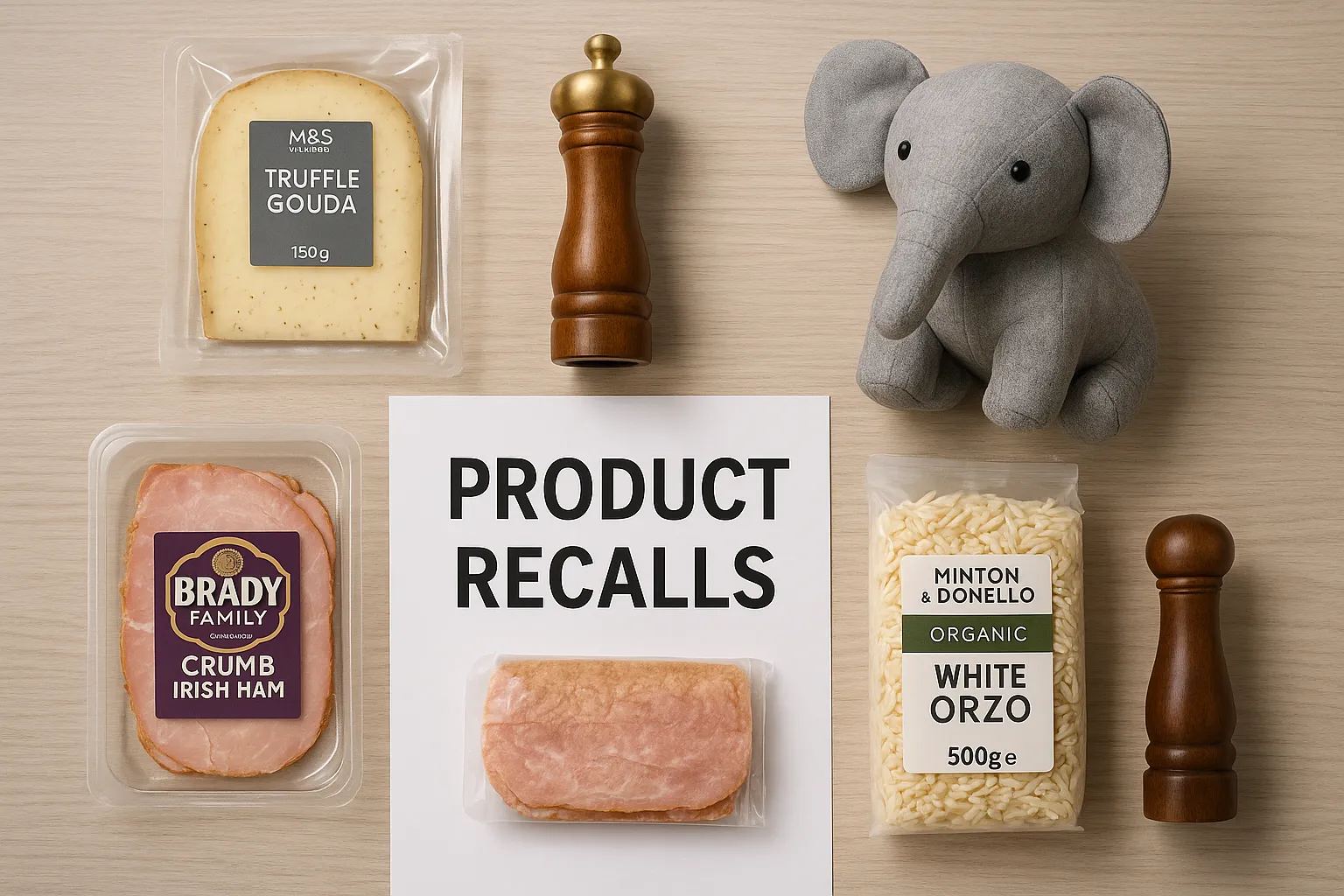
– Major retailers issued multiple product recalls this week.
– Listeria contamination risk in Lidl and Tesco ham products.
– Marks and Spencer recalled cheese due to Listeria risk.
– Primark pepper mills found to contain lead contamination.
– John Lewis items may be contaminated with asbestos.
Full Story
Various well-known retailers in the UK, including Marks and Spencer, Tesco, Lidl, John Lewis, and Primark, have recently announced multiple recalls of food and consumer products due to health and safety concerns. Customers are being advised to stop using and return the affected items as soon as possible.
The Food Standards Agency (FSA) has raised alarms regarding the potential for food poisoning linked to specific products from Marks and Spencer, Tesco, and Lidl. Simultaneously, issues concerning consumer goods have led the Office for Product Safety and Standards (OPSS) to issue recalls for items sold by John Lewis and Primark. Shoppers are urged to refrain from consuming or using these products and to return them to the point of purchase for a full refund.
Among the recalled items are certain ham products from both Lidl and Tesco, which are suspected of containing Listeria monocytogenes. This bacterium can lead to listeriosis, a serious infection that may result in severe illness, especially in vulnerable populations. The NHS warns that symptoms often resemble those of the flu, including high fever, muscle aches, chills, nausea, vomiting, and diarrhoea. In more severe instances, it could potentially lead to complications such as meningitis.
Tesco and Lidl have specifically identified the following products for recall:
– Brady Family Crumb Irish Ham
– Pack size: 80g
– Batch codes: 235880, 235765
– Use by date: July 16, 2026
– Deluxe Honey Roast Carved Irish Ham
– Pack size: 130g
– Batch code: 235473
– Use by date: July 16, 2026
– Deluxe Triple Oak Smoked Carved Irish Ham
– Pack size: 130g
– Batch code: 235461
– Use by date: July 16, 2026
The FSA explicitly instructs customers who have purchased these items to return them without consuming them first. Notably, these recalls specifically affect Northern Ireland.
Adding to these food-related concerns, Marks and Spencer has issued a recall for its Food Truffle Gouda cheese due to potential contamination with Listeria monocytogenes. The retailer requested that consumers not consume this product and return it to their nearest store for a refund. The recall affects only specific date codes, with reassurance that no other products from Marks and Spencer are implicated.
The details of the recalled cheese are as follows:
– M&S Food Truffle Gouda
– Pack size: 150g
– Product code: 29424887
– Use by date: October 9, 2026
Additionally, the FSA has highlighted a recall involving Minton and Donello Organic White Orzo. This product was found to contain wheat, which is not indicated on the packaging. The product incorrectly labels this pasta as “Orzo White Rice,” which may confuse customers, particularly those with allergies or intolerances to wheat or gluten. The FSA has advised consumers with such dietary restrictions to return the product promptly.
The details concerning the orzo pasta recall are as follows:
– Minton & Donello Organic White Orzo
– Pack size: 500g
– Batch codes: 78850, 78850, 78850
– Best before dates: January 31, May 2, and May 24, 2027
From a safety perspective, Primark has taken the precautionary step of recalling three models of pepper mills that have been found to contain lead, presenting a significant chemical risk. Priced at £8, these mills were manufactured in India and sold across various locations within the UK. The OPSS guidance indicates that consumers should stop using these products immediately and return them for a full refund.
The affected pepper mill models include:
– Model 6772201, Product code: 5397349037640
– Model 6770801, Product code: 5397349037541
– Model 3022201, Product code: 5397349075604
Lastly, John Lewis has joined the list of retailers implementing recalls after it was discovered that certain doorstops and draught excluders may contain asbestos contamination. These products were available for purchase from January 31, 2021, to June 11, 2026, raising significant health concerns since asbestos is recognised as a hazardous material, even in small quantities. The OPSS has highlighted the need for immediate cessation of use and has recommended that these items be kept away from children.
The specific doorstops and draught excluders under recall include:
– Draught Excluder Navy – Product code: 57090502
– Draught Excluder Grey – Product code: 57090506
– Draught Excluder Stripe – Product code: 57090509
– Duck Doorstop – Product code: 57090429
– Elephant Doorstop – Product code: 57090428
– Frog Doorstop – Product code: 57090427
– Patterned Navy Doorstop – Product code: 57090409
– Pig Doorstop – Product code: 57090421
– Sausage Dog Doorstop – Product code: 57090420
– Fusion Doorstop – Product code: 57090426
– Snowman Doorstop – Product code: 57090425
– Gingerbread Doorstop – Product code: 57090424
– Grey Stripe Doorstop – Product code: 57090423
– Felt Doorstop – Product code: 57090420
– Llama Doorstop – Product code: 57090421
Customers who have purchased any of these recalled products are strongly urged to follow the guidance provided by the respective retailers to ensure their safety. The health risks associated with the consumption or use of these items cannot be overstated, highlighting the importance of remaining vigilant regarding product recalls.
Our Thoughts
To avoid the recent recalls by major retailers due to food and product safety hazards, stringent compliance with UK health and safety regulations is essential. Key lessons emphasize the importance of thorough risk assessments and effective traceability procedures in the supply chain, especially under the Food Safety Act 1990 and General Product Safety Regulations 2005.
For instance, the detected presence of Listeria monocytogenes in the ham and cheese products indicates a failure in monitoring food safety, which could be mitigated through regular microbial testing and supplier audits. Similarly, the recall of products containing undeclared allergens highlights the need for rigorous labeling verification as mandated by the Food Information Regulations 2014.
Regarding the contamination risk with lead in Primark’s pepper mills and potential asbestos in John Lewis’s doorstops, adherence to the REACH Enforcement Regulations 2008 is crucial. Enhanced materials safety assessments before product approval would prevent such hazards.
Overall, improving supply chain transparency, conducting frequent safety audits, and ensuring compliance with packaging and labeling regulations can significantly reduce the likelihood of similar incidents in the future.