













Choose an AI chat
UK cold snap prompts safety advice for vulnerable households
UK Health and Safety Latest

UK cold snap prompts safety advice for vulnerable households

by Ellie Cartwright
February 2, 2026
0

As the UK grapples with a sharp cold spell, officials are urging residents to prioritise safe heating practices in their...

Read moreDetails
Four Britons die after contracting gastric illnesses in Cape Verde holidays

Four Britons die after contracting gastric illnesses in Cape Verde holidays

February 2, 2026
Man rescued from bridge railings in Plymouth

Man rescued from bridge railings in Plymouth

February 2, 2026
Hospital scandal reveals toxic culture and patient safety risks in Welsh NHS

Hospital scandal reveals toxic culture and patient safety risks in Welsh NHS

February 2, 2026
Toothbrush charger banned over fire and explosion risks

Toothbrush charger banned over fire and explosion risks

February 1, 2026
  • About
  • Advertise
  • Policies
    • Privacy Policy
    • Editorial Policy
    • Corrections & Complaints policy
  • Useful Documents
    • Understanding RIDDOR
    • 10 Workplace Safety Failures
    • A Complete Guide to Reporting Safety Incidents in the UK
    • Fire Risk Assessment: Meeting the Regulatory Reform (Fire Safety) Order
    • COSHH Basics: A Practical Guide to Control of Substances Hazardous to Health
    • Working at Height in the UK: The Essentials (WAH Regulations 2005)
    • Asbestos in the Workplace: Control of Asbestos Regulations 2012 (CAR) Essentials
    • Managing Contractors Under CDM 2015: Roles, Duties & Controls
    • DSE & Ergonomics: Healthy Workstations for Office & Hybrid Teams
    • Lock out Tag out LOTO
    • Workplace Transport Safety: Forklifts, Pedestrians & Traffic Management
    • Noise & Vibration at Work: Practical Controls (2005 Regulations)
    • Confined Spaces in the UK: Safe Entry under the Confined Spaces Regulations 1997
  • Contact
  • Agent
Tuesday, February 3, 2026
  • Login
UK Safety News
  • Home
  • News
    • All
    • UK Health and Safety Latest
    Residents in Wirral express anger over plans for carbon dioxide pipeline

    Residents in Wirral express anger over plans for carbon dioxide pipeline

    UK cold snap prompts safety advice for vulnerable households

    UK cold snap prompts safety advice for vulnerable households

    Four Britons die after contracting gastric illnesses in Cape Verde holidays

    Four Britons die after contracting gastric illnesses in Cape Verde holidays

    Man rescued from bridge railings in Plymouth

    Man rescued from bridge railings in Plymouth

    Hospital scandal reveals toxic culture and patient safety risks in Welsh NHS

    Hospital scandal reveals toxic culture and patient safety risks in Welsh NHS

    Toothbrush charger banned over fire and explosion risks

    Toothbrush charger banned over fire and explosion risks

    MHRA alerts patients on serious risks linked to GLP-1 medications

    MHRA alerts patients on serious risks linked to GLP-1 medications

    MHRA issues warning over rare pancreatitis risk linked to GLP-1 medications

    MHRA issues warning over rare pancreatitis risk linked to GLP-1 medications

    Supermarkets recall multiple food products over health risks

    Supermarkets recall multiple food products over health risks

    Warning issued over rare side effect of GLP-1 weight loss drugs

    Warning issued over rare side effect of GLP-1 weight loss drugs

    Trending Tags

    • Donald Trump
    • Future of News
    • Climate Change
    • Market Stories
    • Election Results
    • Flat Earth
No Result
View All Result
UK Safety News
No Result
View All Result
Home News UK Health and Safety Latest

MHRA warns GLP-1 drug users of rare side effect risk

Michael Harland by Michael Harland
January 30, 2026
in UK Health and Safety Latest
Reading Time: 4 mins read
0
MHRA warns GLP-1 drug users of rare side effect risk

Story Highlight

– MHRA warns GLP-1 drug users of serious side effect.
– Look for severe stomach and back pain symptoms.
– 1.6 million people in UK used GLP-1s recently.
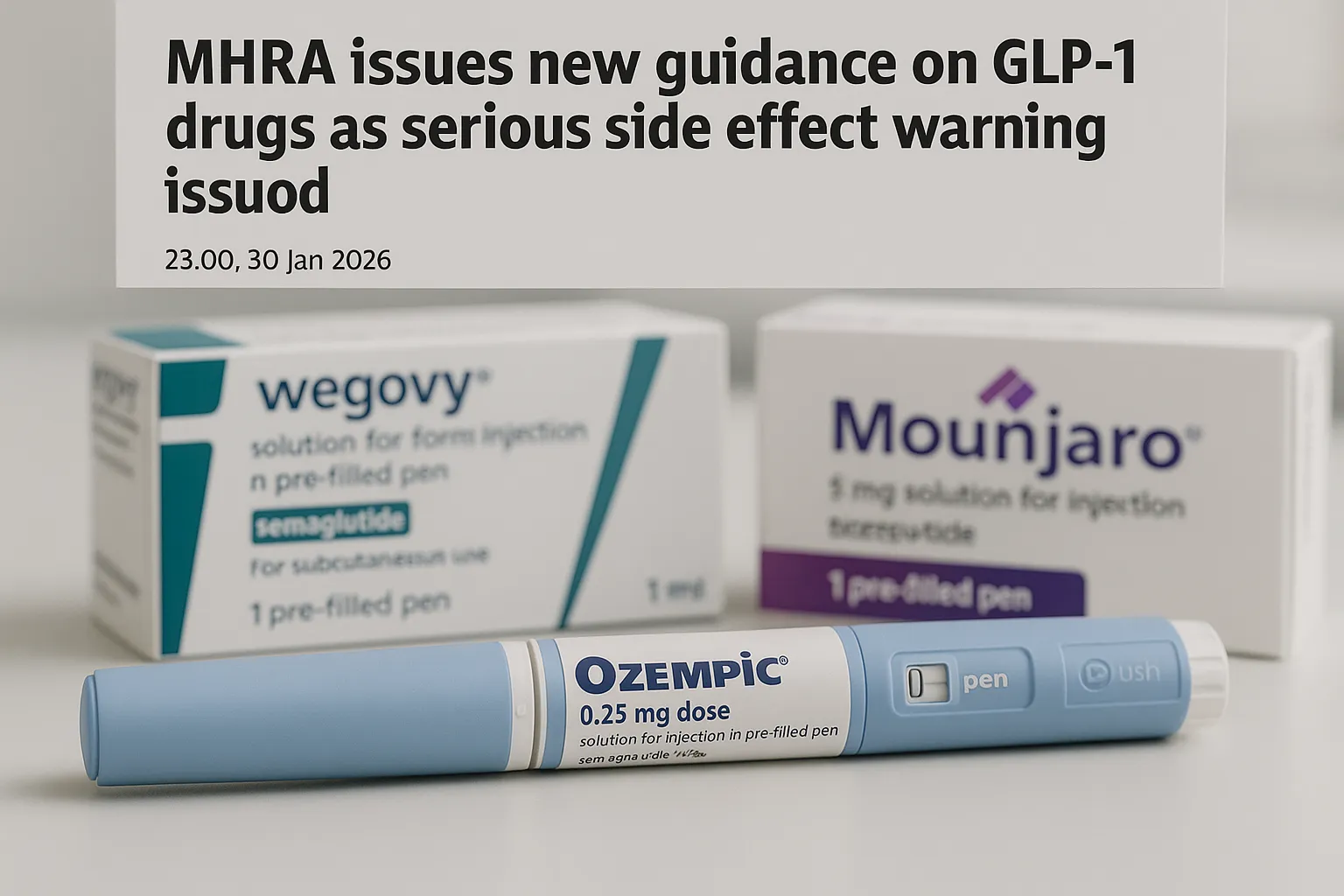
– Ozempic, Wegovy, and Mounjaro linked to pancreatitis risk.
– Seek medical help if severe pain occurs.

Full Story

Patients and healthcare professionals are being alerted to a rare but serious potential side effect linked to GLP-1 (glucagon-like peptide-1) medications, according to new guidance from the Medicines and Healthcare products Regulatory Agency (MHRA). These drugs, which include widely used options such as Ozempic, Wegovy, and Mounjaro, have gained popularity in the UK, with approximately 1.6 million individuals reportedly receiving these injections over the past year for weight management.

The MHRA’s latest update highlights the importance of being vigilant for symptoms that may indicate acute pancreatitis, a condition characterised by inflammation of the pancreas, which is situated behind the stomach. The agency has urged anyone using GLP-1 medications to seek immediate medical attention if they experience severe, persistent abdominal pain, particularly if this pain extends to the back, as well as accompanying symptoms like nausea and vomiting.

While most patients who develop acute pancreatitis can recover within a week and typically do not face ongoing issues, the NHS warns that some may experience more serious complications. In light of this, the MHRA has amended product information for healthcare professionals and patients to ensure awareness of the risks associated with these medications.

Alison Cave, Chief Safety Officer at the MHRA, emphasised the agency’s commitment to patient safety: “Patient safety is the MHRA’s top priority and we continually monitor the safety and efficacy of all licensed medicines.” She reassured patients that the majority of people taking GLP-1 medications do so without significant issues, noting, “For the vast majority of patients who are prescribed GLP-1s, they are safe and effective medicines which deliver significant health benefits.”

The MHRA’s guidance serves as a critical reminder for both patients and physicians to remain alert to possible symptoms of acute pancreatitis. Cave further advised that if anyone using GLP-1 medications observes symptoms such as intense stomach pain or signs of nausea and vomiting, they should consult a healthcare professional promptly and report the occurrence through the MHRA’s Yellow Card scheme, which is designed for monitoring drug safety.

Various brands of GLP-1 medications have differing indications. While Wegovy and Mounjaro are specifically licensed for weight management, Ozempic is approved for the treatment of type 2 diabetes and for reducing cardiovascular risk. According to the MHRA, these medications are used not only for diabetes management but also to assist individuals with a BMI of 27 kg/m² or more in reducing weight and cardiovascular risk if they have existing cardiovascular disease.

A study conducted by University College London has disclosed the extensive use of GLP-1 medications across England, Wales, and Scotland, asserting that around 1.6 million adults have utilised them over a year-long period to facilitate weight loss. It underscores the growing trend and acceptance of these treatments, which have emerged as critical tools in the management of both obesity and type 2 diabetes.

However, the necessity for ongoing vigilance regarding potential risks associated with any medication cannot be overstated. Although GLP-1s are widely regarded as safe and effective for their intended purposes, like any therapeutic intervention, they come with certain risks which require acknowledgment from patients and prescribers alike. The MHRA has made it clear that understanding the symptoms of severe pancreatitis is crucial for those utilising GLP-1 treatments.

Patients experiencing acute pancreatitis often report a sudden onset of severe pain in the centre of the abdomen, which can be accompanied by nausea or vomiting. A high temperature of 38 degrees Celsius or more could also indicate the condition. In cases where any of these symptoms develop unexpectedly, individuals are encouraged to seek immediate medical advice, whether through a general practitioner or NHS 111, ensuring timely intervention can take place.

The MHRA’s updated guidance reflects an ongoing commitment to ensuring that the benefits of medications like GLP-1s do not come at the expense of patient safety. In recent years, there has been increasing scrutiny of pharmaceutical products as they become integral to treating chronic conditions like obesity and diabetes. With the rise of these medications, informed decision-making by patients and healthcare providers is more essential than ever.

Maintaining awareness of potential side effects enables patients to take an active role in their health management, reinforcing that while GLP-1 drugs provide significant health improvements, awareness and prompt action regarding adverse symptoms is vital. The MHRA continues to urge both prescribers and patients to remain informed and proactive in addressing any concerns that may arise during treatment.

Our Thoughts

To mitigate the risks associated with GLP-1 drugs and prevent incidents of acute pancreatitis, several measures could have been taken. Firstly, enhanced pre-prescription risk assessments based on the patient’s medical history could ensure only suitable candidates receive these medications. This would align with the Health and Safety at Work Act 1974, which mandates ensuring the health and safety of individuals using medicines.

Secondly, there should be a structured monitoring system post-prescription for early detection of adverse effects, facilitating prompt intervention. Clear and consistent communication of potential side effects, beyond product information, could empower patients to recognize symptoms early, adhering to the Control of Substances Hazardous to Health Regulations (COSHH).

Key safety lessons include the importance of continuous education for healthcare professionals regarding emerging risks, ensuring compliance with the Medicines Act 1968, which governs the safety of medicines. The MHRA’s guidance highlights the need for vigilant monitoring and reporting of side effects through methods like the Yellow Card scheme. Overall, proactive measures in patient education and healthcare professional training are essential to prevent similar incidents effectively.

SummarizeShare34Share197SendSend
ADVERTISEMENT
Michael Harland

Michael Harland

Related Posts

Product recalls issued over fire risks and safety concerns in major retailers

Product recalls issued over fire risks and safety concerns in major retailers

by Ellie Cartwright
December 20, 2025
0

The Office for Product Safety and Standards (OPSS) has announced urgent product recalls from Asda, Marks & Spencer, and B&M...

New curriculum empowers students with medicine safety education

New curriculum empowers students with medicine safety education

by Jade Anderson
September 17, 2025
2

In a landmark move for public health, the Medicines and Healthcare products Regulatory Agency (MHRA) has integrated medicine safety education...

Leave a Reply Cancel reply

Your email address will not be published. Required fields are marked *

I agree to the Terms & Conditions and Privacy Policy.

Useful Documents

  • Understanding RIDDOR
  • 10 Workplace Safety Failures
  • A Complete Guide to Reporting Safety Incidents in the UK
  • Understanding RIDDOR
  • Fire Risk Assessment: Meeting the Regulatory Reform (Fire Safety) Order
  • COSHH Basics: A Practical Guide to Control of Substances Hazardous to Health
  • Working at Height in the UK: The Essentials (WAH Regulations 2005)
  • Lock out Tag out LOTO
ADVERTISEMENT
Toothbrush charger banned over fire and explosion risks
UK Health and Safety Latest

Toothbrush charger banned over fire and explosion risks

by Tara Rowden
February 1, 2026
0

The Electric Toothbrush Charger, model WY-3757, has been banned from sale in the UK due to severe fire and explosion...

Read moreDetails
MHRA alerts patients on serious risks linked to GLP-1 medications

MHRA alerts patients on serious risks linked to GLP-1 medications

January 31, 2026
MHRA issues warning over rare pancreatitis risk linked to GLP-1 medications

MHRA issues warning over rare pancreatitis risk linked to GLP-1 medications

January 31, 2026
Supermarkets recall multiple food products over health risks

Supermarkets recall multiple food products over health risks

January 30, 2026
UK Safety News

Copyright © 2025
UK Safety News

Navigate Site

  • About
  • Advertise
  • Policies
  • Useful Documents
  • Contact
  • Agent

Follow Us

Welcome Back!

Login to your account below

Forgotten Password?

Retrieve your password

Please enter your username or email address to reset your password.

Log In
No Result
View All Result
  • Home
  • News

Copyright © 2025
UK Safety News

This website uses cookies. By continuing to use this website you are giving consent to cookies being used. Visit our Privacy and Cookie Policy.