














Choose an AI chat
Safety technology from Res Digital
Tragedy of heatstroke highlights urgent need for athlete safety reforms
UK Health and Safety Latest

Tragedy of heatstroke highlights urgent need for athlete safety reforms

by Tara Rowden
September 18, 2026
0

In a tragic incident that underscores the critical need for improved athlete safety protocols, Arizona State University hockey player Matthew...

Read moreDetails
Parents outraged by school’s no-contact policy following detention for high-five

Parents outraged by school’s no-contact policy following detention for high-five

September 18, 2026
New research explores gene therapy potential to combat muscle loss with age

New research explores gene therapy potential to combat muscle loss with age

September 18, 2026
Cornwall considers ban on disposable barbecues amid safety concerns

Cornwall considers ban on disposable barbecues amid safety concerns

September 18, 2026
University of Liverpool hosts successful IST Technical Conference focusing on future careers and collaboration

University of Liverpool hosts successful IST Technical Conference focusing on future careers and collaboration

September 18, 2026

Archives

  • September 2026
  • August 2026
  • July 2026
  • June 2026
  • May 2026
  • April 2026
  • March 2026
  • February 2026
  • January 2026
  • December 2025
  • November 2025
  • October 2025
  • September 2025
  • July 2025
  • August 2009

Categories

  • Health and Safety Help
  • News
  • Policies
  • UK Health and Safety Latest
  • About
  • Advertise
  • Policies
    • Privacy Policy
    • Editorial Policy
    • Corrections & Complaints policy
  • Useful Documents
    • Understanding RIDDOR
    • 10 Workplace Safety Failures
    • A Complete Guide to Reporting Safety Incidents in the UK
    • Fire Risk Assessment: Meeting the Regulatory Reform (Fire Safety) Order
    • COSHH Basics: A Practical Guide to Control of Substances Hazardous to Health
    • Working at Height in the UK: The Essentials (WAH Regulations 2005)
    • Asbestos in the Workplace: Control of Asbestos Regulations 2012 (CAR) Essentials
    • Managing Contractors Under CDM 2015: Roles, Duties & Controls
    • DSE & Ergonomics: Healthy Workstations for Office & Hybrid Teams
    • Lock out Tag out LOTO
    • Workplace Transport Safety: Forklifts, Pedestrians & Traffic Management
    • Noise & Vibration at Work: Practical Controls (2005 Regulations)
    • Confined Spaces in the UK: Safe Entry under the Confined Spaces Regulations 1997
  • Contact
  • Agent
Saturday, September 19, 2026
19 °c
London
20 ° Sun
20 ° Mon
17 ° Tue
  • Login
UK Safety News
  • Home
  • News
    • All
    • UK Health and Safety Latest
    Tragedy of heatstroke highlights urgent need for athlete safety reforms

    Tragedy of heatstroke highlights urgent need for athlete safety reforms

    Parents outraged by school’s no-contact policy following detention for high-five

    Parents outraged by school’s no-contact policy following detention for high-five

    New research explores gene therapy potential to combat muscle loss with age

    New research explores gene therapy potential to combat muscle loss with age

    Cornwall considers ban on disposable barbecues amid safety concerns

    Cornwall considers ban on disposable barbecues amid safety concerns

    University of Liverpool hosts successful IST Technical Conference focusing on future careers and collaboration

    University of Liverpool hosts successful IST Technical Conference focusing on future careers and collaboration

    Nurses warn of dire consequences for patients amid record heat in UK hospitals

    Nurses warn of dire consequences for patients amid record heat in UK hospitals

    Concerns raised over safety and staff training at Welsh mental health wards

    Concerns raised over safety and staff training at Welsh mental health wards

    Cooper raises hopes for NHS access to breakthrough dementia drug

    Cooper raises hopes for NHS access to breakthrough dementia drug

    Care home implements safety measures following choking tragedy

    Care home implements safety measures following choking tragedy

    Hand wash recalled due to microbiological risk in UK stores

    Hand wash recalled due to microbiological risk in UK stores

    Trending Tags

No Result
View All Result
UK Safety News
No Result
View All Result
Home News UK Health and Safety Latest

New guide aims to promote greener practices in global anaesthesia and perioperative care

Jade Anderson by Jade Anderson
June 12, 2026
in UK Health and Safety Latest
Reading Time: 4 mins read
0
New guide aims to promote greener practices in global anaesthesia and perioperative care

Story Highlight

– NIHR developed GAP-PACK guide for sustainable perioperative care.
– Guides on local anaesthesia, reusable equipment, and repairs.
– Collaborated with WHO and anaesthesia professional bodies.
– Aims to reduce waste without compromising patient safety.
– Involves input from 1900 professionals across 70 countries.

Full Story

A new initiative spearheaded by the Birmingham-led National Institute for Health and Care Research (NIHR) aims to enhance the environmental sustainability of perioperative care through the introduction of the Greener Anaesthesia and Perioperative Care (GAP-PACK) guide. This comprehensive framework encourages healthcare professionals worldwide to adopt practices that reduce waste in operating theatres while maintaining high standards of patient safety and care.

The GAP-PACK guide has been developed in collaboration with the World Health Organisation, along with professional organisations including the National Institute of Academic Anaesthesia, the Association of Anaesthetists GB & NI, and the World Federation of Societies of Anaesthesiologists. Its primary objective is to provide clear and actionable recommendations that enable operating theatres to diminish their environmental footprint effectively. This approach aims to facilitate clinicians in integrating sustainable practices into their routine operations.

Operating theatres are notorious for their substantial consumption of energy, use of medical supplies, and reliance on single-use plastics, which generate significant waste and financial burdens. By adopting the GAP-PACK recommendations, hospitals can implement more sustainable practices that simultaneously enhance patient recovery, comfort, and safety. Furthermore, these practices can lead to reduced risks and complications, greater efficiency for medical staff, and improved reliability of medical equipment.

The guide has received input from over 1,900 healthcare professionals across more than 70 countries, including those from low-resource settings, through an expansive global prioritisation exercise. Participants evaluated potential actions according to three key criteria: feasibility, acceptability, and affordability. Seven actions emerged as particularly effective, having garnered high scores across all three metrics, demonstrating their potential for immediate enactment by healthcare teams.

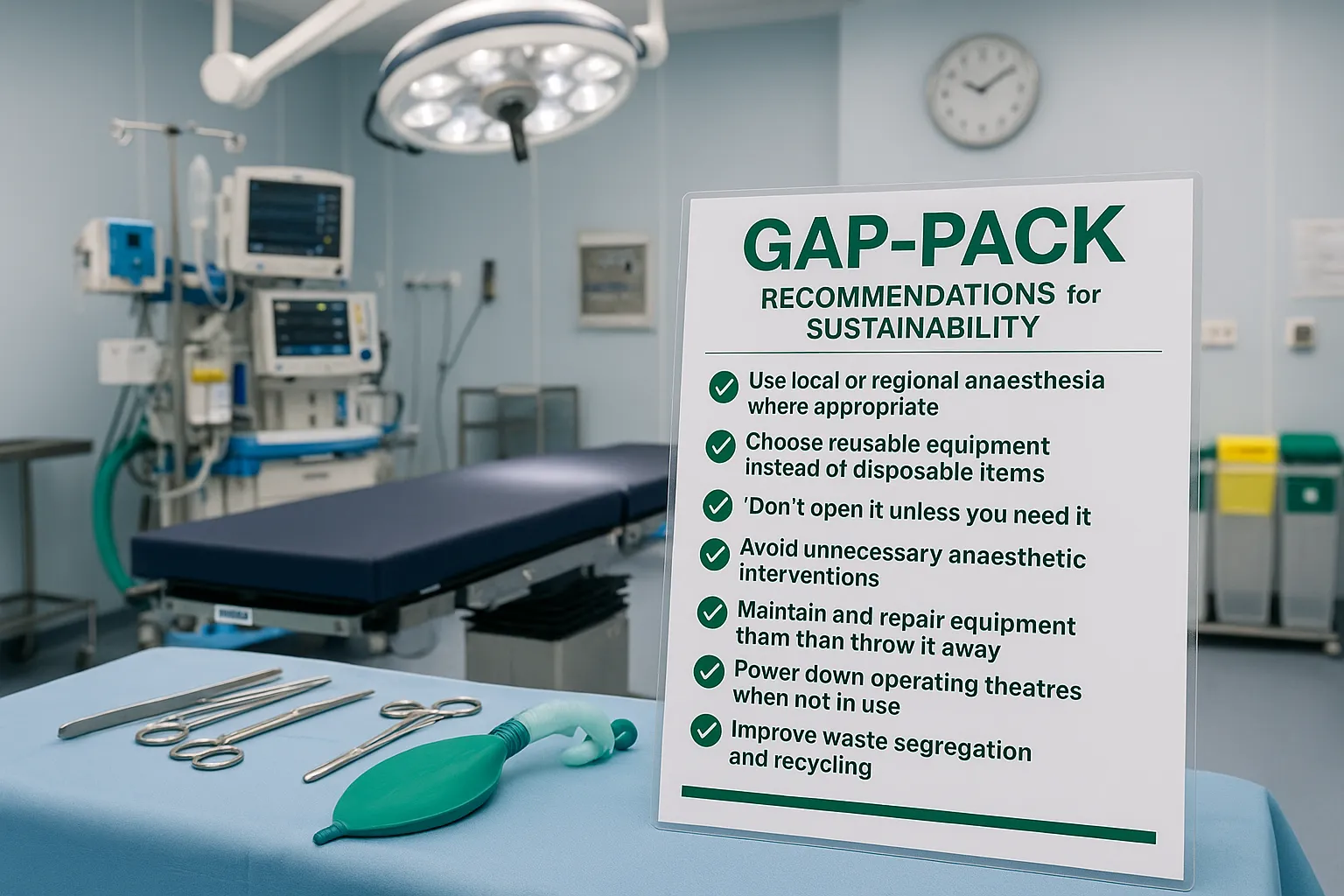
The selected seven recommendations of the GAP-PACK are as follows:

1. Utilise local or regional anaesthesia whenever suitable.
2. Prefer reusable equipment instead of relying on disposable items.
3. Observe the principle of “don’t open it unless you need it” to minimise waste.
4. Avoid unnecessary anaesthetic interventions that do not benefit patient outcomes.
5. Opt for maintenance and repair of existing equipment rather than discarding it.
6. Ensure that operating theatres are powered down when not in use to conserve energy.
7. Improve the processes of waste segregation and recycling within hospitals.

Rather than proposing substantial technological investments or costly new equipment, the GAP-PACK guide highlights how small adjustments in daily operations can significantly contribute to greener, more efficient, and safer surgical environments.

James Glasbey, who serves as an Assistant Professor and Perioperative Care Lead for the NIHR Global Group on Environmentally Sustainable Operating Theatres, noted the critical need for actionable solutions. He remarked, “The perioperative care community, both in the UK and worldwide, wants to take action against climate change but it’s not always clear where to begin. GAP-PACK has taken ‘low hanging fruit’ which can be immediately implemented in any operating theatre, and given clinical teams the tools required to make a change.”

As awareness regarding climate change and sustainability grows, healthcare consumers are increasingly expecting environmentally responsible practices in their medical care. The GAP-PACK guide represents an important step towards aligning the operations of healthcare facilities with these expectations, without sacrificing the quality of care provided to patients.

The implementation of these sustainable practices can result in significant organisational efficiencies, as well as cost savings that can be redirected to enhance services or invest in additional training for staff. Furthermore, by promoting practices such as maintaining equipment and opting for local anaesthesia, hospitals can foster a culture of sustainability that benefits both their patients and the environment.

The guide stresses that hospitals do not need to undertake extensive overhauls of their systems or invest heavily in new technology to achieve their sustainability goals. Instead, adopting simple and pragmatic changes can yield considerable improvements, demonstrating the potential for healthcare systems to balance operational logistics with environmental responsibility.

For healthcare professionals eager to engage in sustainable practices, the full GAP-PACK guide is accessible via a dedicated survey platform, providing further insights and resources to aid in effective implementation. The initiative represents a collaborative effort to promote a future where healthcare not only prioritises patient wellbeing but also actively contributes to safeguarding the planet.

Our Thoughts

The creation and implementation of the GAP-PACK guide by the NIHR highlights key safety lessons in the context of environmental sustainability in perioperative care. To avoid the unnecessary waste and environmental impact described, healthcare facilities should have adhered to the Management of Health and Safety at Work Regulations 1999, ensuring risk assessments are conducted for waste management and energy use.

Implementing the recommended practices—such as using local anaesthesia, choosing reusable equipment, and maintaining rather than discarding equipment—could significantly reduce material waste and enhance patient safety. Furthermore, the guidelines suggest actions that can mitigate risks associated with rushed or excessive interventions, aligning with the Health and Safety at Work Act 1974 stipulating employers’ responsibilities for ensuring safe working environments.

In terms of preventing similar issues, regular training on sustainability practices for healthcare professionals should be mandated, ensuring adherence to the Health and Safety (Training for Employment) Regulations 1990. Overall, the adoption of these measures would not only comply with existing legislation but promote a culture of safety and sustainability in operating theatres.


SummarizeShare35Share202SendSend
Safety technology from Res Digital
Jade Anderson

Jade Anderson

Jade Anderson is a safety and compliance reporter specialising in UK regulatory affairs, HSE prosecutions, and workplace injury news. With experience covering health and safety law and enforcement, Jade brings in-depth analysis of court cases, fines, and lessons learned from workplace incidents across the UK.

Related Posts

Workers face tough conditions as temperature guidance impacts safety

Workers face tough conditions as temperature guidance impacts safety

by Tara Rowden
January 6, 2026
0

As the UK grapples with severe winter weather, employers are reminded of their obligation to maintain safe working conditions. The...

Injured tawny owl nursed back to health and released in Derbyshire

Injured tawny owl nursed back to health and released in Derbyshire

by Jade Anderson
December 30, 2025
0

A tawny owl discovered injured on the A517 in Derbyshire has made a remarkable recovery and was released back into...

Useful Documents

  • Understanding RIDDOR
  • 10 Workplace Safety Failures
  • A Complete Guide to Reporting Safety Incidents in the UK
  • Understanding RIDDOR
  • Fire Risk Assessment: Meeting the Regulatory Reform (Fire Safety) Order
  • COSHH Basics: A Practical Guide to Control of Substances Hazardous to Health
  • Working at Height in the UK: The Essentials (WAH Regulations 2005)
  • Lock out Tag out LOTO

Recent Posts

  • Tragedy of heatstroke highlights urgent need for athlete safety reforms
  • Parents outraged by school’s no-contact policy following detention for high-five
  • New research explores gene therapy potential to combat muscle loss with age
  • Cornwall considers ban on disposable barbecues amid safety concerns
  • University of Liverpool hosts successful IST Technical Conference focusing on future careers and collaboration

Recent Comments

  1. Lendy Araujo on Oil spill at Piper Bravo deemed potentially catastrophic by safety regulator
  2. Piper Douglas on Worker dies due to inadequate machinery safety measures
  3. Simon Barrett on Honeymoon ruined by illness as newlywed suffers severe infection in Cape Verde
  4. Nolan Barrett on Work-related ill health in Great Britain remains a concern after pandemic peak
  5. Dylan Reeves on Sickness rates among Scottish police officers soar to troubling levels
UK Safety News

Copyright © 2026
UK Safety News

Navigate Site

  • About
  • Advertise
  • Policies
  • Useful Documents
  • Contact
  • Agent

Follow Us

Welcome Back!

Login to your account below

Forgotten Password?

Retrieve your password

Please enter your username or email address to reset your password.

Log In
No Result
View All Result
  • Home
  • News

Copyright © 2026
UK Safety News

This website uses cookies. By continuing to use this website you are giving consent to cookies being used. Visit our Privacy and Cookie Policy.