














Story Highlight
- Fifteen new plant protection products approved in the UK this year.
- Approvals include herbicides, fungicides, and a biostimulant product.
- New products authorised under UK’s post-Brexit MAPP system.
- BASF, Bayer, and FMC Agro among companies receiving new approvals.
- UK’s independent system is important for global agribusiness testing.
Full Story
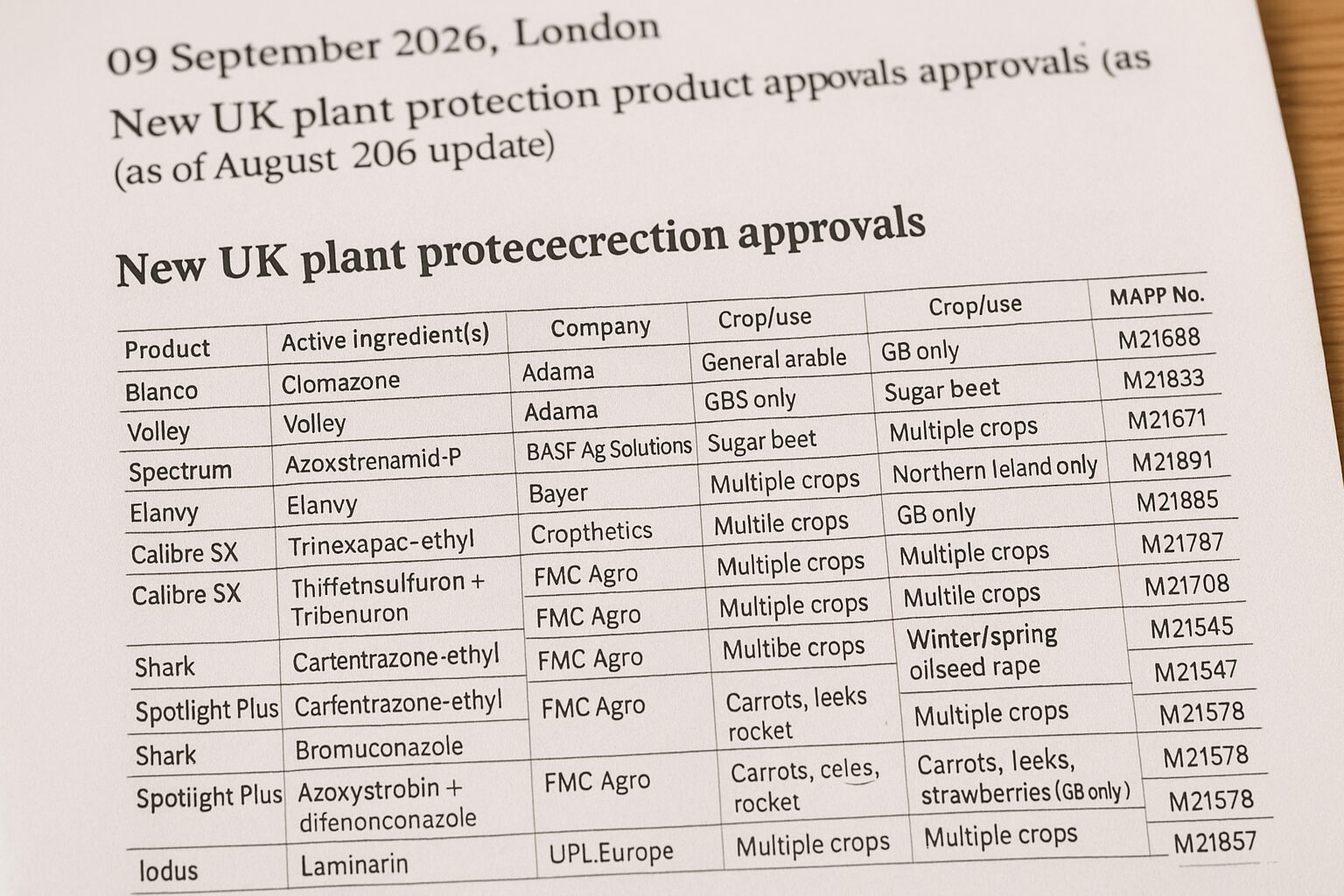
The United Kingdom has seen the addition of fifteen new plant protection products in 2026, according to the BCPC’s Online UK Pesticide Guide. The recent update, published on August 3, indicates that these new products include a variety of herbicides, fungicides, and one biostimulant, representing numerous key agrochemical suppliers in the UK market.
The products have been authorised under the Marketing Authorizations for Plant Protection Products, abbreviated as MAPP numbers, following reviews by the Chemicals Regulation Division of the Health and Safety Executive. The new approvals contribute to ongoing product innovation and reformulation efforts by both major multinational companies and generic manufacturers within the UK, which now operates its own pesticide authorisation process, separate from the EU system following Brexit.
Among the newly approved products, BASF received authorisation for Spectrum, a dimethenamid-P herbicide for sugar beet, and Elanvy, a combination fungicide that includes azoxystrobin and mefentrifluconazole for use on various crops. Bayer achieved approval for Cofeno, a prosulfocarb herbicide intended for potatoes, winter wheat, and winter barley. FMC Agro became the most active registrant with four approvals, including products like Calibre SX, a herbicide containing thifensulfuron and tribenuron, as well as Shark and Spotlight Plus, both formulated with carfentrazone-ethyl. Other companies such as Adama, Sharda, Sipcam, Sumitomo, and UPL Europe also received approvals, with UPL notably introducing Iodus, a laminarin-based biostimulant, highlighting the presence of unconventional pesticide products.
Several of the newly authorised products are limited to specific regions, with some approved solely for Great Britain or Northern Ireland. This regional distinction has emerged as a common practice since the UK’s independent authorisation system developed post-Brexit, which now necessitates separate approvals for each jurisdiction. This change has increased administrative requirements, particularly impacting smaller suppliers.
The significance of these approvals extends beyond the UK as it remains an important testing ground for new crop protection technologies. Although the UK is smaller in terms of acreage compared to global standards, its independent authorisation framework now serves as a case study for how a regulatory system can evaluate novel and reformulated products outside the EU framework. The diverse mix of established multinational companies and generic suppliers among the latest approvals illustrates the competitive nature of the UK market, especially in the segments of post-patent and off-patent products. As a result, companies planning to launch products in multiple European markets are increasingly recognising the need to factor UK approval timelines as a separate consideration.
Source: read the original report.