















Story Highlight
– Serious cold burns suffered by engineer Vladimir Volkov.
– Liquid propane release caused by flawed Shell safety procedures.
– Incident could have led to catastrophic explosion risk.
– Shell fined £450,000 for breaching safety regulations.
– HSE criticizes Shell for inadequate risk assessments.
Full Story
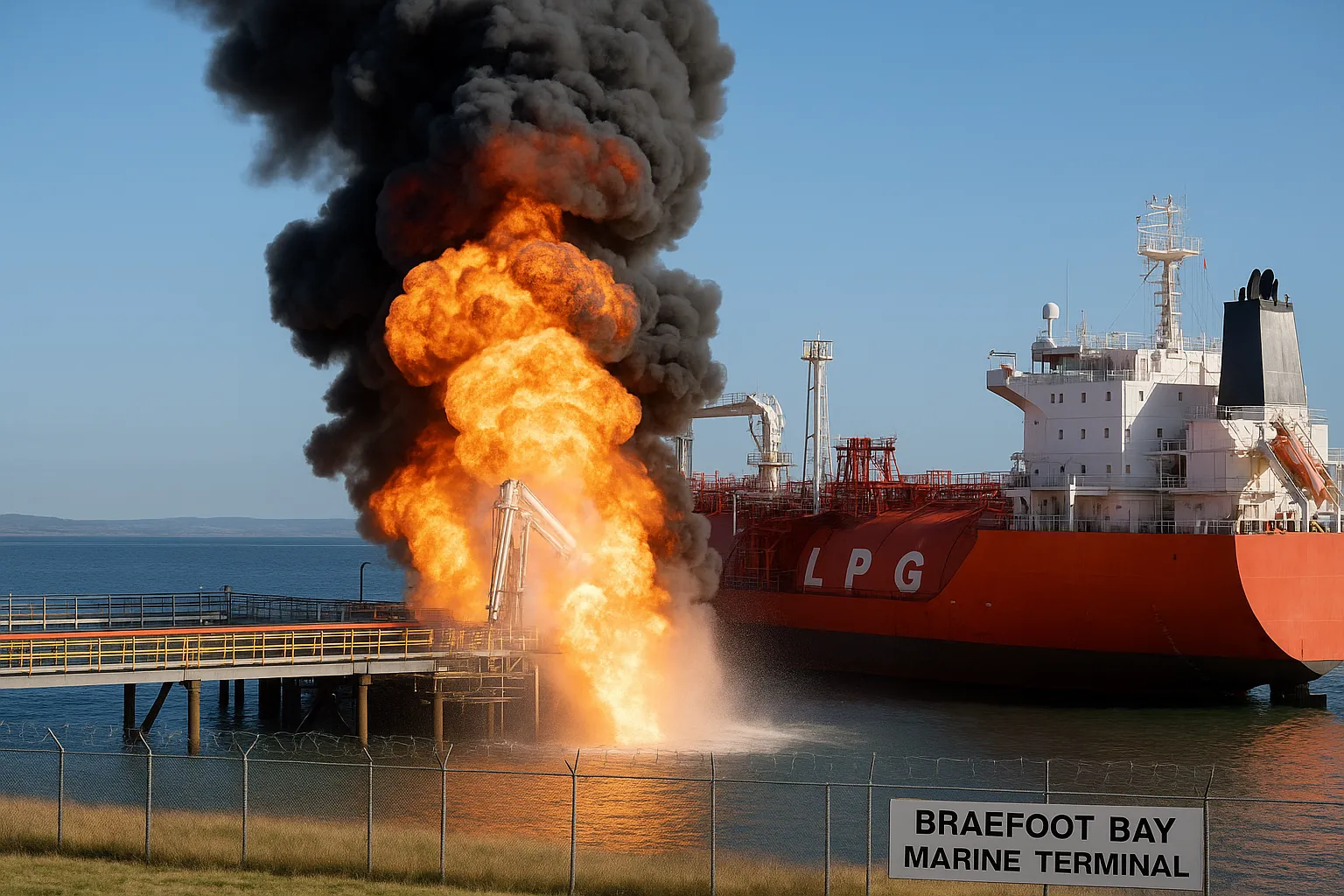
A significant incident resulting in serious injuries occurred at the Braefoot Bay Marine Terminal on 1 November 2018, when a gas engineer working for Shell UK experienced severe cold burns due to a lapse in safety protocols. The incident, which unfolded in the early hours of the morning, highlighted failures in safety measures that raised alarms regarding the handling of dangerous substances at the facility near Dalgety Bay in Fife.
Vladimir Volkov, the engineer aboard the vessel MV Symi, suffered burns covering 10 to 13 per cent of his body after a release of liquid propane. This unfortunate event transpired while loading operations were underway at the terminal, where large amounts of volatile substances are processed. Following the accident, Volkov received initial treatment in a local hospital and was subsequently flown back to Russia for further medical care. Reports indicate that he has since returned to work.
The Health and Safety Executive (HSE) launched an investigation into the incident, aiming to shed light on the safety failures that led to the dangerous release of propane, which rapidly formed a flammable vapour cloud. This cloud enveloped employees on both the ship’s deck and the adjoining jetty, creating a potentially lethal situation that could have resulted in a catastrophic explosion had it come into contact with an ignition source.
According to the HSE’s findings, the sequence of events that led to the release began when a technician at Shell inadvertently activated a button on a remote-control unit. This action disconnected a loading arm’s quick release coupling from the ship’s manifold before it had been thoroughly purged of propane. In mere seconds, an estimated 250 to 300 kilograms of liquid propane were discharged at high pressure.
The inquiry revealed that Shell’s existing operational procedures were at odds with both the manufacturer’s recommendations for the loading arm and the guidance from an external firm involved in its installation. Shell had established a protocol requiring the disarming of a critical safety mechanism—an emergency release coupling—prematurely, creating a dangerous gap in safety that increased the risk of accidental propane discharge.
Two key deficiencies were identified in Shell’s safety management. First, the existing work system was deemed unsafe. The procedure mandated that workers disengage the emergency release coupling too early during the disconnection process, prior to ensuring the loading arm was entirely cleared of propane. This allowed for the possibility of an unintentional button activation that could lead to a sudden release of the substance.
Second, Shell’s approach to managing changes within its operations was insufficient. The company had replaced its marine loading arms in 2018, upgrading to new equipment featuring a different operational mechanism—including wireless remote control. However, instead of treating this replacement as a significant change necessitating thorough risk assessment, Shell regarded it as a straightforward update. The new loading arms came equipped with a remote-control device that had exposed buttons, which had not been part of the previous design. Completely neglecting to evaluate new risks introduced by this shift, Shell did not implement basic safety measures, such as interlocks that would prevent the coupling from releasing while propane was still present.
Following the incident and an Improvement Notice from the HSE, Shell acknowledged that implementing a coupling interlock system—deemed both technically feasible and practical—could have entirely averted the incident.
The vapour cloud created by the propane release extended from the ship to the jetty and even reached the water’s surface, with gas detection monitors registering its presence 20 metres away. Given that propane vapour is heavier than air and highly flammable, the potential for it to migrate over significant distances to locate an ignition source posed a grave risk to individuals nearby.
In the aftermath, Shell UK Limited pleaded guilty to violations under The Control of Major Accident Hazards Regulations 2015 and the Health and Safety at Work etc. Act 1974. The company faced a fine of £450,000, which was imposed on 26 May 2026 during proceedings at Kirkcaldy Sheriff Court.
Euan Ross, the principal specialist inspector at HSE, emphasised the gravity of the oversight: “Shell had adapted procedures from its old equipment and applied them to a new and fundamentally different system, without carrying out adequate safety checks.” He further noted, “While the injuries sustained were serious enough, this could have been a far more catastrophic event. We will not hesitate to take action against companies which fail to do all that they should to keep people safe.”
The HSE serves as the national authority for workplace health and safety in Britain, with a mandate to ensure that people and environments are safeguarded. This incident serves as a stark reminder of the paramount importance of upholding rigorous safety standards, especially in industries handling hazardous materials. More comprehensive information regarding health and safety legislation can be accessed through HSE’s official channels, alongside details on ongoing safety initiatives.
Our Thoughts
The incident at Braefoot Bay Marine Terminal highlights several key failures in health and safety practices that could have been prevented. Firstly, Shell UK’s operating procedure was flawed by requiring the disarming of the emergency release coupling before the loading arm was fully purged, creating a significant risk of an uncontrolled release of propane.
Proper adherence to the Management of Change principles under the Health and Safety at Work etc. Act 1974, including thorough risk assessments when introducing new equipment, was neglected. The failure to adequately assess the new loading arms, which operated via remote control, led to a lack of necessary safeguards, such as interlocks to prevent premature release.
The breach of The Control of Major Accident Hazards Regulations 2015 indicates a failure to ensure that safety measures were in place for the handling of hazardous substances. To prevent similar incidents, companies must conduct comprehensive risk assessments, ensure that all staff are trained on new systems, and implement engineering controls to minimize the risk of accidental activation. Enhanced safety protocols should have been strictly followed to safeguard against potential catastrophic outcomes.