
















Choose an AI chat
Gas hobs linked to health risks as households warned to ventilate kitchens
UK Health and Safety Latest

Gas hobs linked to health risks as households warned to ventilate kitchens

by Jade Anderson
May 4, 2026
0

Households are being urged to reconsider their reliance on gas hobs amid alarming health risks linked to indoor air pollution....

Read moreDetails
Landlords face fines and jail under new renters' rights law for failing to manage Legionnaires' disease risk

Landlords face fines and jail under new renters’ rights law for failing to manage Legionnaires’ disease risk

May 4, 2026
Security measures block access to The Telegraph website

Security measures block access to The Telegraph website

May 3, 2026
Food agency issues recalls over safety concerns for multiple supermarket products

Food agency issues recalls over safety concerns for multiple supermarket products

May 2, 2026
Key changes affecting families as phone bans, smoking laws, and benefit reforms announced

Key changes affecting families as phone bans, smoking laws, and benefit reforms announced

May 2, 2026
  • About
  • Advertise
  • Policies
    • Privacy Policy
    • Editorial Policy
    • Corrections & Complaints policy
  • Useful Documents
    • Understanding RIDDOR
    • 10 Workplace Safety Failures
    • A Complete Guide to Reporting Safety Incidents in the UK
    • Fire Risk Assessment: Meeting the Regulatory Reform (Fire Safety) Order
    • COSHH Basics: A Practical Guide to Control of Substances Hazardous to Health
    • Working at Height in the UK: The Essentials (WAH Regulations 2005)
    • Asbestos in the Workplace: Control of Asbestos Regulations 2012 (CAR) Essentials
    • Managing Contractors Under CDM 2015: Roles, Duties & Controls
    • DSE & Ergonomics: Healthy Workstations for Office & Hybrid Teams
    • Lock out Tag out LOTO
    • Workplace Transport Safety: Forklifts, Pedestrians & Traffic Management
    • Noise & Vibration at Work: Practical Controls (2005 Regulations)
    • Confined Spaces in the UK: Safe Entry under the Confined Spaces Regulations 1997
  • Contact
  • Agent
Tuesday, May 5, 2026
20 °c
London
16 ° Sat
15 ° Sun
12 ° Mon
  • Login
UK Safety News
  • Home
  • News
    • All
    • UK Health and Safety Latest
    Ireland considers changing fire safety rules amid health concerns over toxic chemicals

    Ireland considers changing fire safety rules amid health concerns over toxic chemicals

    Gas hobs linked to health risks as households warned to ventilate kitchens

    Gas hobs linked to health risks as households warned to ventilate kitchens

    Landlords face fines and jail under new renters' rights law for failing to manage Legionnaires' disease risk

    Landlords face fines and jail under new renters’ rights law for failing to manage Legionnaires’ disease risk

    Security measures block access to The Telegraph website

    Security measures block access to The Telegraph website

    Food agency issues recalls over safety concerns for multiple supermarket products

    Food agency issues recalls over safety concerns for multiple supermarket products

    Key changes affecting families as phone bans, smoking laws, and benefit reforms announced

    Key changes affecting families as phone bans, smoking laws, and benefit reforms announced

    Tree surgeon suffers life-threatening injuries after electric shock from powerline

    Tree surgeon suffers life-threatening injuries after electric shock from powerline

    Login issues disrupt access to online services

    Login issues disrupt access to online services

    Cardiff University fined after staff develop asthma from laboratory allergens

    Cardiff University fined after staff develop asthma from laboratory allergens

    Cardiff University fined £280,000 after staff develop asthma from lab allergens

    Cardiff University fined £280,000 after staff develop asthma from lab allergens

    Trending Tags

    • Donald Trump
    • Future of News
    • Climate Change
    • Market Stories
    • Election Results
    • Flat Earth
No Result
View All Result
UK Safety News
No Result
View All Result
Home News UK Health and Safety Latest

Safety alert as over 100,000 UK patients face pacemaker battery issues

Ellie Cartwright by Ellie Cartwright
February 26, 2026
in UK Health and Safety Latest
Reading Time: 4 mins read
0
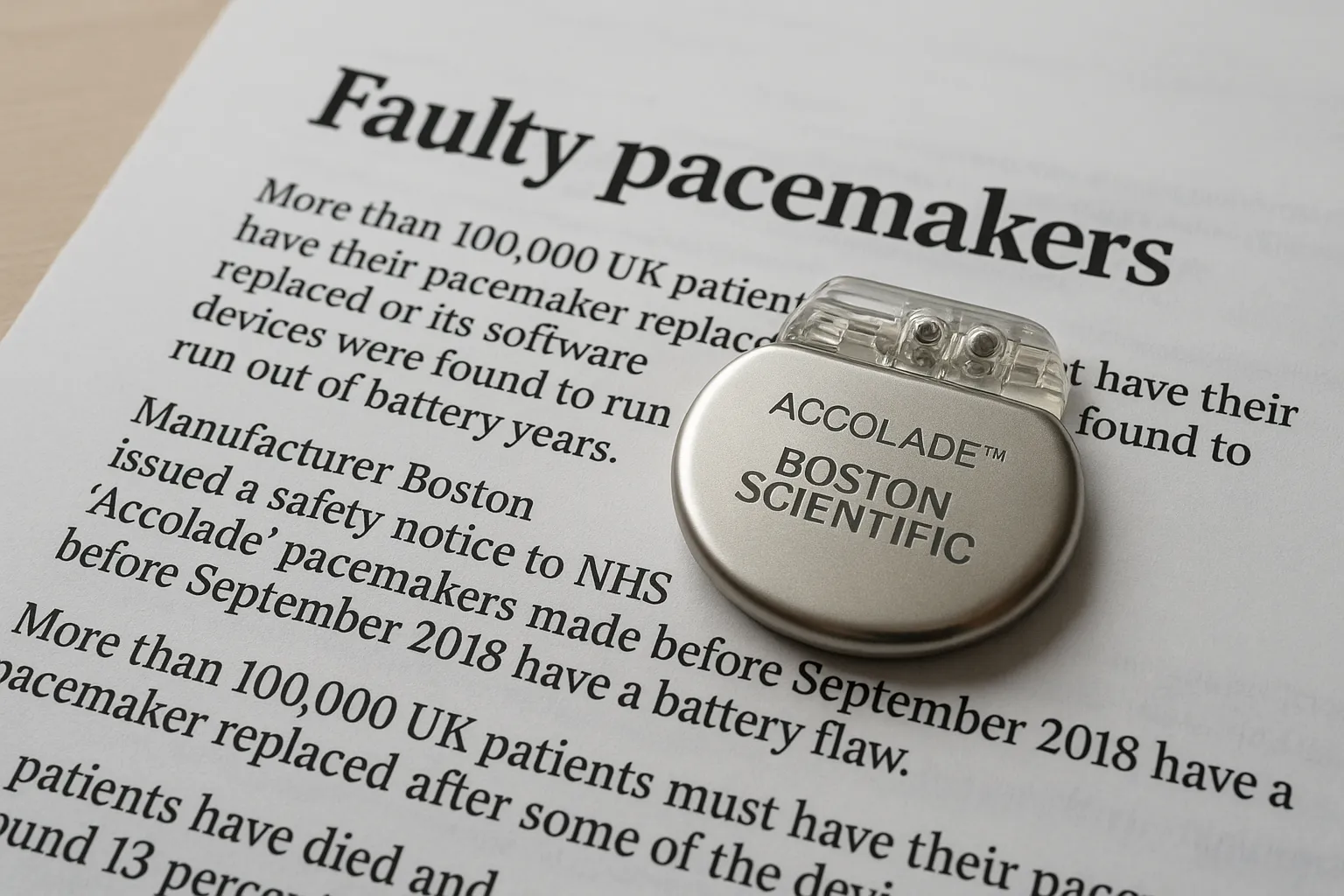
Safety alert as over 100,000 UK patients face pacemaker battery issues

Story Highlight

– Over 100,000 UK patients need pacemaker replacements or updates.
– 13% of ‘Accolade’ pacemakers have battery flaws.
– Two US patients died linked to faulty pacemakers.
– Software update avoids operations for most affected patients.
– Hospitals contacting impacted patients for further evaluation.

Full Story

In the UK, a significant health alert has been issued as over 100,000 patients are urged to either replace or update the software of their pacemakers due to a potentially dangerous battery defect. The manufacturer, Boston Scientific, has informed NHS organisations that approximately 13% of its ‘Accolade’ pacemakers produced before September 2018 are affected by this issue. This defect increases the risk of the devices unexpectedly entering a ‘safety mode’, which poses severe health risks for patients relying on them for maintaining proper heart rhythms.

The Medicines and Healthcare products Regulatory Agency (MHRA) has confirmed to the Health Service Journal that 13,969 defective devices were distributed to 153 hospitals across the UK. Reports indicate that two fatalities and upwards of 800 injuries associated with these malfunctioning devices have been documented in the United States.

Boston Scientific has been proactive, issuing a software fix last autumn specifically designed to address the identified battery flaw. The company has advised that this update should be administered on-site during patient appointments. However, according to the MHRA, the concern extends beyond the initially reported batch, suggesting that an additional 97,557 devices across 308 NHS hospitals also require software updates.

The pacemakers in question were implanted in patients between 2015 and 2018, primarily to manage conditions such as slow or irregular heart rhythms. Originally, these devices were expected to function effectively for a decade, but the discovered issue has led to some entering safety mode after just six years of use.

NHS hospitals are currently in the process of reaching out to those affected. Professor Simon Ray, the clinical director for heart disease at NHS England, stated, “While all pacemakers will need their battery replaced eventually, a small proportion of patients affected by this will need to have them replaced early. Patients affected will be contacted by their local hospital and reviewed by an expert clinical team, who will decide if they require an early replacement. People should continue to attend their usual pacemaker follow-up appointments.”

The implementation of the software update typically negates the need for surgical replacement of the devices. Instead, a straightforward software correction should suffice, allowing for ongoing monitoring of the patient’s condition. Nonetheless, the MHRA has reported that 89 early replacement surgeries have already been performed, along with 51 standard device replacements necessitated by the pacemakers shifting to safety mode.

Despite the software update being available since last September, healthcare providers observed a continuation of 88 early replacement surgeries and an additional 23 routine replacements in the months following the release. At the Royal Wolverhampton Trust, 912 patients have been identified as needing further attention, with 53 previously replaced devices documented in their records. The trust has acknowledged that this situation is considered a national emergency and has prioritised it accordingly.

Internal documents reviewed by the Health Service Journal indicated that the Royal Wolverhampton Trust is evaluating potential compensation from Boston Scientific for the additional financial burden incurred due to the defective devices. The trust noted that discussions with the manufacturer regarding compensation have begun, though it remains uncertain if the offered remedy will adequately address the incurred costs.

Similarly, Norfolk and Norwich University Hospitals previously reported identifying 580 patients with the malfunctioning pacemakers, 72 of whom were categorised as being at heightened risk due to their device’s battery issues. Concerns among patients are considerable, particularly for those directly affected by the device failures.

Adding to the legal ramifications of this safety issue, a woman from Southport has taken action against Boston Scientific following her experience with two failed pacemakers. This case exemplifies the broader implications of the product defect for patients, as the legal landscape surrounding medical device malfunctions can become increasingly complex.

The ramifications of the battery defect in Boston Scientific’s Accolade pacemakers extend beyond mere inconvenience for patients and healthcare providers. With an ongoing patient follow-up and monitoring process underway, health authorities must balance the need for immediate action with the complexities of coordination and resource allocation across the NHS.

As hospitals continue to grapple with both the clinical implications and administrative challenges posed by this safety notice, the response from Boston Scientific remains under scrutiny. The health of numerous patients hangs in the balance as health professionals work collaboratively to ensure the safety of medical devices and the well-being of individuals who depend on them. The situation emphasizes the importance of regular device checks and patient engagement in proactive health management as the NHS navigates this significant challenge in cardiac care.

Our Thoughts

To avoid the issues related to the faulty Boston Scientific ‘Accolade’ pacemakers, several improvements could have been executed. Firstly, enhanced pre-market testing and post-market surveillance should have been mandated under the UK Medical Devices Regulations, ensuring thorough reliability of device batteries well beyond the claimed lifespan. Effective risk management protocols would have identified potential failure modes early, enabling timely action before patient harm occurred.

Although a software update has been rolled out, communication channels to inform and monitor patients would benefit from expansion, ensuring all affected individuals receive prompt updates. Consistent follow-up and patient engagement are crucial in fostering patient safety, as highlighted by the regulatory framework governing medical devices.

The fact that early replacements continue, despite the software update, indicates a breach of the Health and Safety at Work Act 1974, where manufacturers must ensure that their devices are safe and do not pose risks to users. Future incidents could be mitigated through stricter adherence to safety reporting and risk assessment regulations, such as those outlined in the UK’s Medical Devices Regulation and the General Product Safety Regulations, emphasizing proactive patient safety measures and accountability from manufacturers.


SummarizeShare35Share201SendSend
ADVERTISEMENT
Ellie Cartwright

Ellie Cartwright

Related Posts

Accidental deaths in northern England twice as common as in London

Accidental deaths in northern England twice as common as in London

by Michael Harland
April 15, 2026
0

A new report reveals a stark contrast in accidental death rates across England, with the north experiencing rates double those...

More than 30 children's toys recalled in UK due to asbestos contamination

More than 30 children’s toys recalled in UK due to asbestos contamination

by Ellie Cartwright
April 27, 2026
0

Over 30 children's toys have been recalled in the UK after alarming findings revealed they contained asbestos-laden play sand supplied...

Useful Documents

  • Understanding RIDDOR
  • 10 Workplace Safety Failures
  • A Complete Guide to Reporting Safety Incidents in the UK
  • Understanding RIDDOR
  • Fire Risk Assessment: Meeting the Regulatory Reform (Fire Safety) Order
  • COSHH Basics: A Practical Guide to Control of Substances Hazardous to Health
  • Working at Height in the UK: The Essentials (WAH Regulations 2005)
  • Lock out Tag out LOTO
ADVERTISEMENT
Key changes affecting families as phone bans, smoking laws, and benefit reforms announced
UK Health and Safety Latest

Key changes affecting families as phone bans, smoking laws, and benefit reforms announced

by Tara Rowden
May 2, 2026
0

A series of transformative measures aimed at enhancing children's welfare and supporting families across the UK has been unveiled. Key...

Read moreDetails
Tree surgeon suffers life-threatening injuries after electric shock from powerline

Tree surgeon suffers life-threatening injuries after electric shock from powerline

May 1, 2026
Login issues disrupt access to online services

Login issues disrupt access to online services

May 1, 2026
Cardiff University fined after staff develop asthma from laboratory allergens

Cardiff University fined after staff develop asthma from laboratory allergens

May 1, 2026
UK Safety News

Copyright © 2025
UK Safety News

Navigate Site

  • About
  • Advertise
  • Policies
  • Useful Documents
  • Contact
  • Agent

Follow Us

Welcome Back!

Login to your account below

Forgotten Password?

Retrieve your password

Please enter your username or email address to reset your password.

Log In
No Result
View All Result
  • Home
  • News

Copyright © 2025
UK Safety News

This website uses cookies. By continuing to use this website you are giving consent to cookies being used. Visit our Privacy and Cookie Policy.