













Story Highlight
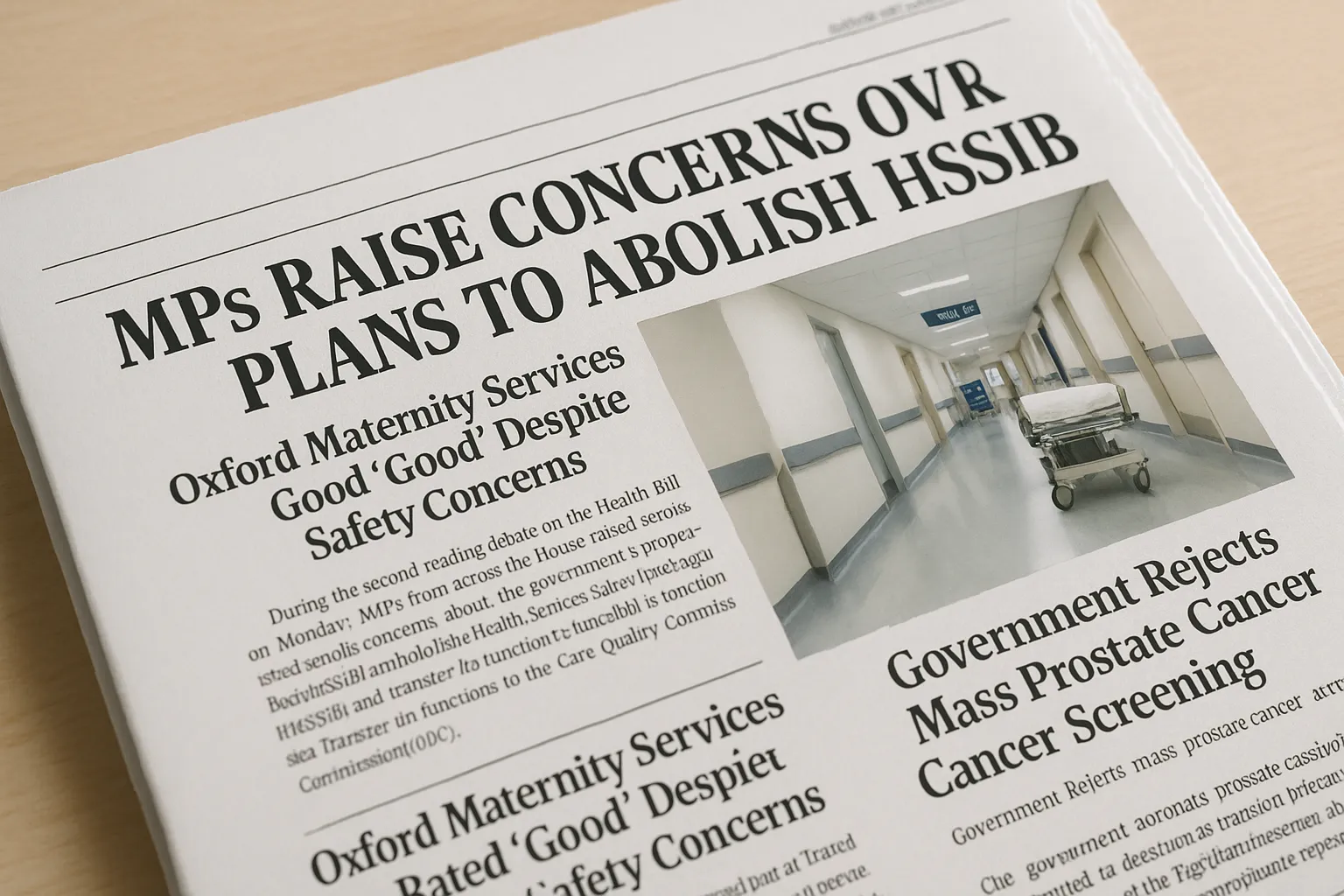
– MPs oppose proposal to abolish HSSIB; call it a mistake.
– Oxford’s maternity services rated ‘good’ despite safety concerns.
– Government rejects mass prostate cancer screening recommendations.
– NMC faces criticism for 12-year applicant checking failure.
– Lab error led to unnecessary cancer investigations for patients.
Full Story
In this edition of the Patient Safety Watch newsletter, the focus is sharply on the crucial developments concerning patient safety, encapsulating a variety of recent discussions and reports that highlight the ongoing challenges and changes within the healthcare system.
Concerns Over Abolishing HSSIB
A significant point of contention arose during the second reading of the Health Bill, as Members of Parliament expressed acute concerns regarding the government’s intentions to dissolve the Health Services Safety Investigations Body (HSSIB). This body, which plays a vital role in conducting independent investigations into healthcare incidents, is proposed to have its functions transferred to the Care Quality Commission (CQC).
Sir Bernard Jenkin MP was particularly vocal, labeling the government’s move as a “dreadful mistake.” He argued that the HSSIB is uniquely positioned to conduct investigations free from the pressures of regulation and enforcement, which is essential for fostering an environment where learning from mistakes is possible.
The abolition of HSSIB raises alarms as it represents one of the more troubling aspects of the proposed Health Bill. Established as a response to past tragedies and avoidable fatalities in healthcare, the HSSIB aims to promote improvements through independent inquiries that focus on systemic issues. Its independence is not merely advantageous; it is a cornerstone of its legitimacy and effectiveness in gaining the trust of patients, families, and healthcare practitioners.
Critics of the government’s proposal argue that merging HSSIB’s functions with those of the CQC risks undermining the specialised learning and investigative processes that the HSSIB currently provides. Carl Macrae, in an analysis, warns that this shift could diminish the healthcare sector’s capacity for comprehensive safety investigations at a time when such capabilities are heavily needed. In critical sectors like aviation and rail, independent investigation entities are already established as fundamental components of safety frameworks, and detracting from this model in healthcare would signify a severe regression in patient safety advancements made in recent years.
Oxford Maternity Services Rated as ‘Good’
In another healthcare update, the CQC has rated the maternity services at Oxford University Hospitals as “good” overall, despite uncovering several safety issues at the John Radcliffe Hospital. While the maternity services received an overall positive rating, they were marked as “requires improvement” with regards to safety standards.
Concerns raised by inspectors included inadequate staffing levels and reports of unsafe working hours, with midwives facing long shifts without adequate rest breaks. Such findings have sparked a debate among healthcare campaigners, leading many to question the apparent contradiction of an overall ‘good’ rating when safety concerns remain prominent. Oxford University Hospitals is currently one of twelve trusts undergoing scrutiny as part of the National Maternity and Neonatal Investigation, with the full report anticipated by the end of June.
Government Decision Against National Prostate Cancer Screening Program
The government has recently accepted the verdict of the UK National Screening Committee, opting not to implement a national screening programme for prostate cancer for the majority of men. Instead, routine screening will be limited to specific groups, including those with certain genetic markers and a familial predisposition to cancer.
James Murray, the Secretary of State for Health and Social Care, confirmed this decision, stating that it stems from a commitment to evidence-based practice aimed at preventing potential harm associated with overdiagnosis and unwarranted treatments. However, the decision has met with backlash from several health advocates and notable figures, including former Prime Minister David Cameron, who described it as a “missed opportunity.”
To address disparities in healthcare, the government announced a £20 million expansion of the Transform prostate cancer trial, which will invite more Black men to participate, thereby enhancing research efforts into early detection strategies. An analysis from the Sunday Times highlighted reinforcing arguments from differing camps regarding the screening decision, featuring insights from Professor Sir Mike Richards, chair of the NSC, and prostate cancer survivor Nick Jones.
E-Prescribing Risks Identified by HSSIB
The HSSIB has unveiled a report assessing the safety of electronic prescribing and medicines administration (ePMA) systems prevalent in NHS facilities. While these systems hold the potential to mitigate medication errors, the report indicates significant inconsistencies in design and assurance processes across different NHS trusts.
The absence of a national framework for patient safety criteria raises serious implications; many trusts must navigate complex safety evaluations with limited expertise. HSSIB’s investigation outlined the necessity for national bodies to promote coherence and robustness in safety frameworks for ePMA systems, making several key recommendations, including the establishment of a national safety framework and enhanced guidance on regulatory expectations.
Nursing and Midwifery Council’s Structural Failings
Following revelations reported by The Guardian, the Nursing and Midwifery Council (NMC) is grappling with intensified scrutiny over its failure to assess health and character declarations adequately from applicants over a prolonged span of 12 years. An extensive review disclosed that over 18,000 applications were not appropriately evaluated, necessitating reassessment for more than 400 registrants, potentially affecting up to 15 applicants who could face removal from the register.
This situation raises serious questions about the NMC’s effectiveness. The Royal College of Nursing indicated that lapses in these procedures could place patients at risk. Echoing past criticisms, these revelations revive concerns previously expressed in the Professional Standards Authority’s examination of the NMC’s oversight in the Morecambe Bay maternity case, noting systemic deficiencies in how concerns were handled.
Laboratory Error Leads to Unnecessary Cancer Investigations
A processing error at South West London Pathology has resulted in the issuance of over 4,200 erroneous bowel cancer screening results between December 2025 and March 2026. The defect was traced back to faecal immunochemical tests (FITs), which were reported incorrectly, indicating rates approximately five times higher than they actually were due to a failure to apply a unit conversion properly.
This miscalculation has had significant ramifications, with as many as 1,326 patients potentially being misdirected toward urgent cancer investigation pathways, subjecting them to unnecessary and invasive procedures such as colonoscopies. Fortunately, the investigation suggests that no cases of missed cancer diagnoses occurred as a direct result of this error. An extensive harm review is currently being organised among 17 entities, with updates expected later this year.
Research Highlights Importance of Empathy in Healthcare
In a fresh study reported by The Guardian, findings indicate that NHS trusts embodying more empathetic organisational cultures tend to achieve superior patient outcomes as well as long-term benefits for staff. Those with elevated “empathy scores” were correlated with higher CQC ratings for safety and effectiveness, alongside reduced staff burnout and lower sickness absence rates.
Public Sentiments on AI Scribes in Healthcare
A recent report reflecting the views of the public reveals widespread approval for the incorporation of AI scribes in healthcare, recognised for their potential to alleviate administrative tasks, enabling clinicians to devote more time to patient interaction. Nonetheless, participants underscored the importance of maintaining stringent safety standards, echoing concerns over accuracy, data security, training, and accountability for errors. A central proposition emerged calling for robust national oversight to ensure the security and effectiveness of AI scribes in a healthcare context.
Upcoming Events and Research Publications
As we conclude this edition, we highlight some forthcoming events and research that may pique readers’ interest. A notable webinar by SafetyNet on 24 June will focus on addressing inequalities in surgical safety, led by Ramani Moonesinghe, who will present research findings aimed at bridging health disparities.
Additionally, a study on the repercussions of differing birth expectations on maternal wellbeing reveals pivotal insights regarding first-time mothers’ experiences. The research suggests that prevailing cultural norms can inadvertently impact psychological wellbeing when childbirth experiences deviate from the anticipated outcomes.
Finally, a review in the Journal of Patient Safety and Risk Management emphasises the necessity for Communication and Resolution Programmes (CRPs) in healthcare, demonstrating their efficacy in decreasing malpractice claims and expediting incident resolution. The potential benefits outlined underpinned the importance of fostering environments supportive of healing and constructive dialogue when healthcare complications arise.
The next edition of the Patient Safety Watch newsletter is anticipated in two weeks, offering further insights into continued developments in patient safety.
Our Thoughts
The article highlights several safety issues within healthcare provisions, notably the inspection of maternity services at Oxford University Hospitals and the processing error by South West London Pathology. To avoid such incidents, adherence to the Health and Safety at Work Act 1974 and CQC fundamental standards is crucial.
Key safety lessons include ensuring adequate staffing levels to mitigate burnout and stress among healthcare workers, as well as the importance of rigorous training for staff on new technologies. The lack of a comprehensive framework for electronic prescribing (ePMA) raised concerns about inconsistent safety practices, indicating that national guidelines and oversight are essential.
Breaches of regulations, such as inadequate staffing and unsafe working conditions, can significantly increase the risk of errors, impacting patient safety. The investigation errors from the pathology lab underscore the necessity for robust quality assurance processes to ensure accuracy in testing, which is imperative for patient safety.
Future prevention of similar incidents can be achieved by strengthening independent investigation bodies like HSSIB, which are vital for learning from mistakes without the bias of regulatory enforcement, thereby maintaining a focus on improving healthcare systems.