Tragedy of heatstroke highlights urgent need for athlete safety reforms
In a tragic incident that underscores the critical need for improved athlete safety protocols, Arizona State University hockey player Matthew...
Read moreDetailsIn a tragic incident that underscores the critical need for improved athlete safety protocols, Arizona State University hockey player Matthew...
Read moreDetails




Last updated: 7 September 2026
Author: Jade Anderson, Senior Reporter, UK-Safety.News
Reading time: about 12 minutes
Falls from height kill more workers in Great Britain than any other kind of accident. HSE’s provisional figures for 2025/26 record 126 workers killed at work, 31 of them in falls from a height, around a quarter of the total. Many of the serious injuries come from falls of less than three metres.
Most fatal falls involve a routine task on a roof, a ladder or an unprotected edge, done without a plan or the right kit. The Work at Height Regulations 2005 were written to break that pattern; this guide sets out what they require.
Work at height means work in any place where, if there were no precautions in place, a person could fall a distance liable to cause personal injury. That includes a ladder, a roof, a platform or the back of a lorry, an edge, an opening or a fragile surface, and ground level work next to an excavation a person could fall into. It does not include slips and trips on the level, or walking up and down a permanent staircase in a building.
The old construction regulations set a two metre threshold; the 2005 Regulations removed it. The test is whether the fall could cause injury, not how far it is. The only place two metres survives is regulation 12, which sets the 7 day inspection interval for construction working platforms from which a person could fall 2 metres or more.
| Who | Main duties |
|---|---|
| Employers | Avoid work at height where reasonably practicable; ensure it is properly planned, appropriately supervised and carried out safely by competent people using suitable equipment; plan for emergencies and rescue; inspect equipment and surfaces; control falling objects |
| Those in control of work (facilities managers, building owners, principal contractors) | The same duties as an employer for the work they control. Handing a job to a contractor does not remove the duty to check it is done safely |
| Self employed people | Duties as an employer for their own work and for anyone under their control |
| Employees and workers | Follow training and instructions, use the equipment provided as shown, report defects and hazards, take reasonable care of themselves and others |
The Regulations sit alongside the Management of Health and Safety at Work Regulations 1999, PUWER 1998, LOLER 1998 and, on construction projects, CDM 2015. HSE’s short guide is INDG401, Working at height: A brief guide.
Regulation 6 sets a strict order of preference, and every decision about a job at height should be traceable to it.
At every level, collective protection (which protects everyone without them having to do anything) comes before personal protection (which only works if the individual clips on correctly). “Reasonably practicable” means weighing the risk against the cost, time and trouble of the control; for a fall that could kill, very little is disproportionate.
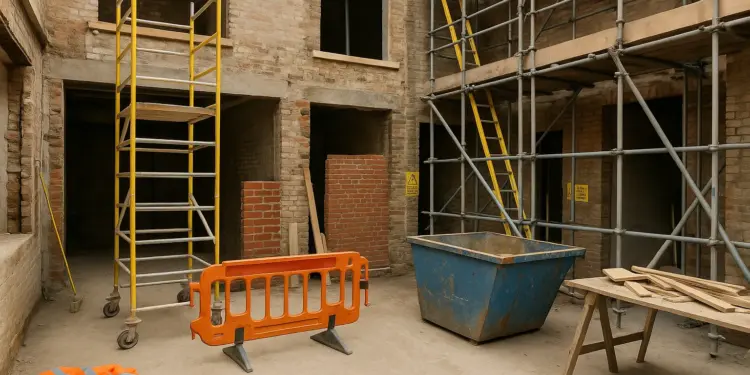
Regulation 4 requires that work at height is properly planned, appropriately supervised and carried out in a way that is, so far as is reasonably practicable, safe. Planning must include selecting the right equipment and, in the words of the regulation, “planning for emergencies and rescue”. For a routine task that may be a risk assessment and a short method statement; for a complex job it is a permit to work and a named rescue team. Match supervision to the risk: a stockroom stepladder needs an occasional check, a team on a fragile roof needs a supervisor present who can stop the job.
Everyone involved in planning, supervising or doing work at height must be competent, or if in training, supervised by someone who is. For low risk ladder work that may be no more than instruction in how to use the equipment safely; for scaffolding, MEWP operation or rope access it means recognised training and assessment. Keep the records.
Regulation 4(3) requires that work at height is carried out only when the weather conditions do not jeopardise the health or safety of the people involved. Check the manufacturer’s maximum wind speed for MEWPs and towers and stop before you reach it; ice, wet surfaces, poor light and heat matter too. Build a go or no go check into the start of shift briefing.
A worker hanging in a harness after a fall arrest can lose consciousness within minutes, and calling the fire service is not a rescue plan. Before anyone relies on fall arrest you need a way of reaching them quickly, such as a MEWP on standby or a rescue kit with trained people, and you need to have rehearsed it.
| Level | Collective (preferred) | Personal (only if collective is not reasonably practicable) |
|---|---|---|
| Prevent a fall | Parapets and guardrails; temporary edge protection with top rail, mid rail and toeboard; guarded scaffolds and towers; MEWPs; covered openings | Work restraint: a harness and a fixed length lanyard adjusted so the wearer cannot reach the edge |
| Minimise the distance and consequences | Safety nets rigged close beneath the work; soft landing systems such as airbags on the floor below | Fall arrest: full body harness, energy absorbing lanyard, rated anchor, clearance below and a rescue plan; industrial rope access |
| Low risk, short duration only | Ladders and stepladders, used as described below | |
Restraint prevents the fall and needs no rescue. Arrest catches a person who has already fallen, shock loads them, needs several metres of clear space below the anchor, and creates an immediate rescue problem. Check harnesses before every use, with a formally recorded inspection at least every 6 months, and scrap any harness that has arrested a fall.
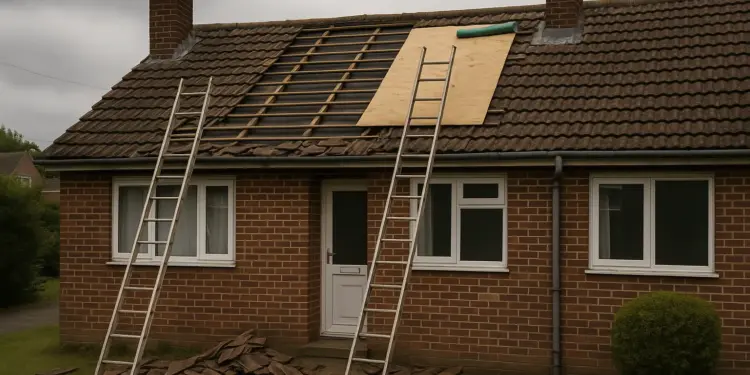
Ladders are not banned, but they are used for jobs they were never suited to. HSE’s guidance Safe use of ladders and stepladders (LA455, which replaced INDG455) sets the tests.
Do a pre use check every time (stiles, feet, rungs, locking bars, platform), take damaged ladders out of service and keep a register with periodic detailed inspection.
Unless a scaffold is built to a recognised standard configuration, such as the National Access and Scaffolding Confederation’s TG20 guidance, it must be designed by a competent person. Every scaffold gang needs at least one trained, competent scaffolder. Nobody else should alter the scaffold, and a missing board or guardrail is a stop the job event.
The manufacturer’s instructions are the method statement, and the person erecting should be trained; the industry standard is the PASMA scheme. Build with advance guardrails or the through the trap method so nobody stands on an unguarded platform, fit stabilisers, lock the castors and never move the tower with people on it.
Mobile elevating work platforms are often the safest option because the operator works inside a guarded basket; the recognised training scheme is run by IPAF. Plan for ground conditions, overhead hazards and the risk of being trapped against a structure. In boom type MEWPs a harness with a short restraint lanyard stops the operator being catapulted out. MEWPs need a thorough examination under LOLER at least every 6 months as well as daily checks, and someone on the ground must know the emergency descent controls.
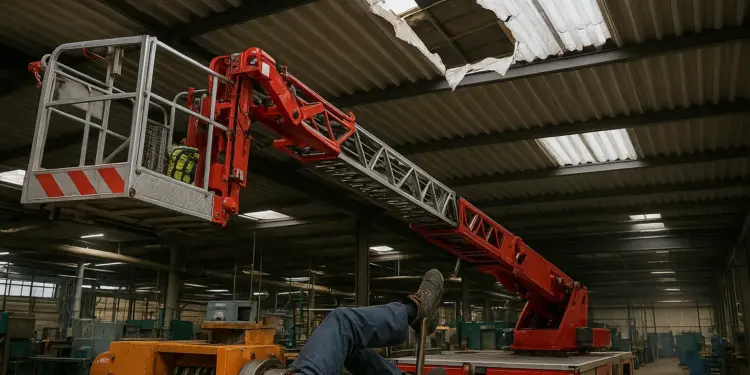
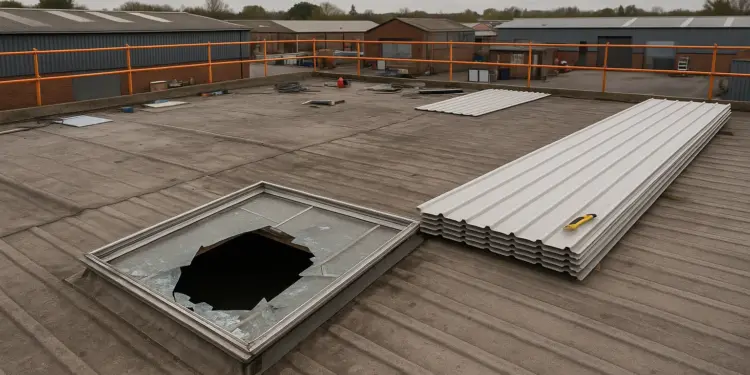
HSE’s guidance HSG33, Health and safety in roof work, notes that falls through fragile materials such as roof lights and asbestos cement sheets account for more roof work deaths than any other single cause. On sloping roofs fit edge protection at the eaves; on flat roofs use a double guardrail and toeboard. Keep people off the roof for work that can be done from a MEWP or from inside. If the roof contains asbestos cement, our guide to the Control of Asbestos Regulations 2012 explains the additional duties.
Treat every roof as fragile until a competent person has confirmed it is not. Regulation 9 requires that nobody passes across, near or works on a fragile surface where it is reasonably practicable to do the work safely without doing so. Where it is not, you must provide platforms, coverings, guardrails or similar means strong enough for the foreseeable loads, and if a risk of falling remains, minimise the distance and consequences, typically with nets slung close beneath the roof. Prominent warning notices must be displayed at the approach to any fragile surface. Roof lights are the classic trap: some are hard to see in certain light, others have been painted over.
Regulation 10 requires you to prevent, so far as is reasonably practicable, the fall of any material or object, and where that is not possible, to stop anyone being struck. Nothing may be thrown or tipped from height where it could injure someone, and materials must be stored so they cannot collapse, overturn or move. Practical controls are toeboards, brick guards, debris netting, tool lanyards, chutes, and a barriered exclusion zone below.
| Requirement | In practice |
|---|---|
| Equipment whose safety depends on installation or assembly must be inspected in position before first use | A scaffold, tower or edge protection system is inspected after it is built and before anyone works from it |
| Equipment exposed to deterioration must be inspected at suitable intervals and after any exceptional circumstance liable to jeopardise safety | After high winds, a vehicle strike, an alteration or a long period unused |
| A construction working platform from which a person could fall 2 metres or more must have been inspected within the previous 7 days | The weekly scaffold inspection. It applies to towers used in construction too |
| The report must be prepared before the end of the working period and handed over within 24 hours | Record the Schedule 7 particulars: location, date, defects, action taken, inspector’s name |
| Reports kept on site until the work is complete, then for 3 months at an office; hired equipment must arrive with evidence of its last inspection | Keep scaffold tags and records together; check hire paperwork on delivery |
Record defects even when fixed on the spot. Under regulation 13 you must also inspect the surface and any parapet or permanent rail of a place of work at height before each use.
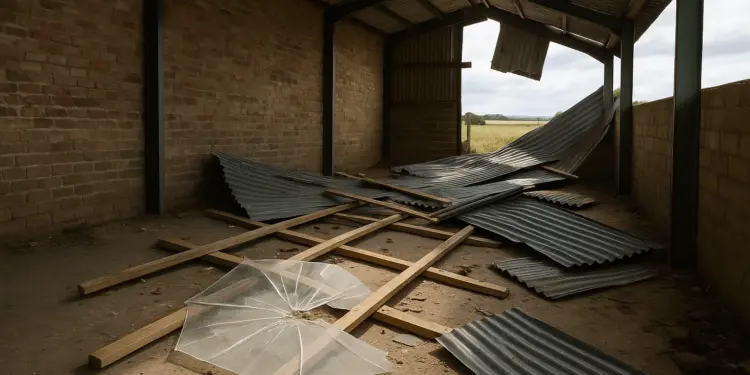
On 5 February 2025 a 24 year old bricklayer employed by Len Smith and Son Building Contractors Limited was repairing a farm building at Seahouses, Northumberland. He stepped on a polycarbonate roof sheet and fell about eight feet to the concrete floor below, breaking two vertebrae and fracturing his sternum. He needed surgery.
HSE found no risk assessment and no safe system of work for the roof repairs. At North Tyneside Magistrates’ Court on 6 August 2026 the company pleaded guilty to breaching sections 2(1) and 3(1) of the Health and Safety at Work etc. Act 1974 and was fined £20,000 with £5,744 in costs.
The roof should have been treated as fragile (regulation 9), the job was not planned (regulation 4), and nothing was in place to prevent a fall or minimise its consequences (regulation 6). A fall of under three metres caused life changing injuries, which is why the two metre rule no longer exists. If a serious fall happens on your site, our guide to reporting safety incidents covers the first hour and what must be reported under RIDDOR.
If any answer is no, the job does not start.
| Question | Evidence | Regulation |
|---|---|---|
| Can the work be done without going to height? | Options recorded in the risk assessment | 6(2) |
| Is there a safe place of work, or equipment chosen to prevent a fall? | Method statement names the equipment | 6(3), 6(4), 7 |
| If a fall cannot be prevented, are distance and consequences minimised? | Nets, airbags or fall arrest with anchors and clearance specified | 6(5) |
| Is there a rescue plan that does not rely on the emergency services? | Named rescuers, kit on site, drill done | 4(2) |
| Are the people competent, with supervision matched to the risk? | Training records, supervisor named on the plan | 4, 5 |
| Has the weather been checked against the equipment limits? | Wind speed and conditions recorded at start of shift | 4(3) |
| Have fragile surfaces been identified, protected and signed? | Roof survey, coverings or nets, warning notices | 9 |
| Are people below protected from falling objects? | Toeboards, netting, exclusion zone with barriers | 10 |
| Has the equipment been inspected, with the record available? | Scaffold report within 7 days, ladder and harness checks, LOLER certificate for the MEWP | 12, 13 |
Yes, because a fall could cause injury. The controls are simple, but the Regulations apply and a short assessment should exist.
No. They need to be competent, which for low risk ladder work usually means instruction and a check that they have understood, recorded. Formal training is needed for scaffolds, towers, MEWPs and personal fall protection.
HSE’s rule of thumb is that if a task would require staying up a leaning ladder or stepladder for more than 30 minutes at a time, you should use alternative equipment such as a tower or MEWP. It is guidance rather than a legal limit, but inspectors expect to see it applied.
Before first use, then at intervals of no more than 7 days, and after any event that could affect its safety such as high winds or an alteration. Keep the report on site until the job finishes and for 3 months after.
Rarely. A harness is personal protection and sits below collective measures in the hierarchy. It only works with a rated anchor, the right lanyard, enough clearance, a trained user and a rescue plan. Restraint that stops the wearer reaching the edge is always better than arrest.
The contractor has duties as an employer for its own staff. You have duties to the extent that you control the work: choosing a competent contractor, telling them about fragile roofs and other hazards, and checking the work is done as agreed. On construction work the CDM 2015 roles apply as well.
This guide is general information for Great Britain and is not legal advice. Check the current HSE guidance before acting on a specific case.
About the author: Jade Anderson specialises in turning regulations into practical steps for supervisors and safety leads.

Copyright © 2026 UK Safety News