














Choose an AI chat
Worker dies in Cardiff after company fails to maintain industrial door
UK Health and Safety Latest

Worker dies in Cardiff after company fails to maintain industrial door

by Ellie Cartwright
June 19, 2026
0

A Cardiff-based printing company has been fined £400,000 following the death of maintenance worker Anthony Webb while repairing an industrial...

Read moreDetails
Thousands face potential spinal surgery due to implant recall

Thousands face potential spinal surgery due to implant recall

June 19, 2026
Amber alert issued as southern England braces for extreme heat

Amber alert issued as southern England braces for extreme heat

June 19, 2026
Temporary mobility issues may lead to Blue Badge eligibility in Scotland

Temporary mobility issues may lead to Blue Badge eligibility in Scotland

June 18, 2026
Patients face unprecedented NHS medicine shortages

Patients face unprecedented NHS medicine shortages

June 17, 2026

Archives

  • June 2026
  • May 2026
  • April 2026
  • March 2026
  • February 2026
  • January 2026
  • December 2025
  • November 2025
  • October 2025
  • September 2025
  • July 2025
  • August 2009

Categories

  • Health and Safety Help
  • News
  • Policies
  • UK Health and Safety Latest
  • About
  • Advertise
  • Policies
    • Privacy Policy
    • Editorial Policy
    • Corrections & Complaints policy
  • Useful Documents
    • Understanding RIDDOR
    • 10 Workplace Safety Failures
    • A Complete Guide to Reporting Safety Incidents in the UK
    • Fire Risk Assessment: Meeting the Regulatory Reform (Fire Safety) Order
    • COSHH Basics: A Practical Guide to Control of Substances Hazardous to Health
    • Working at Height in the UK: The Essentials (WAH Regulations 2005)
    • Asbestos in the Workplace: Control of Asbestos Regulations 2012 (CAR) Essentials
    • Managing Contractors Under CDM 2015: Roles, Duties & Controls
    • DSE & Ergonomics: Healthy Workstations for Office & Hybrid Teams
    • Lock out Tag out LOTO
    • Workplace Transport Safety: Forklifts, Pedestrians & Traffic Management
    • Noise & Vibration at Work: Practical Controls (2005 Regulations)
    • Confined Spaces in the UK: Safe Entry under the Confined Spaces Regulations 1997
  • Contact
  • Agent
Friday, June 19, 2026
16 °c
London
17 ° Sat
15 ° Sun
17 ° Mon
  • Login
UK Safety News
  • Home
  • News
    • All
    • UK Health and Safety Latest
    Worker dies in Cardiff after company fails to maintain industrial door

    Worker dies in Cardiff after company fails to maintain industrial door

    Thousands face potential spinal surgery due to implant recall

    Thousands face potential spinal surgery due to implant recall

    Amber alert issued as southern England braces for extreme heat

    Amber alert issued as southern England braces for extreme heat

    Temporary mobility issues may lead to Blue Badge eligibility in Scotland

    Temporary mobility issues may lead to Blue Badge eligibility in Scotland

    Patients face unprecedented NHS medicine shortages

    Patients face unprecedented NHS medicine shortages

    Patients face record NHS medicine shortages

    Patients face record NHS medicine shortages

    Medicine shortages pose life-threatening risks to patients in the UK

    Medicine shortages pose life-threatening risks to patients in the UK

    Residents oppose council’s warning against flag displays during World Cup

    Residents defend flag displays as council warns against public displays during World Cup

    Residents defend flag displays as council warns against public displays during World Cup

    UK issues amber heat health alerts as temperatures soar

    UK issues amber heat health alerts as temperatures soar

    Trending Tags

    • Donald Trump
    • Future of News
    • Climate Change
    • Market Stories
    • Election Results
    • Flat Earth
No Result
View All Result
UK Safety News
No Result
View All Result
Home News UK Health and Safety Latest

Beware of banned donations for spring cleaning at the British Heart Foundation

Tara Rowden by Tara Rowden
March 4, 2026
in UK Health and Safety Latest
Reading Time: 4 mins read
0
Beware of banned donations for spring cleaning at the British Heart Foundation

Story Highlight

– British Heart Foundation operates nearly 700 charity shops.
– Extensive list of banned items for health reasons.
– Children’s costumes need safety labels to be accepted.
– No used pillows, duvets, or unsafe furniture allowed.
– Personal appliances and weapons are prohibited donations.

Full Story

As the season of spring cleaning unfolds, many individuals are revisiting their New Year’s resolutions regarding decluttering, which often leads to multiple visits to local charity shops. The British Heart Foundation (BHF), the UK’s largest charity retail network with approximately 691 stores across the country, offers a vital service by accepting donations and selling these goods to generate funds for heart disease research and support initiatives.

However, it is important to note that not every item can be accepted. The BHF has implemented a comprehensive list of restrictions on the types of goods they will sell, not just for logistical efficiency but primarily for health and safety considerations. Understanding which items are prohibited can save donors from potential disappointment during their drop-off.

Among the most frequently donated items are clothing and accessories. While the BHF encourages donations of garments, they also highlight several types of clothing that are specifically barred from their shelves. For adult fancy dress costumes, acceptance hinges on the presence of safety labels that indicate low flammability or “keep away from fire” warnings. For children’s fancy dress, it is essential that the attire carries a CE/UKCA marking or comparable safety indication. Additionally, nightwear items—including nightdresses, pyjamas, and robes—must also incorporate appropriate flammability warnings.

An unexpected rule concerns children’s garments that feature drawstring hoods; such items are entirely excluded from donations. Homemade knitted clothing is similarly not permitted. This focus on safety reflects the charity’s commitment to ensuring that all merchandise sold in their shops meets stringent safety regulations.

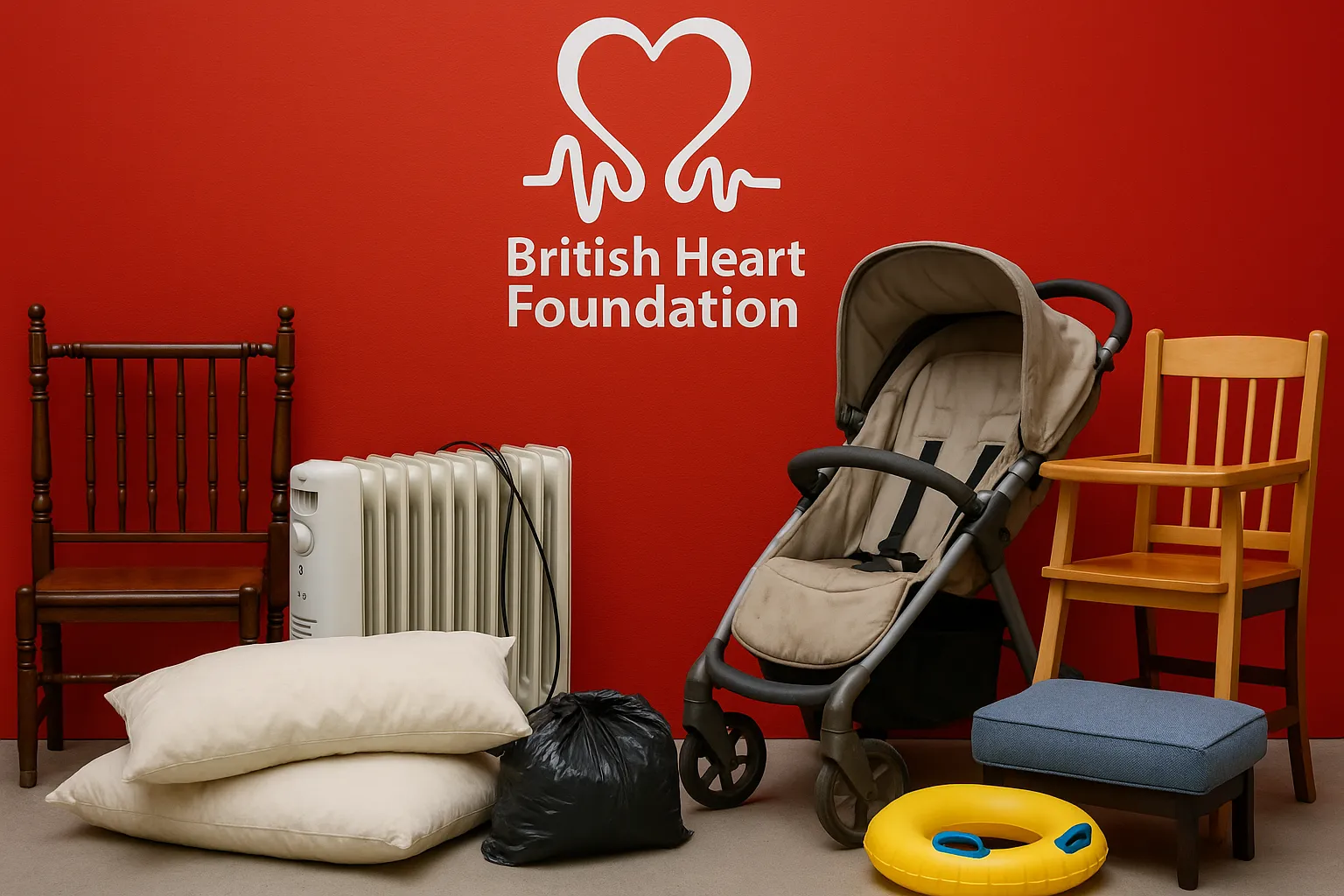
The BHF also has specific guidelines surrounding the donation of furniture and homeware products. While they maintain dedicated outlets for such items, only good quality furniture that meets particular safety standards will be accepted. Used pillows, duvets, and quilts are among the items explicitly rejected unless they have accompanying fire safety labels. Furniture painted with lead-based paint is similarly disallowed, marking a clear boundary aimed at protecting prospective buyers.

When it comes to children’s items, the restrictions are markedly extensive due to safety concerns. The BHF does not accept car seats, booster seats, prams, pushchairs, or buggies. Families may find these second-hand items appealing, but the potential hazards associated with their use make them unsuitable for resale. Other prohibited items in this category include cots, high chairs, safety gates, and playpens. The charity also does not allow inflatable beds, dinghies, or toys designed for water play, reflecting a broader commitment to prioritising children’s safety.

Beyond clothing and children’s goods, there exists an assortment of other items deemed unsuitable for resale. This includes personal equipment like electric shavers or foot spas, which are only accepted if they remain brand new and in sealed packaging. Prescription glasses are notably excluded to avoid hygiene issues as well.

The list of banned items further expands to include any potential weapons and hazardous materials, which encompass a wide range of gas- or oil-powered tools and equipment. Items such as electrical blankets, electrical hoists, oil lamps, and power tools are categorically refused. This careful curation reinforces the BHF’s dedication to maintaining a safe and high-quality shopping environment.

It is always prudent for donors to check BHF’s official website or consult with shop staff when considering what to donate. The implications of not adhering to these guidelines can lead to not only disappointment but also unintentional waste as rejected items must be disposed of responsibly. An awareness of these proscriptions enhances the donation experience, ensuring that what is given is both appreciated and appropriate for resale.

For those contemplating a spring clean, this information is essential in optimising their decluttering efforts. While the BHF plays a crucial role in supporting cardiovascular health initiatives through its charity shops, abiding by these donation protocols amplifies the effectiveness of their mission. By understanding and respecting the items that the BHF cannot accept, donors can contribute positively and efficiently to charitable efforts, making their swings by their local shops more fruitful.

Engaging in the practice of donating to charity shops not only aids those in need but also promotes sustainability by giving a second life to unwanted items. As many prepare for this season of spring cleaning, being informed about what can and cannot be donated is vital for a seamless experience that benefits both the donor and the charitable cause they support.

Our Thoughts

To avoid potential health and safety hazards associated with donations, the British Heart Foundation could implement a clearer communication strategy concerning acceptable items. Providing comprehensive guidance on their website and at donation points would help donors understand the specific safety regulations related to clothing and equipment.

Key safety lessons include the importance of ensuring that donated items meet the relevant safety standards, such as the Consumer Protection Act 1987, which mandates that products must not pose a health risk. Items like children’s clothing and furniture must comply with safety labeling requirements to prevent hazards, particularly those that could lead to fire risks or choking.

Additionally, the Health and Safety at Work Act 1974 emphasizes the duty of care to protect the health and safety of the public. By refusing dangerous items and clearly communicating these policies, the charity minimizes legal complications and protects both staff and customers. Regular training on safety standards for staff handling donations can further reduce risks and ensure compliance with relevant regulations.


SummarizeShare35Share198SendSend
ADVERTISEMENT
Tara Rowden

Tara Rowden

Related Posts

Calls for action on road safety strategy to reduce alcohol limits

Calls for action on road safety strategy to reduce alcohol limits

by Tara Rowden
January 8, 2026
0

The British Medical Association (BMA) has thrown its weight behind the Government's Road Safety Strategy, calling for urgent action following...

Many unaware of caffeine content in daily drinks

Many unaware of caffeine content in daily drinks

by Jade Anderson
April 13, 2026
0

A new study has revealed that many consumers are unaware of their daily caffeine intake, with over 40% failing to...

Useful Documents

  • Understanding RIDDOR
  • 10 Workplace Safety Failures
  • A Complete Guide to Reporting Safety Incidents in the UK
  • Understanding RIDDOR
  • Fire Risk Assessment: Meeting the Regulatory Reform (Fire Safety) Order
  • COSHH Basics: A Practical Guide to Control of Substances Hazardous to Health
  • Working at Height in the UK: The Essentials (WAH Regulations 2005)
  • Lock out Tag out LOTO

Recent Posts

  • Worker dies in Cardiff after company fails to maintain industrial door
  • Thousands face potential spinal surgery due to implant recall
  • Amber alert issued as southern England braces for extreme heat
  • Temporary mobility issues may lead to Blue Badge eligibility in Scotland
  • Patients face unprecedented NHS medicine shortages

Recent Comments

  1. Piper Douglas on Worker dies due to inadequate machinery safety measures
  2. Natalie Coleman on New housing laws aim to tackle damp and mould crisis in England
  3. Simon Barrett on Honeymoon ruined by illness as newlywed suffers severe infection in Cape Verde
  4. Nolan Barrett on Work-related ill health in Great Britain remains a concern after pandemic peak
  5. Dylan Reeves on Sickness rates among Scottish police officers soar to troubling levels
UK Safety News

Copyright © 2026
UK Safety News

Navigate Site

  • About
  • Advertise
  • Policies
  • Useful Documents
  • Contact
  • Agent

Follow Us

Welcome Back!

Login to your account below

Forgotten Password?

Retrieve your password

Please enter your username or email address to reset your password.

Log In
No Result
View All Result
  • Home
  • News

Copyright © 2026
UK Safety News

This website uses cookies. By continuing to use this website you are giving consent to cookies being used. Visit our Privacy and Cookie Policy.