
















Story Highlight
– Grenfell Tower demolition continues amid memorial art installations.
– Ninth anniversary of the fire approaches, remembering 72 victims.
– Criminal charges pending; disillusionment among survivors persists.
– Local community expresses frustration over neglect and delays.
– Calls for justice remain unfulfilled nearly a decade later.
Full Story
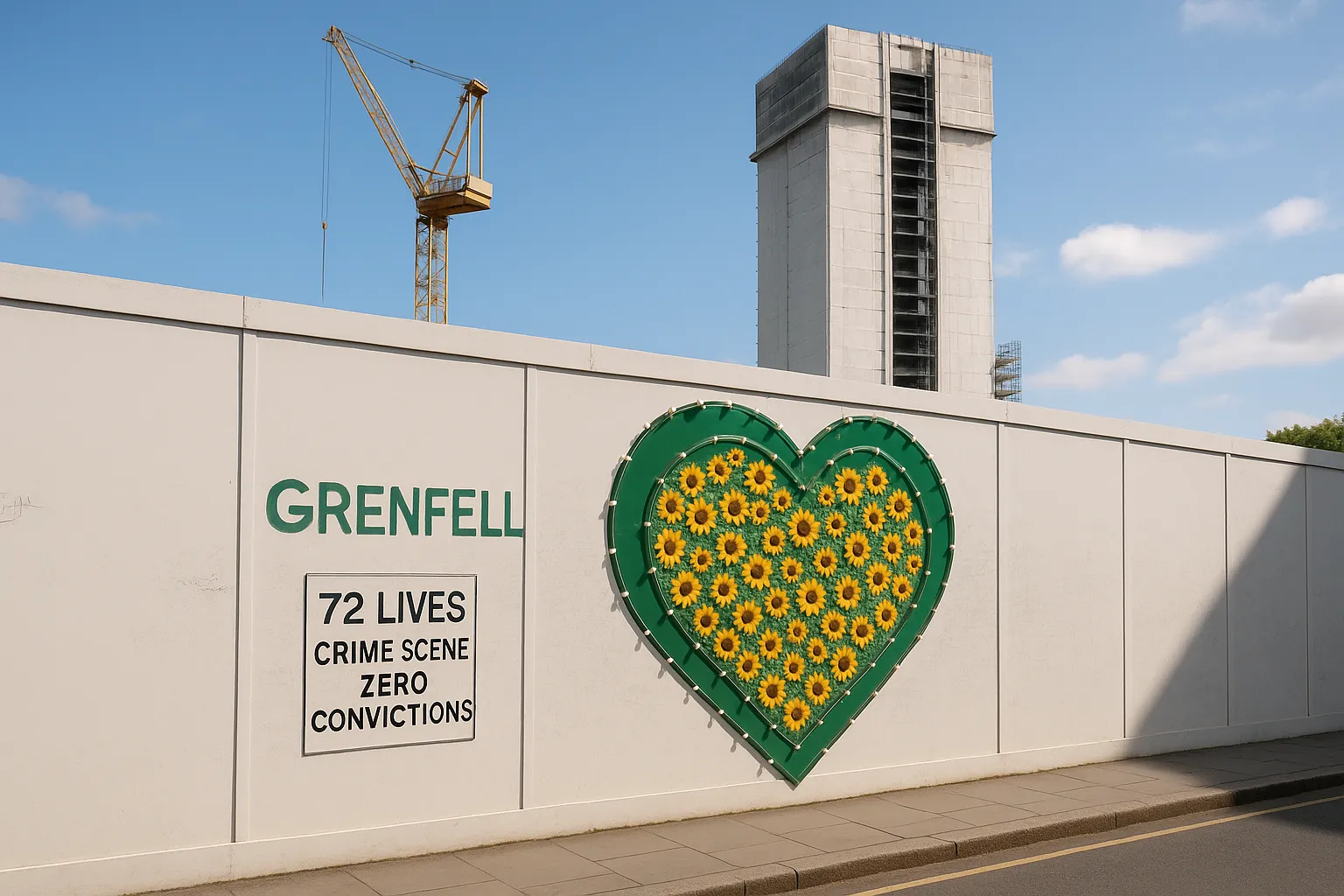
As the demolition of Grenfell Tower proceeds, the cacophony of machinery juxtaposes sharply with the poignant silence enveloping the surrounding area. This site, marked by tragedy, has become a canvas for community remembrance. Artisans are diligently working on the hoardings that encircle the tower, which have functioned as a memorial for the 72 victims who lost their lives in the catastrophic fire that devastated the high-rise in Kensington during the early hours of 14 June 2017. Among the artists is Melanie Juno Wolf, who has dedicated herself to supporting those impacted by this tragedy.
“Each year, as we illuminate it in remembrance, it serves as a space for our local community. It’s vital for the children to carry these memories forward,” she shared while installing lights around a green heart—a symbol now deeply connected to the Grenfell story, adorned with sunflowers placed by local youths as a tribute to the deceased.
The 14th of June marks the ninth anniversary of the tragic event, which, following investigations, was revealed to be exacerbated by the presence of flammable cladding on the tower’s exterior. A protracted inquiry, concluding in 2024, determined that the disaster could have been prevented. Among the tributes displayed along the memorial wall, a stark sign reads, “72 lives, crime scene, zero convictions.” In a recent statement, the Metropolitan Police asserted that decisions regarding potential criminal charges may be made before the tenth anniversary, slated for next summer. Possible charges under consideration include corporate manslaughter, fraud, health and safety violations, and misconduct in public office.
The prolonged search for justice has fostered a pervasive sense of frustration and disillusionment among the survivors, bereaved families, and local residents, as observed by Wolf. Her organisation, the North Kensington Community Kitchen, plays an essential role in providing food assistance to those most in need across Kensington and Chelsea, one of London’s most affluent boroughs. However, this affluence is absent from the Lancaster West estate, where the Grenfell Tower stands, leading Wolf to express her community’s pressing concerns.
“Many of us who have long been part of this community feel a profound sense of being forgotten,” Wolf expressed. “People feel as though they’ve been cast aside, receiving only the barest attention.”
The shortcomings in the treatment of Grenfell survivors and relatives have long come under criticism. The inquiry identified systemic failures spanning decades, primarily by governmental bodies and the construction industry. It concluded that the victims, survivors, and bereaved were grievously let down by incompetence, dishonesty, and a lack of integrity. Survivors have faced considerable trauma without sufficient support in the aftermath of the tragic event. “No family should have to wait over ten years for justice for their loved ones, if it comes at all,” stated a spokesperson for Grenfell United, a campaign group advocating for accountability.
Elizabeth Campbell, leader of the Kensington and Chelsea council, acknowledged that the local authority fell short in its duty to protect residents before the fire and in its aftermath. “We are deeply sorry for those failings,” she stated. “We remain committed to meeting the challenges posed by bereaved families and survivors.”
The investigation carried out by the Metropolitan Police has been described by Deputy Assistant Commissioner Kevin Southworth as “relentless,” with plans to submit all findings to the Crown Prosecution Service this autumn. “We appreciate that it has been an incredibly long journey for bereaved families and survivors, and we are committed to ensuring our investigation is thorough to provide the best possible evidence for charging decisions,” he affirmed.
In the midst of these developments, Wolf strives to instill moments of joy within the community. She recognises the unique challenges faced by the children who are maturing in the shadow of this tragedy. “They don’t have access to the support they need, and their voices often go unheard,” she lamented, echoing the sentiments of many.
Hamid Ali Jafari, aged 42, continues to grapple with unimaginable loss. His father, Ali Yawar Jafari, 82, perished on the eleventh floor of Grenfell Tower. As the inferno engulfed the building, Ali attempted to alert neighbours and family friends, but his health issues vastly complicated his escape route. Hamid recalls, “It’s been nine years, and yet I’m still struggling to process it. My life has been irreparably altered.”
Close to the memorial wall, Hamid affixes a photograph of his father as a reminder of the human cost of this disaster. For Hamid, the tower’s continued existence serves as a persistent reminder of the systemic failures that resulted in such profound loss. The towering structure, which used to be 24 stories high, remains a poignant symbol of a community grappling with the shadows of grief and injustice.
William “Joe” Walsh, 66, who has lived in the adjacent Silchester Estate for three decades, recalls the night of the fire vividly. As flames engulfed Grenfell Tower, he opened the doors to the Maxilla Social Club as a refuge for affected residents. “The noise was deafening, and so we offered shelter, tea, and coffee,” he recounted.
The community’s rapid response highlighted remarkable solidarity as people flocked from far and wide to donate supplies. However, Walsh is disheartened by the lingering neglect of the estates. He asserts that both the council and authorities appear to have ceased listening to the voices of the local population. Walsh is relieved by the ongoing demolition of the tower, believing it crucial for the community’s healing process.
“In the aftermath, it should be transformed into a park for children, accompanied by a memorial,” he advocated. “The sight of that tower is a constant reminder of pain; it impedes the community’s ability to move on.”
For residents like 49-year-old Leighton Evans, living adjacent to the site of such immense tragedy presents ongoing challenges. Longtime resident Evans notes that maintenance work continues in the area, but basic enhancements within their flats remain unfulfilled. “To be living by a constant construction site has created an understandably difficult atmosphere,” he remarked.
Despite recent announcements of scheduled improvements, including the provision of new triple-glazed windows and fire safety measures, frustrations persist. “There is a generation here that has endured nothing but construction noise and disruption,” Evans lamented. He fears for the emotional health of residents plagued by the tragedy’s associated scars. “Those who wanted to escape the turmoil have left; for others, it’s detrimental.”
As the community navigates this complex emotional landscape, many residents yearn for closure. Nearly a decade later, the anticipation surrounding the prospect of accountability feels unresolved. Hamid Jafari encapsulates this uncertainty, reflecting on a prior conversation with his solicitor regarding the nature of justice: “Even if someone is convicted, it won’t bring my father back or restore my family,” he mused. “The void remains. Will we ever find solace?”
Our Thoughts
The Grenfell Tower fire incident highlights critical failures in health and safety management, particularly concerning building regulations and fire safety standards. To prevent such tragedies, stringent adherence to the Building Regulations 2010 (specifically Approved Document B) concerning fire safety and fire-resistant materials should have been enforced, particularly with regard to the use of non-combustible cladding.
There were significant breaches of the Health and Safety at Work Act 1974, which mandates that employers ensure, as far as reasonably practicable, the health and safety of all employees and the public. The failures identified included inadequate risk assessments, lack of safety measures for residents, and neglecting maintenance obligations.
Key lessons include the importance of community engagement and transparent communication in safety practices. Local authorities must foster an environment where residents feel empowered to voice concerns. Regular inspections and maintenance of safety standards should be prioritised to ensure compliance, alongside continuous training for contractors and staff involved in building works.
To avoid similar incidents, a robust enforcement regime must ensure that building codes are strictly followed, penalties for non-compliance are enacted, and comprehensive investigations are conducted following any safety breaches.